Undergrad Matrix Representation of an Operator (from Sakurai)

Click For Summary
The discussion focuses on understanding the matrix representation of the Pauli operators, particularly ##\sigma_z##, in terms of eigenspin bases. Participants clarify that the entries of the matrix can be derived from the inner products of the spin states with the operator, emphasizing that the identity operator can be inserted to rewrite the operator in the desired basis. The conversation also touches on how to express other Pauli matrices, such as ##\sigma_x## and ##\sigma_y##, using raising and lowering operators. A specific example is given for ##\sigma_z##, demonstrating how its matrix representation can be constructed from its eigenstates. Overall, the thread aims to clarify the connection between operator representations and their matrix forms in quantum mechanics.
jaurandt
Messages
24
Reaction score
0
Look, I am sorry for not being able to post any LaTeX. But I am stuck at a place where I feel I should not be stuck.
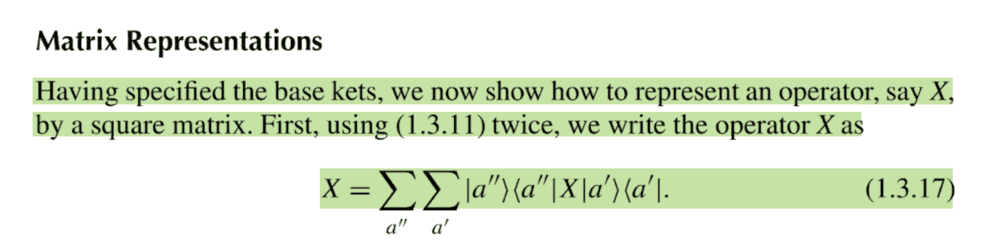
246299


I can not figure out how to correctly do this. I can't seem to recreate the Pauli matrices with that form using the 3 2-dimensional bases representing x, y, and z spin up/down.

Does anyone have any advice on this?
 
Physics news on Phys.org
Just to be clear, you're trying to project the spin matrices in an eigenspin bases right? (say in the z-direction) You only need the spin up and spin down vectors in anyone direction to form a complete basis.
For ##\sigma_z## this is trivial in its eigenbasis:
$$\sigma_z = \sum_s \sum_r |s\rangle\langle s|\sigma_z|r\rangle\langle r|$$
$$\sigma_z = |\uparrow \rangle \langle \uparrow | - | \downarrow \rangle \langle \downarrow |$$

For ##\sigma_x## and ##\sigma_y## you could use the raising and lowering operators to make the same decomposition.
 
  • Like
Likes aaroman, jaurandt and vanhees71
HomogenousCow said:
Just to be clear, you're trying to project the spin matrices in an eigenspin bases right? (say in the z-direction) You only need the spin up and spin down vectors in anyone direction to form a complete basis.
For ##\sigma_z## this is trivial in its eigenbasis:
$$\sigma_z = \sum_s \sum_r |s\rangle\langle s|\sigma_z|r\rangle\langle r|$$
$$\sigma_z = |\uparrow \rangle \langle \uparrow | - | \downarrow \rangle \langle \downarrow |$$

For ##\sigma_x## and ##\sigma_y## you could use the raising and lowering operators to make the same decomposition.

Can you please give the same example, but with the ##\sigma_y## operator? What I'm trying to say is that I don't understand how

$$\sigma_z = \sum_s \sum_r |s\rangle\langle s|\sigma_z|r\rangle\langle r|$$

Reveals the entries of the matrix...
 
The numbers $$\left\langle a'\right|X\left|a''\right\rangle $$
are the entries of the matrix. For the z Pauli matrix we have $$
\left\langle \uparrow\right|\sigma_{z}\left|\uparrow\right\rangle =1;
\left\langle \downarrow\right|\sigma_{z}\left|\uparrow\right\rangle =0;
\left\langle \uparrow\right|\sigma_{z}\left|\downarrow\right\rangle =0;
\left\langle \downarrow\right|\sigma_{z}\left|\downarrow\right\rangle =-1$$
 
  • Like
Likes jaurandt
You don't even have to deal with matrices if you don't want to, all that's happening is we're rewriting the operator by inserting some identity operators. Since $$I = \sum_s |s\rangle\langle s|,$$ we can just stick one in front of and behind an operator to rewrite it in terms of the operator basis ##|s \rangle \langle r|##,
$$A = I A I = \sum_s \sum_r |s\rangle\langle s| A |r\rangle\langle r| = \sum_s \sum_r A_{sr} |s\rangle \langle r|,$$ where ##A_{sr}## are the matrix elements.
 
  • Like
Likes aaroman and jaurandt
andresB said:
The numbers $$\left\langle a'\right|X\left|a''\right\rangle $$
are the entries of the matrix. For the z Pauli matrix we have $$
\left\langle \uparrow\right|\sigma_{z}\left|\uparrow\right\rangle =1;
\left\langle \downarrow\right|\sigma_{z}\left|\uparrow\right\rangle =0;
\left\langle \uparrow\right|\sigma_{z}\left|\downarrow\right\rangle =0;
\left\langle \downarrow\right|\sigma_{z}\left|\downarrow\right\rangle =-1$$

So then what happens to the rest of the construct if you just pull out

$$\left\langle a'\right|X\left|a''\right\rangle $$

What happened to the summation and what becomes of $$\left|a'\right\rangle\left\langle a''\right| $$
 
jaurandt said:
So then what happens to the rest of the construct if you just pull out

$$\left\langle a'\right|X\left|a''\right\rangle $$

What happened to the summation and what becomes of $$\left|a'\right\rangle\left\langle a''\right| $$
Put everything in the formula and you have the representation of the operator in that basis of vectors. HomogenousCow already showed how the z Pauli operator looks like written in terms of its own set of eigenvectors.
 
Last edited:
  • Like
Likes jaurandt
The object ##|a' \rangle \langle a''|## is an operator. Every entry in a representation matrix is tied to such an operator.

Consider this rewrite of the third Pauli matrix:
<br /> \begin{pmatrix}<br /> 1 &amp; 0\\<br /> 0 &amp; -1<br /> \end{pmatrix}<br /> <br /> =<br /> <br /> 1 \cdot<br /> \begin{pmatrix}<br /> 1 &amp; 0\\<br /> 0 &amp; 0<br /> \end{pmatrix}<br /> <br /> +<br /> <br /> 0 \cdot<br /> \begin{pmatrix}<br /> 0 &amp; 1\\<br /> 0 &amp; 0<br /> \end{pmatrix}<br /> <br /> +<br /> <br /> 0 \cdot<br /> \begin{pmatrix}<br /> 0 &amp; 0\\<br /> 1 &amp; 0<br /> \end{pmatrix}<br /> <br /> +<br /> <br /> (-1) \cdot<br /> \begin{pmatrix}<br /> 0 &amp; 0\\<br /> 0 &amp; 1<br /> \end{pmatrix}<br />
This is what corresponds to the operator equation
##\sigma_z = 1 \cdot |\!\uparrow_z \rangle \langle \uparrow_z \!| + 0 \cdot |\!\uparrow_z \rangle \langle \downarrow_z\!| + 0 \cdot |\!\downarrow_z \rangle \langle \uparrow_z\!| + (-1) \cdot |\!\downarrow_z \rangle \langle \downarrow_z\!|.##

(Note that the symbol ##\sigma_z## is ofen used to symbolize both the operator and its matrix representation in the z-basis. This is a sloppy but very common notation.)
 
Last edited:
  • Like
Likes jaurandt

Similar threads

  • · Replies 1 ·
Replies
1
Views
2K
  • · Replies 9 ·
Replies
9
Views
2K
  • · Replies 9 ·
Replies
9
Views
2K
  • · Replies 1 ·
Replies
1
Views
2K
  • · Replies 4 ·
Replies
4
Views
4K
  • · Replies 3 ·
Replies
3
Views
2K
  • · Replies 0 ·
Replies
0
Views
1K
  • · Replies 3 ·
Replies
3
Views
2K
  • · Replies 16 ·
Replies
16
Views
3K
  • · Replies 5 ·
Replies
5
Views
4K