Mattie_j37890's Q: Estimate Critical Values of Function

  • Context:
  • Thread starter Thread starter MarkFL
  • Start date Start date
Join the discussion
Registration is free. Ask a follow-up in this thread, or start your own.
1 reply · 5K views
MarkFL
Gold Member
MHB
Messages
13,284
Reaction score
12
Here is the question:

What are the critical values of this function?

A model for the average price of a pound of white sugar in a certain country from August 1993 to August 2003 is given by the function
S(t) = −0.00003237t^5 + 0.0009037t^4 − 0.008956t^3 + 0.03629t^2 − 0.04467t + 0.4438
where t is measured in years since August of 1993. Estimate the times when sugar was cheapest and most expensive during the period 1993-2003. (Round your answers to three decimal places.)

I have posted a link there to this topic so the OP can see my work.
 
Physics news on Phys.org
Re: mattie_j37890's quetion at Yahoo! Answers regarding approximating critical values

Hello mattie_j37890,

We are given the function:

$$S(t)=-0.00003237t^5+0.0009037t^4-0.008956t^3+0.03629t^2-0.04467t+0.4438$$

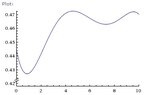
First, let's look at a plot of this function just so we have some idea of what it looks like over the relevant domain:

View attachment 944

We can see that there are 4 relative extrema in the interval $0\le t\le10$

To find where they are, that is for what values of $t$ do they exist, we want to equate the first derivative to zero:

$$S'(t)=-0.00016185t^4+0.0036148t^3-0.026868t^2+0.07258t-0.04467=0$$

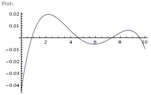
Let's look at a plot of the derivative to get some idea of where the roots are:

View attachment 945

We may use Newton's method to approximate these roots. We may write:

$$f(t)=-0.00016185t^4+0.0036148t^3-0.026868t^2+0.07258t-0.04467=0$$

$$f'(t)=-0.0006474t^3+0.0108444t^2-0.053736t+0.07258$$

And so we have the recursion:

$$t_{n+1}=t_{n}-\frac{f\left(t_{n} \right)}{f'\left(t_{n} \right)}$$

We see the first root is near $t=1$, and so we may compute:

$$t_0=1$$

$$t_1\approx0.845220550257$$

$$t_2\approx0.857337077417$$

$$t_3\approx0.857416179268$$

$$t_4\approx0.857416182626$$

$$t_5\approx0.857416182626$$

We see the second root is near $t=5$, and so we may compute:

$$t_0=5$$

$$t_1\approx4.53064243449$$

$$t_2\approx4.60497652706$$

$$t_3\approx4.60659458701$$

$$t_4\approx4.606595386$$

$$t_5\approx4.606595386$$

We see the third root is near $t=7$, and so we may compute:

$$t_0=7$$

$$t_1\approx7.3250339402$$

$$t_2\approx7.30609727792$$

$$t_3\approx7.30607003007$$

$$t_4\approx7.30607003001$$

$$t_5\approx7.30607003001$$

We see the fourth root is near $t=10$, and so we may compute:

$$t_0=10$$

$$t_1\approx9.66222062004$$

$$t_2\approx9.57077528295$$

$$t_3\approx9.56421133076$$

$$t_4\approx9.56417851958$$

$$t_5\approx9.56417851876$$

$$t_6\approx9.56417851876$$

And so, we have the four roots of the first derivative approximated by:

$$t\approx0.857416182626,\,4.606595386,\,7.30607003001,\,9.56417851876$$

Now, to find the absolute extrema on the given closed interval, we need to evaluate the function at the endpoints and at the critical values:

$$S(0)=0.4438$$

$$S(0.857416182626)=0.4270063563925$$

$$S(4.606595386)=0.47243084424924303$$

$$S(7.30607003001)=0.462862495347419$$

$$S(9.56417851876)=0.47195253062506465$$

$$S(10)=0.4701$$

And so rounding to 3 decimal places, we find:

The absolute minimum occurs when $$t\approx0.857$$

The absolute maximum occurs when $$t\approx4.607$$
 

Attachments

  • mattie1.jpg
    mattie1.jpg
    5.5 KB · Views: 128
  • mattie2.jpg
    mattie2.jpg
    5.4 KB · Views: 122
Last edited: