Maximal Elements in a Bounded Set

  • Context:
  • Thread starter Thread starter ertagon2
  • Start date Start date
  • Tags Tags
    Sets
Join the discussion
Ask a follow-up here, or get your own question answered by working scientists, mathematicians and engineers — people, not an autocomplete.
Real named experts · corrections over time · the nuance an AI answer skips
4 replies · 2K views
ertagon2
Messages
36
Reaction score
0
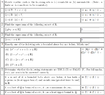
Could someone please check these questions? Please correct them if necessary, with an explanation if you could.
View attachment 7937
 

Attachments

  • maths52p1.png
    maths52p1.png
    18.3 KB · Views: 160
Physics news on Phys.org
Hi ertagon2,

Everything looks OK, except 5b. Think about the set $\displaystyle\left\{1-\frac{1}{n+1}\:\bigg|\: n\in\mathbb{N}\right\}$.
 
I agree with everything except 5.2. Consider an open interval.
 
castor28 said:
Hi ertagon2,

Everything looks OK, except 5b. Think about the set $\displaystyle\left\{1-\frac{1}{n+1}\:\bigg|\: n\in\mathbb{N}\right\}$.

I don't think I understand. Can you elaborate?
 
ertagon2 said:
I don't think I understand. Can you elaborate?
Hi ertagon2,

This is the set $\displaystyle S=\left\{0,\frac12,\frac23,\frac34,\ldots\right\}\subset\mathbb{Q}$. This set is bounded above (by $1$). In fact, $1$ is the least upper bound of $S$, but it is not an element of $S$.

No element of $S$ can be maximal, because, for each element $\left(1 - \dfrac{1}{n+1}\right)\in S$, $\left(1 - \dfrac{1}{n+2}\right)$ is greater and also an element of $S$.