SUMMARY
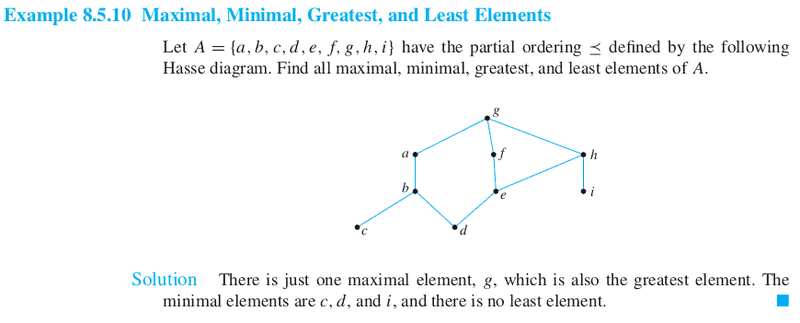
The discussion clarifies the definitions of maximal, greatest, minimal, and least elements within a set. It establishes that while element c is a minimal element, it is not a least element due to the existence of other elements, specifically d, i, e, f, and h, that are not comparable to c. This distinction highlights the importance of understanding comparability in set theory. The implications of these definitions are critical for mathematical reasoning and analysis.
PREREQUISITES
- Understanding of set theory concepts
- Familiarity with comparability in mathematical sets
- Knowledge of maximal and minimal elements definitions
- Basic grasp of mathematical notation and terminology
NEXT STEPS
- Study the properties of maximal and minimal elements in set theory
- Explore the concept of comparability among elements in partially ordered sets
- Learn about the differences between least and greatest elements
- Investigate examples of sets with non-comparable elements
USEFUL FOR
Mathematicians, students studying set theory, educators teaching mathematical concepts, and anyone interested in the properties of ordered sets.