lemaitre
- 3
- 0
A fairground ride takes the form of a hollow, cylinder of radius [itex]R[/itex] rotating about its axis. People lie down cylinder wall when it is stationary. The rotation is then started, and once the cylinder has reached its operating angular velocity [itex]\omega[/itex], its axis, and the people, are gradually rotated, as shown in the figure below.
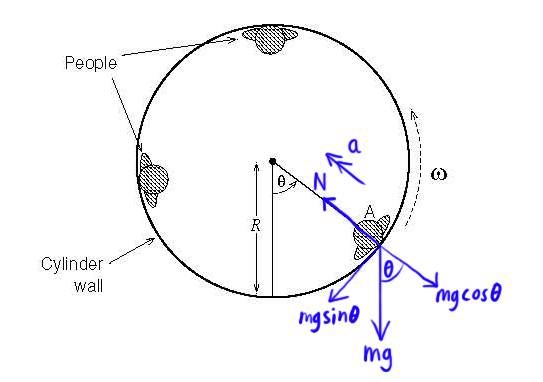
Figure above shows a view along the axis in a horizontal direction showing the heads and shoulders of three people, who face inwards. Thus the person at the top is facing vertically downwards at the moment shown.
A person called Alice who has mass [itex]m[/itex], is indicated by [itex]A[/itex] in the figure at the moment when she subtends angle [itex]\theta[/itex] relative to the downwards vertical direction, as seen from the cylinder’s axis. Assuming that Alice does not slide relative to the cylinder wall, and neglecting her size compared to the radius [itex]R[/itex].
1. Show that the component of force upon Alice from the cylinder wall normal to its surface is given by [itex]N = mg\cos\theta +m\omega^{2}R[/itex].
Answer
The acceleration is towards the center of the cylinder, hence
2. Show that the component of force upon Alice from the cylinder wall parallel to its surface is given by [itex]F = mg\sin\theta[/itex].
Answer
This follows from the diagram.
3. Derive an expression for the minimum [itex]\omega[/itex] required to ensure that Alice remains in contact with the cylinder wall at all times.
4. Show that in order for Alice to avoid sliding along the cylinder wall, [itex]\omega^{2} \geq \frac{g\sin\theta}{\mu_{S}R} - \frac{g\cos\theta}{R}[/itex], where [itex]\mu_{S}[/itex] is the coefficient of static friction between her and the wall.
Answer
[itex]f_{S} \leq\mu_{S}N \Rightarrow mg\sin\theta \leq \mu_{S}(mg\cos\theta +m\omega^{2}R).[/itex] Rearranging, we get [itex]\omega^{2} \geq \frac{g\sin\theta}{\mu_{S}R} - \frac{g\cos\theta}{R}.[/itex]
5. Use the result of question 4 to show that Alice will not slip for any [itex]\theta[/itex] if [itex]\omega^{2} \geq \frac{g}{R}\sqrt{1 + \frac{1}{\mu_{S}^{2}}}[/itex].Question and Attempt
I would like to know if the working for the questions above that I have answered are correct. I'm not sure what concept underlies question 3. For question 5, I put [itex]\theta = \pi[/itex], the angle that subtends when she is at the top but that doesn't work.
I'm looking for hints to be able to answer questions 3 and 5. Thank you for your time.
Figure above shows a view along the axis in a horizontal direction showing the heads and shoulders of three people, who face inwards. Thus the person at the top is facing vertically downwards at the moment shown.
A person called Alice who has mass [itex]m[/itex], is indicated by [itex]A[/itex] in the figure at the moment when she subtends angle [itex]\theta[/itex] relative to the downwards vertical direction, as seen from the cylinder’s axis. Assuming that Alice does not slide relative to the cylinder wall, and neglecting her size compared to the radius [itex]R[/itex].
1. Show that the component of force upon Alice from the cylinder wall normal to its surface is given by [itex]N = mg\cos\theta +m\omega^{2}R[/itex].
Answer
The acceleration is towards the center of the cylinder, hence
[itex]\sum{F}=ma \Rightarrow N - mg\cos\theta = ma \Rightarrow N = mg\cos\theta + m\omega^{2}R.[/itex]
2. Show that the component of force upon Alice from the cylinder wall parallel to its surface is given by [itex]F = mg\sin\theta[/itex].
Answer
This follows from the diagram.
3. Derive an expression for the minimum [itex]\omega[/itex] required to ensure that Alice remains in contact with the cylinder wall at all times.
4. Show that in order for Alice to avoid sliding along the cylinder wall, [itex]\omega^{2} \geq \frac{g\sin\theta}{\mu_{S}R} - \frac{g\cos\theta}{R}[/itex], where [itex]\mu_{S}[/itex] is the coefficient of static friction between her and the wall.
Answer
[itex]f_{S} \leq\mu_{S}N \Rightarrow mg\sin\theta \leq \mu_{S}(mg\cos\theta +m\omega^{2}R).[/itex] Rearranging, we get [itex]\omega^{2} \geq \frac{g\sin\theta}{\mu_{S}R} - \frac{g\cos\theta}{R}.[/itex]
5. Use the result of question 4 to show that Alice will not slip for any [itex]\theta[/itex] if [itex]\omega^{2} \geq \frac{g}{R}\sqrt{1 + \frac{1}{\mu_{S}^{2}}}[/itex].Question and Attempt
I would like to know if the working for the questions above that I have answered are correct. I'm not sure what concept underlies question 3. For question 5, I put [itex]\theta = \pi[/itex], the angle that subtends when she is at the top but that doesn't work.
I'm looking for hints to be able to answer questions 3 and 5. Thank you for your time.
Last edited: