Maximum suction force in a suction cup

Click For Summary
SUMMARY

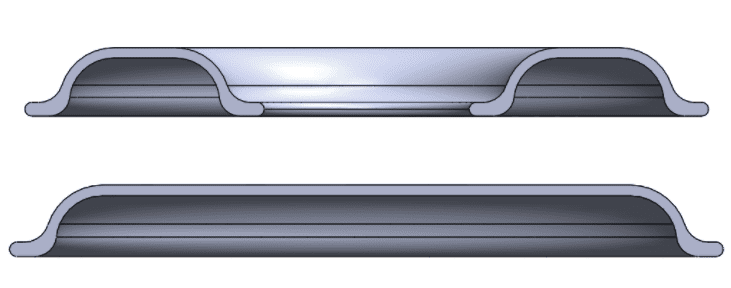
The discussion centers on optimizing suction cup design for lifting objects with flexible silicone surfaces. Two models are considered: a ring and a disk, both featuring eight holes for vacuum creation. Key factors influencing suction performance include the maximum pressure of 600 mmHg from the pump, the flexibility and elasticity of materials, and the number of unblocked holes during operation. Effective strategies include using high vacuum over small areas, low vacuum over larger areas, and incorporating channels for air flow to maintain suction efficiency.

PREREQUISITES
  • Understanding of vacuum pressure measurement (e.g., mmHg, torr)
  • Knowledge of material properties, specifically silicone flexibility and elasticity
  • Familiarity with suction cup design principles
  • Experience with vacuum systems and pumps
NEXT STEPS
  • Research the effects of silicone material properties on suction performance
  • Explore advanced suction cup designs that incorporate air flow channels
  • Investigate vacuum pressure measurement techniques and conversions
  • Learn about the impact of hole size and quantity on suction efficiency
USEFUL FOR

Engineers, product designers, and manufacturers involved in creating suction-based lifting devices, particularly those working with flexible materials like silicone.

teunKeusters
Messages
3
Reaction score
0
Sorry if I didn't post this at the right place.

Hi all,

I have a problem that I am not able to solve. I hope you guys can help me! I am creating a suction cup to grab and lift an object with a flexible surface made of out silicone The suction cup is also made out of some sort of flexible material (not sure which yet).

I currently am considering two different models, both circular, but one is a ring, while the other one is more like a disk. Both models contain 8 holes in the top surface to create a vacuum. A cross-section of both:
upload_2018-3-7_15-5-0.png


My question is: Which of the two models will stuck the best to the flexible surface, considering you are using the same pump. And which parameters are important for this question?

My reasoning so far:
On first instance you would expect the suction cup with the largest surface to pull with the largest force. However, when the silicone surface is sucked into the cup it will block the air holes. This probably limits the surface area to the surface of the 8 holes. My gut feeling is that more pressure is needed to make the silicone reach the top of the model in the ring model, but perhaps that is just nonsense.

I hope you guys can help me making sense of the choice I will eventually make. I tried to ask this question as clear as possible, but I have trouble formulating it, so if anything is unclear, pleas ask me.

Thanks in advance guys!
 

Attachments

  • upload_2018-3-7_15-5-0.png
    upload_2018-3-7_15-5-0.png
    13 KB · Views: 837
Engineering news on Phys.org
teunKeusters said:
However, when the silicone surface is sucked into the cup it will block the air holes. This probably limits the surface area to the surface of the 8 holes.

Interesting problem. But there should be two questions. How much suction can you apply? How much time does it take to achieve max suction? The second question is related to the number of unblocked holes. The first question should be independent of the number of holes, unless there is air leaking in.

I would also guess that the degree of flexibility and elasticity would play a role.
 
Total "grab" is vacuum times area, so the challenge is is maximize the product of vacuum times area when working with flexible materials. Some ideas:

1) High vacuum over small areas. This would be the case of the 8 holes you mention. With high enough vacuum this might work.
2) Low vacuum over a large area. Your second figure with vacuum low enough that the parts do not suck together. Just make the area large enough.
3) Let the parts suck together, but add channels so air can flow to the suction source. Make the suction cup in your second figure with a knurled surface so that contact is only at the points of the knurls. You get the advantage of both large vacuum area and high vacuum.
 
  • Like
Likes   Reactions: Ketch22
Thanks for you replies!

@anorlunda Could you explain how your second question is relevant? I don't really understand that. The pump that I use has maximum pressure of 600mmHg. I am not familiar with this unit. Does it mean that this also counts the other way around?

@hrmichler Thanks for the suggestions! The third one seems like a great alternative. Am I correct that I could create the same effect by increasing the number of air holes?
 
teunKeusters said:
Could you explain how your second question is relevant?

It is just a matter of time. With two holes, you can pump out twice as much air per second as with one hole.

If you have a limited time between first contact and lifting, then that is a constraint.
 
teunKeusters said:
maximum pressure of 600mmHg. I am not familiar with this unit.
mmHg is a measurement of pressure (or vacuum, as the case may be), and is the pressure required to change the height of a column of mercury (Hg), in this case, by 600 millimeters. Historically, mercury hasn't been isn't the only fluid, nor metric units the only ones used. Approximate conversions (ignoring temperature, for instance, inches of mercury is specified at 32°F while water column is specified at 60°F; mmHg is at 0°C while mm water is at 4°C).

600 mm Hg = 600 torr (another unit name you may see) = 23.6 inches of mercury = 799.9 millibar =
8157 mm water = 321.4 inch of water (often abbreviated as "in. w.c." - inches of water column) = 11.60 PSI
 
Thanks for your input guys. I can really work with this!

@Asymptotic, thanks, makes it a lot clearer!
 
A couple observations. 1) if the cups are made of a silicone material you will need to work on the attachment. At higher levels of vacuum the lifting capacity will exceed the strength of the material if it is a direct bolt in or screw type anchor. 2) In vacuum bag applications used in composite manufacture and repair, a non woven fabric is placed inside the bag next to the film. Even when drawn down to high levels of vacuum the fabric still allows air to travel laterally and be drawn out at the ports. One could go with either design if there was a flow space as jrmichler said.
 

Similar threads

  • · Replies 5 ·
Replies
5
Views
8K
  • · Replies 19 ·
Replies
19
Views
6K
Replies
7
Views
9K
Replies
3
Views
2K
  • · Replies 6 ·
Replies
6
Views
3K
Replies
15
Views
2K
  • · Replies 10 ·
Replies
10
Views
6K
Replies
12
Views
2K
  • · Replies 1 ·
Replies
1
Views
4K
  • · Replies 15 ·
Replies
15
Views
3K