Maxwell equations in terms of potentials

Click For Summary
SUMMARY

This discussion focuses on the formulation of Maxwell's equations in terms of potentials, specifically the electric potential field (φ), magnetic potential vector field (A), electric vector field (E), and magnetic vector field (B). Key equations include ∇²φ = DIV(grad(φ)) and ∇²A = ROT(ROT(A)) = ROT(B) = grad(DIV(A)) - Laplace(A). The conversation also addresses the generalization of these equations to D-dimensional space, emphasizing the need for a tensor formulation to avoid vector products in operators.

PREREQUISITES
  • Understanding of Maxwell's equations and their standard formulations.
  • Familiarity with vector calculus operations such as divergence (DIV), curl (ROT), and Laplacian (Laplace).
  • Knowledge of electromagnetic theory, particularly the roles of electric and magnetic fields.
  • Basic understanding of tensor calculus for generalizing equations to multiple dimensions.
NEXT STEPS
  • Research the tensor formulation of electromagnetism to understand its application in D-dimensional space.
  • Study the properties and applications of the Levi-Civita symbol in higher-dimensional calculus.
  • Explore the implications of different gauges in electromagnetic theory, particularly Lorenz and Coulomb gauges.
  • Investigate the mathematical foundations of vector calculus, focusing on the generalization of Laplacians for vector and scalar fields.
USEFUL FOR

This discussion is beneficial for theoretical physicists, mathematicians specializing in electromagnetism, and researchers working on advanced topics in field theory and higher-dimensional physics.

olgerm
Gold Member
Messages
532
Reaction score
35
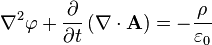
These are Maxwell´s equations in potential formulation:
29ed508c553583e1477fc6a3681158fe.png

621ac837ee1d1d742fcf5ed3f73c033a.png


2φ = DIV(grad(φ)) . Am I right?
2A = ROT(ROT(A))=ROT(B)=grad(DIV(A))-Laplace(A) . Am I right?
In coulomb gauge in every point and at any time DIV(A)=[PLAIN]https://upload.wikimedia.org/math/4/4/1/44131cc26bd9db464d0edb7459ccca84.png. Am I right?
Where could I find Maxwell´s equations in terms of potentials without vector operator?

How must ROT (same as curl) be generalized to make the equations describe EM-field in D-dimensional space equally with these equation
##\begin{cases}
& \sum_{i=1}^D(\frac{\partial E_i}{\partial x_i})=\rho \frac{1}{{\epsilon_0}} \\
& \frac{\partial E_a}{\partial t}=\sum_{i=1}^D(\frac{\partial B_{[i;a]}}{\partial x_i})-J_a \\
& \frac{\partial B_{[a;b]}}{\partial t}=\frac{\partial E_b}{\partial x_a}-\frac{\partial E_a}{\partial x_b}\\
& \frac{\partial B_{[a;b]}}{\partial x_c}+\frac{\partial B_{[b;c]}}{\partial x_a}+\frac{\partial B_{[c;a]}}{\partial x_b}=0
\end{cases}##
,which are in terms of E and B?

φ is electripotentialfield.
E is electricvectorfield.
A is magneticpotentialvectorfield.
B is magneticvectorfield.
ρ is electriccharge density.
 
Last edited by a moderator:
Physics news on Phys.org
olgerm said:
∇2φ = DIV(grad(φ)) . Am I right?
Yes
olgerm said:
∇2A = ROT(ROT(A))=ROT(B)=grad(DIV(A))-Laplace(A) . Am I right?
No. Look here: https://en.wikipedia.org/wiki/Vector_Laplacian
olgerm said:
In coulomb gauge in every point and at any time DIV(A)=
p?image=https%3A%2F%2Fupload.wikimedia.org%2Fmath%2F4%2F4%2F1%2F44131cc26bd9db464d0edb7459ccca84.png
. Am I right?
Yes
olgerm said:
Where could I find Maxwell´s equations in terms of potentials without vector operator?
You can do this yourself. Just take what you have above and replace with partial derivatives. Also, this might be useful
https://en.wikipedia.org/wiki/Covariant_formulation_of_classical_electromagnetism

Your last question is a little weird. Are interested in a 2D subset (x,y) of 3D space (x,y,z) where z is a symmetry?
 
  • Like
Likes   Reactions: olgerm
Khashishi said:
It seems to confirm, that ROT(ROT(A))=grad(DIV(A))-Laplace(A) .
also this http://m.wolframalpha.com/input/?i=curl+(curl+A)&x=0&y=0 seems to confirm, that ROT(ROT(A))=grad(DIV(A))-Laplace(A) . Or does ∇2 A in the second equation note Laplace(A) not ROT(ROT(A))?

Khashishi said:
Your last question is a little weird. Are interested in a 2D subset (x,y) of 3D space (x,y,z) where z is a symmetry?
I am interested about theoretical physical system with D-dimensional space. Understanding physical meaning of such system is not necessary to answer the question.
 
##\nabla^2 A## means the same thing as Laplace(A).

How many dimensions do you want to work in?
 
  • Like
Likes   Reactions: olgerm
Khashishi said:
How many dimensions do you want to work in?
D dimensions. Generalization must include variable D.
 
Now as I understand there are different Laplacians for vectorfield and scalarfield it makes more sense.

So are these equations in lorenz gauge
##\begin{cases}
\frac{\partial^2 A_{D_1}}{\partial t^2}=J_{D_1}\cdot k_E \cdot \pi \cdot c^2 \cdot 4+\sum_{i=1}^D(\frac{\partial^2 A}{\partial x_i \cdot \partial x_{D_1}}) \cdot c^2-ROT(ROT(A)) \cdot c^2\\
\frac{\partial^2 \phi}{\partial t^2}=\rho \cdot k_E \cdot \pi \cdot 4+\sum_{i=1}^D(\frac{\partial^2 \phi}{\partial x_i^2})\\
\frac{\partial \phi}{\partial t}=\sum_{i=1}^D(\frac{\partial A_i}{\partial x_i}) \cdot c^2\\
F_E=q\cdot(\sum_{i=1}^D(v_i \cdot \frac{\partial A_i}{\partial x_{D_1}})-\frac{\partial A_{D_1}}{\partial t}-\frac{\partial \phi}{\partial x_{D_1}})
\end{cases}##
?

But what must ROT(ROT(A)) equal to in D-dimensional space so that the Maxwell equations were equal with these
##\begin{cases}
& \sum_{i=1}^D(\frac{\partial E_i}{\partial x_i})=\rho \frac{1}{{\epsilon_0}} \\
& \frac{\partial E_a}{\partial t}=\sum_{i=1}^D(\frac{\partial B_{[i;a]}}{\partial x_i})-J_a \\
& \frac{\partial B_{[a;b]}}{\partial t}=\frac{\partial E_b}{\partial x_a}-\frac{\partial E_a}{\partial x_b}\\
& \frac{\partial B_{[a;b]}}{\partial x_c}+\frac{\partial B_{[b;c]}}{\partial x_a}+\frac{\partial B_{[c;a]}}{\partial x_b}=0
\end{cases}##
equation?
I also want the equation system to be formed as short and easy as possible. What gauge you recommend me to choose? Any ideas how to simplify the equations?
 
Last edited:
I have hypothesis, that Laplace(A) must be generalized to be equal to ## 2\cdot\frac{\partial^2 A_{D_1}}{\partial x_{D_1}^2}-\sum_{i=1}^D(\frac{\partial^2 A_{D_1}}{\partial x_i^2})## .
Can anybody check if it is correct?
 
You know what the electromagnetic tensor is? You should use a tensor formulation if you want to generalize to different dimensions. I asked what dimension you wanted to work in because it affects the answer. Cross product only really works in 3 or 7 dimensions. You might want to use the Levi-Civita symbol.
 
Khashishi said:
You know what the electromagnetic tensor is? You should use a tensor formulation if you want to generalize to different dimensions.
I got the equations in E and B formulation from Maxwell equations in electromagnetic tensor formulation.

The equations should not contain vector products on operators, but partial derivatives and sums. D must be a variabe, that can be equal to any natural number.
 
Last edited:
  • #10
I have got my answer. Correct equation system is:
##\begin{cases}
\frac{\partial^2 A_{D_1}}{\partial t^2}=J_{D_1}\cdot k_E \cdot \pi \cdot 4+\sum_{i=1}^D(\frac{\partial^2 A_{D_1}}{\partial x_i^2}) \cdot c^2\\
\frac{\partial^2 \phi}{\partial t^2}=\rho \cdot k_E \cdot c^2 \cdot \pi \cdot 4+\sum_{i=1}^D(\frac{\partial^2 \phi}{\partial x_i^2})\\
\frac{\partial \phi}{\partial t}=\sum_{i=1}^D(\frac{\partial A_i}{\partial x_i}) \cdot c^2\\
F_E=q\cdot(\sum_{i=1}^D(v_i \cdot \frac{\partial A_i}{\partial x_{D_1}})-\frac{\partial A_{D_1}}{\partial t}-\frac{\partial \phi}{\partial x_{D_1}})
\end{cases}##
 

Similar threads

  • · Replies 3 ·
Replies
3
Views
402
  • · Replies 2 ·
Replies
2
Views
2K
  • · Replies 1 ·
Replies
1
Views
2K
  • · Replies 3 ·
Replies
3
Views
1K
  • · Replies 3 ·
Replies
3
Views
2K
  • · Replies 11 ·
Replies
11
Views
4K
  • · Replies 19 ·
Replies
19
Views
3K
  • · Replies 1 ·
Replies
1
Views
2K
  • · Replies 9 ·
Replies
9
Views
2K
  • · Replies 3 ·
Replies
3
Views
551
