Oliver-BfS
- 6
- 0
- TL;DR
- When an entry of zero is used in a fully specified fill, how can the position of the missing cell be defined with another cell?
The MCNP6.2 manual (page 3-37) says: "There are two nj values that can be used in the lattice array that have special meanings. A zero in the level-zero (real world) lattice means that the lattice element does not exist, making it possible, in effect, to specify a non-rectangular array."
How can this feature be used? Usually I put the lattice, which is infinitely large, into a universe and fill another cell with finite extent with this lattice. This makes the lattice finite. However, for using a zero entry in the fully specified fill this is not possible because the lattice must be in the real world, not in a universe.
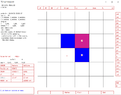
When I define a lattice as in the attached input file, it is infinitely large and three cells ((1,0,0),(0,1,0), (1,1,0)) are defined whereas all other cells are undefined, even if I add another cell for all other space except of the lattice (using the # operator together with the lattice cell number).
(I wonder if the lattice is really meant to be infinitely large or if it is meant to be confined to the three defined cells. However, it is plotted with infinite extent in the MCNP plotter.)
So how can I define a lattice that consists of the three cells and which allows the remaining space to be used for other cells?
(Defining an irregular shaped cell and filling this cell with the lattice in order to clip everything outside this cell is not an option. First of all, this would make the zero entry useless. Second, this is possible for the simple example with four cells but certainly not for more complicated lattices such as a voxel phantom with a million of lattice elements.)
How can this feature be used? Usually I put the lattice, which is infinitely large, into a universe and fill another cell with finite extent with this lattice. This makes the lattice finite. However, for using a zero entry in the fully specified fill this is not possible because the lattice must be in the real world, not in a universe.
When I define a lattice as in the attached input file, it is infinitely large and three cells ((1,0,0),(0,1,0), (1,1,0)) are defined whereas all other cells are undefined, even if I add another cell for all other space except of the lattice (using the # operator together with the lattice cell number).
(I wonder if the lattice is really meant to be infinitely large or if it is meant to be confined to the three defined cells. However, it is plotted with infinite extent in the MCNP plotter.)
So how can I define a lattice that consists of the three cells and which allows the remaining space to be used for other cells?
(Defining an irregular shaped cell and filling this cell with the lattice in order to clip everything outside this cell is not an option. First of all, this would make the zero entry useless. Second, this is possible for the simple example with four cells but certainly not for more complicated lattices such as a voxel phantom with a million of lattice elements.)