Discussion Overview
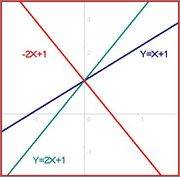
The discussion revolves around the concept of linear dependence in a system of equations, specifically examining the equations ##y=-2x+1##, ##y=x+1##, and ##y=2x+1##. Participants explore the implications of linear dependence in two-dimensional space, the interpretation of linear independence, and methods for determining linear dependency.
Discussion Character
- Exploratory
- Technical explanation
- Debate/contested
- Mathematical reasoning
Main Points Raised
- Some participants assert that in two dimensions, there can be at most two linearly independent equations, implying that with three equations, at least one must be dependent on the others.
- One participant suggests viewing the equations as functions and provides a specific linear combination to demonstrate their dependence.
- Another participant raises a technicality regarding the definition of linear independence, arguing that constant terms should be included when considering equations as vectors.
- Several participants discuss methods for determining linear dependency, including scaling equations and using augmented matrices for row reduction.
- There is mention of a common mistake in the approach to finding dependencies, with one participant expressing a newfound understanding after receiving clarification.
Areas of Agreement / Disagreement
Participants generally agree on the notion that there can be at most two linearly independent equations in two dimensions, but there is some disagreement regarding the interpretation of linear independence and the role of constant terms in equations. The discussion remains unresolved on the precise definitions and methods for determining linear dependency.
Contextual Notes
Some participants note that the definitions and interpretations of linear independence may vary, and there are unresolved aspects regarding the inclusion of constant terms in the analysis of equations.