Measure of spring in system with roller

Click For Summary

Homework Help Overview

The discussion revolves around a problem involving an Atwood machine with a spring, where the original poster provides specific masses and forces to analyze the system's movement after the spring has stopped vibrating. The goal is to determine the effective measurement of the spring during this movement.

Discussion Character

  • Exploratory, Conceptual clarification, Assumption checking

Approaches and Questions Raised

  • Participants explore the relationships between forces acting on the masses and the spring, questioning the roles of tension and gravitational forces. There are attempts to clarify the application of Newton's laws and the effects of each mass on the system's dynamics.

Discussion Status

The discussion has progressed with some participants providing insights into the relationships between forces and the implications of mass on the system's movement. There is an ongoing exploration of how to represent forces in a diagram, with varying opinions on the necessity of illustrating all forces involved.

Contextual Notes

Participants express uncertainty regarding the correct representation of forces and the implications of the spring's mass being omitted. There is also a mention of translation issues affecting the clarity of the problem statement.

Aireve
Messages
8
Reaction score
0

Homework Statement


m1= 0,05 kg, m2= 0,03 kg, mass of spring is omitted. We look at movement after spring stopped vibrate. How long does the spring measure during the movement if not stretched spring measure 0,1 meter and if we use force 0,1N elongation measures 0,02 meter.
(sorry, English isn't my main language, I've never learn scientific words so I'm not quite sure if my translation is right)

I know the answer is 0,174 meter.

Homework Equations

The Attempt at a Solution


m1*a = m1*g - Ft (Ft is thread tension)
m2*a = Ft + Fs - m2*g

0,1 = k*0,02
k=5

Don't know what next and if it's even right.
 

Attachments

  • nn.jpg
    nn.jpg
    5.6 KB · Views: 409
Physics news on Phys.org
Hym, I can solve problems when there is no spring. That spring is real problem since I don't know how to mark forces at that device. Is Fs=Fg? My friend tried to solve that without Fs but I'm not sure...
 
Aireve said:
Is Fs=Fg? My friend tried to solve that without Fs but I'm not sure...
Why would Fs be Fg?
Is the spring applying force in either direction? what does Newton's third law tell us?
 
Last edited:
  • Like
Likes   Reactions: Aireve
Jamison Lahman said:
Why would Fs be Fg?
Is the spring applying force in either direction? what does Newton's third law tell us?

I'm not sure but aren't second mass applying force? Can't Fg be force of action and Fs force of reaction?
 
Aireve said:
I'm not sure but aren't second mass applying force? Can't Fg be force of action and Fs force of reaction?
Is there any effect from mass 1?
 
Jamison Lahman said:
Is there any effect from mass 1?

Well, because of mass 1 that system is moving to the left.
 
Aireve said:
Well, because of mass 1 that system is moving to the left.
I think you have the right idea. Translation may be a little off. Because of mass 1, the force on mass 2 does not equal the the force of gravity on mass 2.
With that being said, because the spring is without mass it does not contribute to the acceleration of mass 1. The tension in the string, Ft , is therefore also the same force acting on the spring, Fs .
 
  • Like
Likes   Reactions: Aireve
Jamison Lahman said:
I think you have the right idea. Translation may be a little off. Because of mass 1, the force on mass 2 does not equal the the force of gravity on mass 2.
With that being said, because the spring is without mass it does not contribute to the acceleration of mass 1. The tension in the string, Ft , is therefore also the same force acting on the spring, Fs .

So...
0,1 = k*0,02
k=5

m1*a = m1*g - Ft
m2*a = Ft - m2*g

a(m1 + m2) = g(m1 - m2)
a = 0,2/0,08 = 2,5 m/s^2

Ft = m2(a + g) = 0,03*12,5 = 0,375 = Fs

0,375 = 5*x
x = 0,075 m

x+0,1 = 0,175 m = 17,5 cm

Is it correct?
 
  • #10
Aireve said:
So...
x+0,1 = 0,175 m = 17,5 cm

Is it correct?
Looks like it
 
  • #11
Jamison Lahman said:
Looks like it

Ok, thank you!
But can I have one more question? How should I draw those forces at that picture? Should I draw Fs and Ft or only one of them? They should "touch" mass 2 or spring?
 
  • #12
Aireve said:
Ok, thank you!
But can I have one more question? How should I draw those forces at that picture? Should I draw Fs and Ft or only one of them? They should "touch" mass 2 or spring?
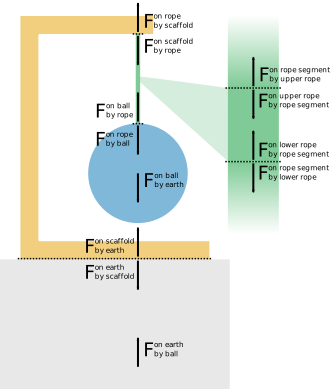
You could explicitly show all of the forces (so that the spring looks like the green to the side):
Tension_figure.svg

But I think that would be messy and overly complicated. I personally would only draw forces on objects with mass.
 
  • #13
Jamison Lahman said:
You could explicitly show all of the forces (so that the spring looks like the green to the side):
Tension_figure.svg

But I think that would be messy and overly complicated. I personally would only draw forces on objects with mass.

Right, I don't think I have to do that much.
To be 100% sure, it's ok?
 

Attachments

  • xxxxx.jpg
    xxxxx.jpg
    9.6 KB · Views: 504
  • #14
Looks fine to me
 
  • #15
Ok, thank you. :)
 

Similar threads

Replies
17
Views
2K
Replies
3
Views
2K
Replies
1
Views
1K
  • · Replies 3 ·
Replies
3
Views
4K
Replies
2
Views
2K
  • · Replies 3 ·
Replies
3
Views
3K
  • · Replies 2 ·
Replies
2
Views
3K
  • · Replies 13 ·
Replies
13
Views
8K
  • · Replies 7 ·
Replies
7
Views
2K
  • · Replies 6 ·
Replies
6
Views
2K