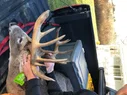
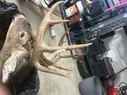
Measuring Deer Antler Volume

  • Thread starter Thread starter erobz
  • Start date Start date
  • #31
Oh. A suspended spring scale. I am such a stupidhead. :sorry:
 
Engineering news on Phys.org
  • #32
Thanks, Jack.

Some expensive balances are designed with the ability to do this. I've used a small digital scale. I built a jig that allowed me to suspend an object below the scale on thin fishing line. It wasn't difficult to do. It looked sort of like this (you'll have to imagine how the scale is supported):

jig.webp


If the object isn't dense enough to sink well on its own then you'd need to add a dense weight.

This idea is used to estimate body fat percentage. You are weighed in air and then submerged in a tank, sitting on a seat attached to a scale. I did this once as part of a class. It was kind of fun.

But for antlers it's probably not worth the trouble. The guys in that paper I linked above used the overflow method.
 
Last edited:
  • #33
All that is necessary to obtain the volume is to put the tank on a balance. No need for an overflow of any sort. Push the antlers down into the water until covered, not touching the bottom, and note the change of reading on the balance, in grams. That is the volume of the antlers in cubic centimetres.
 
  • #34
tech99 said:
All that is necessary to obtain the volume is to put the tank on a balance. No need for an overflow of any sort. Push the antlers down into the water until covered, not touching the bottom, and note the change of reading on the balance, in grams. That is the volume of the antlers in cubic centimetres.
Except that you're trying to read off grams from a scale that is designed to measure tonnes (that's how big it would have to be to hold the largest set of antlers).

(see post 25)
 
  • #35
tech99 said:
All that is necessary to obtain the volume is to put the tank on a balance.
The balance would need to be counterweighted against about 300 kg of water, then the difference measured. That would require a very sensitive balance, where a difference of 1 gram will move 2 x 300 kg = 600 kg to settle in a new position.

Weighing the force difference in the balance, measured without the balanced masses moving, would give the fastest and most accurate result.
 
  • #36
tech99 said:
All that is necessary to obtain the volume is to put the tank on a balance. No need for an overflow of any sort. Push the antlers down into the water until covered, not touching the bottom, and note the change of reading on the balance, in grams. That is the volume of the antlers in cubic centimetres.
But wouldn't that change of reading NOT include the volume of the antlers already submerged without pushing them down? For example, what if the antlers sink completely below the surface (on the bottom or not), on their own? Then the reading is just the combined weight of the tank and the antlers.
 
  • #37
Baluncore said:
...300 kg of water...
Pending erobz's responses to some of my questions, I think 300kg is conservative, depending on scope-of-use.
If this were to hope to challenge the current system, it would need to support the maximum possible dimensions of any antler set.

Moose antlers can spread 2m wide and 1m long. You would need a 2m x 1m x 1m tank - that's 2,000kg.

But we'll see.
 
  • #38
jack action said:
But wouldn't that change of reading NOT include the volume of the antlers already submerged without pushing them down? For example, what if the antlers sink completely below the surface (on the bottom or not), on their own? Then the reading is just the combined weight of the tank and the antlers.
When you dip anything into the tank, it has upthrust due to its displacement volume. If you hold the object rigid, then there is an equal downward reaction force on the balance. The weight of the object is not relevant if the object is held rigidly.
 
  • Like
Likes jack action
  • #39
DaveC426913 said:
Moose antlers can spread 2m wide and 1m long. You would need a 2m x 1m x 1m tank - that's 2,000kg.
I was being conservative in the opposite direction to you. For 1 gram = 1 ml = 1 cc resolution, neither 1 in 3x10⁵, nor 1 in 2x10⁶ is good.

So dispense with the tank of water and the balance, submerge the antlers in a lake, holding them fully submerged with a wire from the scales. The change in weight, in air, then in water, will give the volume of water displaced by the volume of the antlers. If needed, correct that value for density variation due to temperature, or salinity for seawater.
 
  • #40
Baluncore said:
I was being conservative in the opposite direction to you. For 1 gram = 1 ml = 1 cc resolution, neither 1 in 3x10⁵, nor 1 in 2x10⁶ is good.

So dispense with the tank of water and the balance, submerge the antlers in a lake, holding them fully submerged with a wire from the scales. The change in weight, in air, then in water, will give the volume of water displaced by the volume of the antlers. If needed, correct that value for density variation due to temperature, or salinity for seawater.
If antlers float. What if they don't?
 
  • #41
DaveC426913 said:
If antlers float. What if they don't?
They will be held down by the solid wire that connects them to the scales.
 
  • #42
Baluncore said:
They will be held down by the solid wire that connects them to the scales.
If they sink, they don't need to be held down, but it also means you have a to use a different technique to weigh the antlers.
 
  • #43
DaveC426913 said:
If they sink, they don't need to be held down, but it also means you have a to use a different technique to weigh the antlers.
Since the wire is rigid, it can push down or pull up, and the scales using a load-cell, can read and display ±weight, as required by antler density.
 
  • Informative
Likes DaveC426913
  • #44
I wasn't really thinking about weight(although it could be argued to be just as genetically of interest)
). The reason for all this is that the most genetically gifted trophy white tail are usually the largest volume of antler on the head...its naturally most impressive. They assert their dominance among other competing males by growing large alters and then fighting ( age/maturation has much to much to do with it). It may be about torque (I don't know)! There is an extra criterion of symmetry, (right vs left antler) that acts as a deduction in the Boone and Crocket scoring system that is pleasing aesthetically. I however think its mostly about either volume (or mass). Deer age and maturity greatly impacts horn growth. The older bucks (to a point) grow larger antlers in a season. The Boone and Crocket uses as "characteristic length", I just though I would like to shift the tides to an actually scientific measurement (and something repeatable ). There is a lot of subjectivity in the Boone and Crocket scoring system I would like to eliminate.
 
  • #45
Boone and Crocket measure subjective volume which is what any buck on seeing the size of the antlers on the opponent may either back away from a fight or not be impressed. Actual volume may represent something else.
Does that make sense.

Another option without all the trouble,
One might put the antlers in front of a grided screen, take a frontal photograph ( or some other specified direction ), designate the tip points of the antlers on the grid, and calculate the projected area encompassed within these exterior points of an area as if they had been joined by a string. Similar to a method of collision detection of two objects that meet in a video game.
 
  • #46
erobz said:
I wasn't really thinking about weight(although it could be argued to be just as genetically of interest)
The difference between the weight in air, and weight submerged in water, is the buoyancy, which is due only to the volume of the antlers. For freshwater, that is; 1 cc volume per 1g weight difference, or 1 litre per kg.

Procedure.
Attach the antler to the digital scales with a rigid wire, suspended from the scales. Weigh the antlers in air.
Then lower them into a lake, or your bath, not touching the bottom or sides, weighing them submerged, up to a fixed mark on the wire.
Subtract the weight submerged from the weight in air.
You then have both the weight and the volume of the antlers, in two weighings, without a need to weigh or to transport a tank.
 

Similar threads

  • · Replies 1 ·
Replies
1
Views
4K
  • · Replies 6 ·
Replies
6
Views
5K
  • · Replies 5 ·
Replies
5
Views
4K
  • · Replies 1 ·
Replies
1
Views
3K