Undergrad Measuring reflectance of a non-planar object w/ an integrating sphere

Click For Summary
SUMMARY

This discussion focuses on measuring the reflectance of non-planar insect specimens using an integrating sphere. The user plans to orient the sample at an 8-degree incidence angle to minimize losses of specular reflectance, utilizing a large integrating sphere with a port fraction of approximately 0.3%. The primary measurement sought is directional-hemispherical reflectance, and the user is advised to design a sample mount that allows for optimal orientation with respect to the illumination beam. The illumination beam will be slightly larger than the specimen, with plans to use a transparent mounting slide or a highly absorptive material to manage the beam.

PREREQUISITES
  • Understanding of integrating spheres and their application in reflectance measurements
  • Knowledge of directional-hemispherical reflectance and bi-directional reflectance distribution function (BRDF)
  • Familiarity with sample mounting techniques for optical measurements
  • Experience with optical illumination systems and beam diameter considerations
NEXT STEPS
  • Research the design and specifications of integrating spheres for optical measurements
  • Study the differences between directional-hemispherical reflectance and hemispherical-directional reflectance
  • Explore sample mounting techniques that optimize orientation for reflectance measurements
  • Investigate methods for controlling illumination beam size and managing stray light
USEFUL FOR

Researchers and technicians in optical measurement fields, particularly those involved in reflectance studies of non-planar objects, as well as professionals working with integrating spheres and optical systems.

aferrie
Messages
6
Reaction score
2
TL;DR
Are there any potential issues with measuring the reflectance of a non-planar object (e.g. a ball bearing or an insect specimen) using an integrating sphere?
I am designing an experiment to measure the reflectance (diffuse+specular) of insect specimens, and I plan to use an integrating sphere to collect the measurements. Typically, I have seen that reflectance measurements with integrating spheres are done with planar (i.e. flat) sample objects. So, I am curious if a non-planar sample object would produce an incorrect measurement.

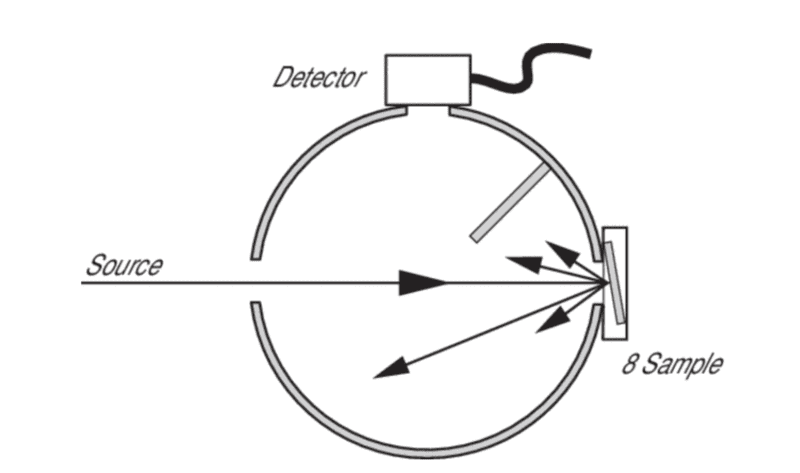
My main concern is that the specular reflectance of the sample is now contained over a variety of angles, so orienting the sample at an 8deg incidence angle with respect to the source (as shown below) will not redirect all of the specular signal within the sphere. My proposed solution is to obtain a large integrating sphere so that the port fraction is low (i.e. around 0.3% assuming a port diameter of ~13mm and and integrating sphere diameter of 200mm). This will not eliminate all of the losses of the specular signal, but it will minimize them such that the reflectance measurement is accurate.
1699402598293.png

Image source

For reference, the reflectance measurement needs to be taken with each specimen fully illuminated.
 
Science news on Phys.org
It's not clear what you are trying to measure- the image you included shows a measurement of the directional-hemispherical reflectance, but your final sentence seems to indicate you want to measure the hemispherical-directional reflectance.

Or, do you want to measure the full bi-directional reflectance (BRDF)?
 
Andy Resnick said:
It's not clear what you are trying to measure- the image you included shows a measurement of the directional-hemispherical reflectance, but your final sentence seems to indicate you want to measure the hemispherical-directional reflectance.

Or, do you want to measure the full bi-directional reflectance (BRDF)?
Can you elaborate on what you mean by directional-hemispherical reflectance vs. hemispherical-directional reflectance?
 
aferrie said:
https://nvlpubs.nist.gov/nistpubs/Legacy/MONO/nbsmonograph160.pdf

Based off of these definitions, I need to measure the directional-hemispherical reflectance.
Then I think an integrating sphere will work well for you; spend a little time designing the sample mount so that you can orient the sample with respect to the illumination beam as you like. I'm still a bit confused about "the reflectance measurement needs to be taken with each specimen fully illuminated."- is the illumination beam larger diameter than the object?
 
Andy Resnick said:
Then I think an integrating sphere will work well for you; spend a little time designing the sample mount so that you can orient the sample with respect to the illumination beam as you like. I'm still a bit confused about "the reflectance measurement needs to be taken with each specimen fully illuminated."- is the illumination beam larger diameter than the object?
Yes, the beam will be slightly larger than the object (I will use an aperture to limit the beam diameter). To eliminate the section of the beam that is not illuminating the insect, I plan to either use a transparent mounting slide with a light trap behind it or a slide made out of a highly absorptive material.
 

Similar threads

  • · Replies 2 ·
Replies
2
Views
2K