SUMMARY
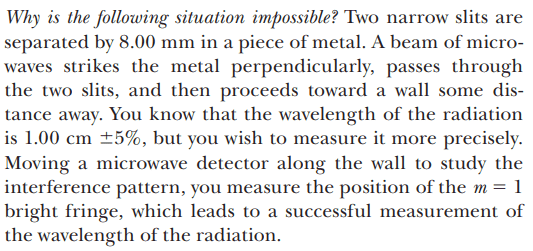
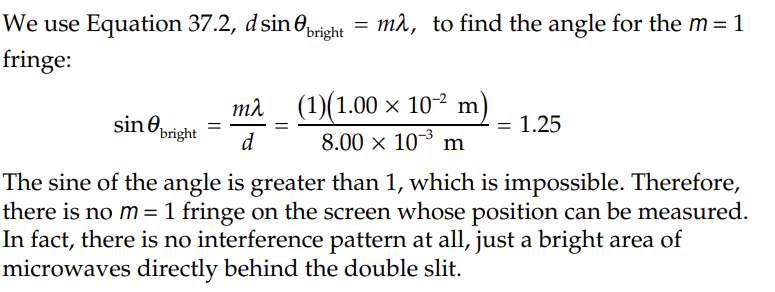
The discussion focuses on measuring the wavelength of microwave radiation using double slits, specifically addressing the implications of uncertainty in angle calculations. Participants emphasize that the sine of the angle cannot exceed 1, and any uncertainty must be accounted for when determining the wavelength (λ). A consensus emerges that the wavelength should be calculated using the lower limit of λ = 0.95 cm, rather than λ = 1.00 cm, to ensure accurate results. The conversation highlights the importance of considering physical constraints in wave phenomena.
PREREQUISITES
- Understanding of wave mechanics and interference patterns
- Familiarity with the double-slit experiment
- Knowledge of uncertainty analysis in measurements
- Basic mathematical skills for trigonometric functions
NEXT STEPS
- Research the principles of the double-slit experiment in wave physics
- Learn about uncertainty propagation in experimental measurements
- Study the relationship between wavelength and fringe spacing in interference patterns
- Explore the implications of physical constraints on wave behavior
USEFUL FOR
Physicists, engineering students, and anyone involved in experimental physics or wave mechanics who seeks to understand the nuances of measuring wavelengths and the impact of uncertainty on calculations.