Mechanical Advantage vs. Lever vs. Human Error

Click For Summary
SUMMARY

The discussion centers on the application of Mechanical Advantage (MA) in lever mechanics, specifically 1st Class Levers. The calculations presented indicate that to lift 40,000 lbs with a force of 1,000 lbs, a mechanical advantage of 40:1 is required. The gravitational constant does not affect the MA in this context, as the same ratio applies regardless of the gravitational environment. The consensus is that the force values provided are already in terms of weight, negating the need for further gravitational adjustments.

PREREQUISITES
  • Understanding of Mechanical Advantage (MA)
  • Knowledge of 1st Class Lever mechanics
  • Familiarity with force and weight concepts
  • Basic grasp of gravitational effects on mass and weight
NEXT STEPS
  • Research the principles of Mechanical Advantage in different lever classes
  • Study the applications of levers in engineering design
  • Explore the effects of varying gravitational forces on mechanical systems
  • Learn about the calculations involved in force and weight conversions
USEFUL FOR

Mechanical engineers, physics students, and anyone involved in designing or analyzing lever systems and mechanical advantage calculations.

BMR
Messages
1
Reaction score
1
This is my first post here, so pardon if forum guidelines/criteria require this to be designated elsewhere.

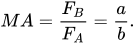
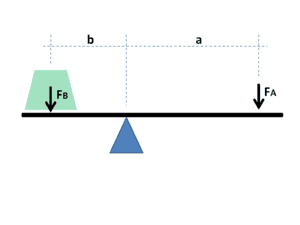
I am designing a clamp mechanism utilizing lever mechanics, and I am getting conflicting info regarding Mechanical Advantage and the Law of 1st Class Levers. Regarding MA, knowing that
300px-Lever_mechanical_advantage.png

e4516522ccaaa831010fc757760110894929d202


If:
FB = 40,000 lbs
FA = 1,000 lbs
Then: b = 40, a = 1, and the MA is 40:1

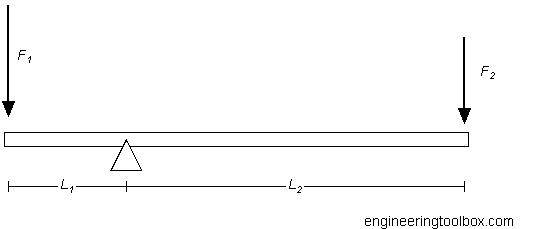
In regards to Levers (Specifically 1st Class Levers)
torque_lever.png

F2 = F1 L1 / L2

If:
FB = 40,000 lbs
FA = 1,000 lbs

Then:
40,000 = 1,000 (32.174 ft/s2 [gravity constant]) (L1 / L2)
40 = 32.174 (L1 / L2)
L1 / L2 = approx. 1.243 or 1.243:1.

So for 1,000 lbs to lift 40,000 lbs., either a 40:1 or 1.243:1 lever ratio is required. Am I simply wrong for factoring in a gravitational constant?
 

Attachments

  • 300px-Lever_mechanical_advantage.png
    300px-Lever_mechanical_advantage.png
    2 KB · Views: 449
  • torque_lever.png
    torque_lever.png
    657 bytes · Views: 456
  • Like
Likes   Reactions: anorlunda
Engineering news on Phys.org
BMR said:
Am I simply wrong for factoring in a gravitational constant?
Yes. You get the same mechanical advantage whether the lever is on the Earth, the Moon or in free space.

On Edit: Assuming that F1 and F2 are either both pushing forces or both weights, that is.
 
  • Like
Likes   Reactions: BMR
BMR said:
So for 1,000 lbs to lift 40,000 lbs., either a 40:1 or 1.243:1 lever ratio is required.

@kuruman gave you the correct answer. But to amplify, if you move the whole apparatus to a planet with one half Earth's gravity, then the same weights would weigh 500 lbs and 20000 lbs, but the ratio 40:1 remains unchanged and the MA remains unchanged. That is why you don't need G.
 
Another way to say the same thing as @anorlunda: If the number 1000 is a mass, then you multiply by g to get a weight which is a force. Here you have 1000 lbs which is already a force (the mass has already been multiplied by g) so it would be wrong to multiply by g again.
 
  • Like
Likes   Reactions: Tom.G and anorlunda

Similar threads

Replies
17
Views
9K
  • · Replies 8 ·
Replies
8
Views
8K
Replies
9
Views
2K
  • · Replies 26 ·
Replies
26
Views
9K
  • · Replies 6 ·
Replies
6
Views
13K
Replies
2
Views
2K
  • · Replies 2 ·
Replies
2
Views
16K
  • · Replies 5 ·
Replies
5
Views
3K
Replies
3
Views
2K
  • · Replies 7 ·
Replies
7
Views
31K