Meteorite with something inside?

  • Thread starter Thread starter onion
  • Start date Start date
  • Tags Tags
    Meteorite
Click For Summary

Discussion Overview

The discussion revolves around a user's inquiry about a rock they believe to be a meteorite, which produces a rattling sound when shaken. Participants explore various possibilities regarding the nature of the rock, including its potential composition and origin, while considering the implications of it being hollow.

Discussion Character

  • Exploratory
  • Debate/contested
  • Technical explanation

Main Points Raised

  • One participant suggests the rock may be a meteorite based on initial research but expresses uncertainty about the rattling sound.
  • Another participant humorously warns about potential dangers, referencing the movie "Alien," while also engaging with the original poster.
  • A participant raises questions about the rock's magnetic properties and its exact location of discovery, indicating these factors could help in identification.
  • Several participants propose that the rock might not be a meteorite if it is hollow, suggesting it could be a geode or a "rattle stone," which may contain various materials.
  • One participant describes the characteristics of the rock, including its patina and polished corners, and discusses possible geological processes that could lead to the rattling sound.
  • Another participant shares personal experience, stating they have never encountered a hollow meteorite and aligns with others in suggesting it is likely a geode or rattlestone.

Areas of Agreement / Disagreement

Participants do not reach a consensus on the nature of the rock. Multiple competing views are presented, with some suggesting it could be a meteorite while others argue it is more likely a geode or rattlestone.

Contextual Notes

Participants note the importance of the rock's magnetic properties and location for identification, but these factors remain unresolved in the discussion.

onion
Messages
5
Reaction score
6
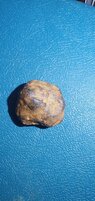
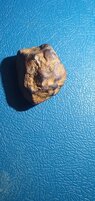
I have this rock that I'm assuming, after research, is a meteorite. When you shake it slightly you can hear something knocking around on the inside. Whatever is inside, from the sound, doesn't seem to be hard like the outside. Any ideas what this could be? Curiosity is about to kill this cat!
 
  • Like
Likes   Reactions: AlexB23
Earth sciences news on Phys.org
Welcome to PF.

Um, I'd be a little careful with that. Have you seen the movie Alien? I'm not kidding.

Paging @davenn
 
  • Like
  • Haha
Likes   Reactions: pinball1970 and davenn
20230421_204147.jpg
20230421_204155.jpg
20230421_204202.jpg
 

Attachments

  • 20230421_204218.jpg
    20230421_204218.jpg
    49.3 KB · Views: 162
  • Like
Likes   Reactions: AlexB23
berkeman said:
Welcome to PF.

Um, I'd be a little careful with that. Have you seen the movie Alien? I'm not kidding.

Paging @davenn
😂😂😂 I feel it.... I tried posting a video but I'm not exactly sure how honestly
 
onion said:
I tried posting a video but I'm not exactly sure how honestly
I think at PF you need to link to YouTube videos. I'm pretty sure there is no way to upload videos with "Attach Files" yet.
 
berkeman said:
Paging @davenn
So anticipating some of the questions from Dave and @Baluncore is it magnetic? Can you say exactly where you found it (lat/long)? What kind of terrain did you find it in (desert, riverbed, forest, etc.)?
 
Looking at the pictures shows a patina with polished corners. If it is a rock, it has either been handled by people for a long time, or has remained on the surface in a gibber stone desert. The lenticular notches suggest weathering of rock containing fossil shells.

Does it contain one rock or many particles of grit?
You have a "rattle stone", google it.

Rocks that rattle can be made from selectively weathered chemical concretions, geodes, or can be based on fossils in sandstone. Consider a bivalve shell, filled with sand and buried in sand. Groundwater, temperature and time, fossilise the shell and sand to a solid. The calcium carbonate from the shell, and silica from the sand, cement the near sandstone. When the rock comes to the surface, it may be differentially weathered chemically, to remove the calcium shell, resulting in a rattling rock.

There are a few other possibilities. It could be a concretion from an animal's gut, like a gall stone or a bezoar stone. Or a stone swallowed by an animal, a gastrolith, like a grindstone in the gizzard of a bird or reptile, from a dinosaur fossil or recently employed.

You will need to open it to identify the origin.

https://en.wikipedia.org/wiki/Gastrolith
https://en.wikipedia.org/wiki/Bezoar
 
  • Like
  • Informative
Likes   Reactions: Astranut, Klystron, Bandersnatch and 4 others
  • #10
  • Informative
  • Like
Likes   Reactions: davenn, AlexB23 and berkeman
  • #11
If it is hollow might not be a meteorite, as they fuse in entry to the Earth's atmosphere. Hollow rocks are most likely be a geode.
 
  • Like
Likes   Reactions: davenn
  • #12
onion said:
I have this rock that I'm assuming, after research, is a meteorite. When you shake it slightly you can hear something knocking around on the inside.

hi ya
welcome to PF :)
In the over 300 meteorites I have and the probably 1000's of others I have seen, I have never seen a hollow one.

As @Baluncore and @Terrakron have suggested, and I agree with them it's likely to be a geode ( thunderegg) or a rattlestone.
The look of the outer surface doesnt really give me any confidence of it being a meteorite

cheers
Dave
 
  • Like
Likes   Reactions: dlgoff

Similar threads

  • · Replies 10 ·
Replies
10
Views
2K
  • · Replies 15 ·
Replies
15
Views
3K
  • · Replies 1 ·
Replies
1
Views
3K
  • · Replies 17 ·
Replies
17
Views
4K
  • · Replies 11 ·
Replies
11
Views
6K
  • · Replies 4 ·
Replies
4
Views
11K
Replies
2
Views
4K
  • · Replies 96 ·
4
Replies
96
Views
17K
  • · Replies 21 ·
Replies
21
Views
3K
  • · Replies 35 ·
2
Replies
35
Views
2K