Methane as a greenhouse gas

  • Thread starter Thread starter Philolsophy
  • Start date Start date
Philolsophy
Messages
1
Reaction score
0
I was looking into the matter of methane as a greenhouse gas. Just as with CO2, it is rising sharply. From what I was reading, they say that methane is 84 to 87 times more potent of a greenhouse gas than CO2. That being over a 20 year timeframe. But methane only last in the atmosphere as methane for about 10 years. So would I be wrong in assuming that during the 10 years where methane is released at any particular point into the atmosphere, it is well over 100 times more potent of a greenhouse gas than CO2?

This is an important question. Because any time I see anything on TV about human caused global warming, they talk about what ocean levels will be like in the year 2100. But by the looks of things, most of the life on Earth will be extinct by the year 2050. Mainly because of the exponentially increasing amount of methane release. Also, I have a picture to show you of what the Earth looked like in 1972 and what it looked like from the recent Artemis moon flyby over 50 years later. As you can see, the Earth looks noticeably dingier. Which in itself must mean that the atmosphere is absorbing more heat from the sun.
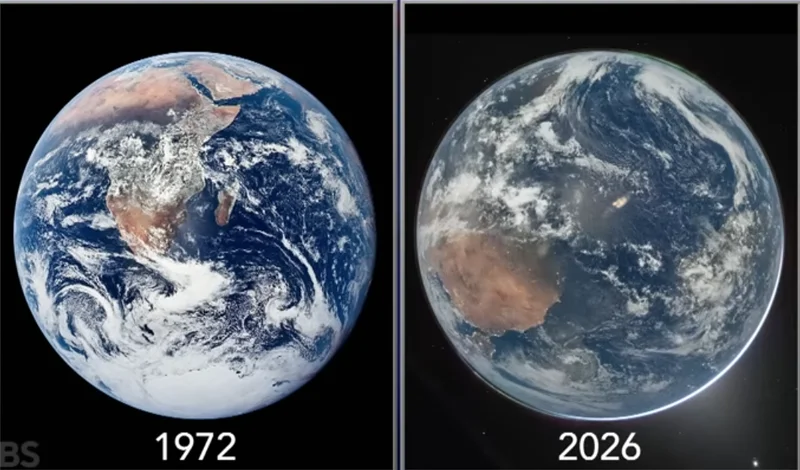
Earth, 1972 and 2026.webp
 
Earth sciences news on Phys.org
Please always post links to your claims and to your images. We need those links to be sure that PF stays compliant with copyright regulations, and to help other PF users to be able to respond to your post.
 
Philolsophy said:
From what I was reading, they say that methane is 84 to 87 times more potent of a greenhouse gas than CO2. That being over a 20 year timeframe. But methane only last in the atmosphere as methane for about 10 years. So would I be wrong in assuming that during the 10 years where methane is released at any particular point into the atmosphere, it is well over 100 times more potent of a greenhouse gas than CO2?
That would be a false assumption. Once CO2 is added to the atmosphere, it hangs around, for a long time: between 300 to 1,000 years.
 
Philolsophy said:
Also, I have a picture to show you of what the Earth looked like in 1972 and what it looked like from the recent Artemis moon flyby over 50 years later. As you can see, the Earth looks noticeably dingier. Which in itself must mean that the atmosphere is absorbing more heat from the sun.
I boosted the brightness and contrast a bit on your Artemis photo and voilà! Earth in 2026 actually looks as good or even better than it did in 1972!
1778456979827.webp

My point is simply that you cannot draw scientifically valid conclusions without referencing your data to properly calibrated standards.
 
  • Like
Likes   Reactions: berkeman
renormalize said:
I boosted the brightness and contrast a bit on your Artemis photo and voilà! Earth in 2026 actually looks as good or even better than it did in 1972!
Except North America has morphed into Australia! Plate tectonics? :wink:
 
berkeman said:
Except North America has morphed into Australia! Plate tectonics? :wink:
Must be a Rorschach test! I see Africa, the Middle East and Madagascar in 1972 and Australia(?) in 2026.
 
  • Haha
Likes   Reactions: berkeman
berkeman said:
Except North America has morphed into Australia! Plate tectonics? :wink:
The Great Morph has been covered up. If they knew the people might panic.
 
Surely average residence time is not the same as how long before it has all decayed to CH4 and H2O from contact with OH radicals - some will decompose sooner than the average and some will decompose later. Because some will still be present in the atmosphere after the average time has passed it does not look like a mistake or inconsistent to consider the effects over longer periods than average residence time.
 
  • Like
Likes   Reactions: Baluncore
Philolsophy said:
But by the looks of things, most of the life on Earth will be extinct by the year 2050.
There's no reason to think that. Certainly none given in the opening post.
If you've just found out about methane's role in global warming - that's excellent. But it's not news to climate modelling, and the predictions for the range of temperature increase that percolate to the general discussion space do include methane emissions, together with a multitude of other factors.
 

Similar threads

Replies
2
Views
2K
  • · Replies 33 ·
2
Replies
33
Views
4K
Replies
8
Views
5K
  • · Replies 12 ·
Replies
12
Views
3K
  • · Replies 85 ·
3
Replies
85
Views
10K
  • · Replies 0 ·
Replies
0
Views
2K
  • · Replies 4 ·
Replies
4
Views
4K
  • · Replies 28 ·
Replies
28
Views
4K
  • · Replies 2 ·
Replies
2
Views
2K
  • · Replies 4 ·
Replies
4
Views
3K