Methane as a greenhouse gas

  • Thread starter Thread starter Philolsophy
  • Start date Start date
Philolsophy
Messages
10
Reaction score
0
I was looking into the matter of methane as a greenhouse gas. Just as with CO2, it is rising sharply. From what I was reading, they say that methane is 84 to 87 times more potent of a greenhouse gas than CO2. That being over a 20 year timeframe. But methane only last in the atmosphere as methane for about 10 years. So would I be wrong in assuming that during the 10 years where methane is released at any particular point into the atmosphere, it is well over 100 times more potent of a greenhouse gas than CO2?

This is an important question. Because any time I see anything on TV about human caused global warming, they talk about what ocean levels will be like in the year 2100. But by the looks of things, most of the life on Earth will be extinct by the year 2050. Mainly because of the exponentially increasing amount of methane release. Also, I have a picture to show you of what the Earth looked like in 1972 and what it looked like from the recent Artemis moon flyby over 50 years later. As you can see, the Earth looks noticeably dingier. Which in itself must mean that the atmosphere is absorbing more heat from the sun.
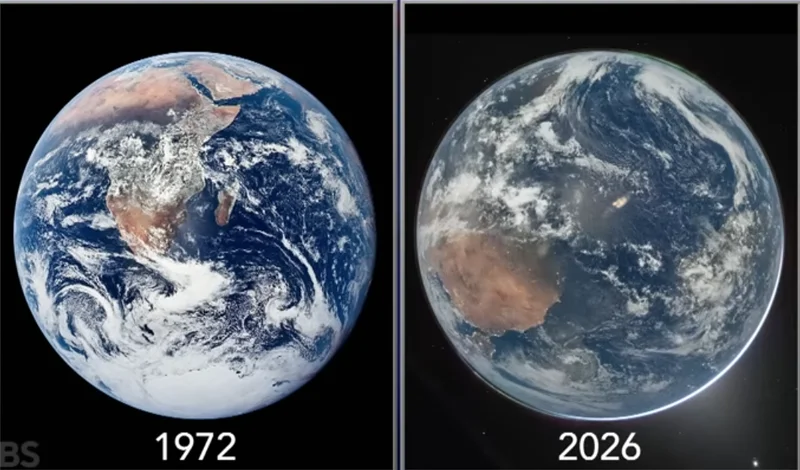
Earth, 1972 and 2026.webp
 
Earth sciences news on Phys.org
Please always post links to your claims and to your images. We need those links to be sure that PF stays compliant with copyright regulations, and to help other PF users to be able to respond to your post.
 
Philolsophy said:
From what I was reading, they say that methane is 84 to 87 times more potent of a greenhouse gas than CO2. That being over a 20 year timeframe. But methane only last in the atmosphere as methane for about 10 years. So would I be wrong in assuming that during the 10 years where methane is released at any particular point into the atmosphere, it is well over 100 times more potent of a greenhouse gas than CO2?
That would be a false assumption. Once CO2 is added to the atmosphere, it hangs around, for a long time: between 300 to 1,000 years.
 
Philolsophy said:
Also, I have a picture to show you of what the Earth looked like in 1972 and what it looked like from the recent Artemis moon flyby over 50 years later. As you can see, the Earth looks noticeably dingier. Which in itself must mean that the atmosphere is absorbing more heat from the sun.
I boosted the brightness and contrast a bit on your Artemis photo and voilà! Earth in 2026 actually looks as good or even better than it did in 1972!
1778456979827.webp

My point is simply that you cannot draw scientifically valid conclusions without referencing your data to properly calibrated standards.
 
  • Like
Likes   Reactions: DaveE and berkeman
renormalize said:
I boosted the brightness and contrast a bit on your Artemis photo and voilà! Earth in 2026 actually looks as good or even better than it did in 1972!
Except North America has morphed into Australia! Plate tectonics? :wink:
 
  • Like
Likes   Reactions: davenn
berkeman said:
Except North America has morphed into Australia! Plate tectonics? :wink:
Must be a Rorschach test! I see Africa, the Middle East and Madagascar in 1972 and Australia(?) in 2026.
 
  • Haha
Likes   Reactions: berkeman
berkeman said:
Except North America has morphed into Australia! Plate tectonics? :wink:
The Great Morph has been covered up. If they knew the people might panic.
 
Surely average residence time is not the same as how long before it has all decayed to CH4 and H2O from contact with OH radicals - some will decompose sooner than the average and some will decompose later. Because some will still be present in the atmosphere after the average time has passed it does not look like a mistake or inconsistent to consider the effects over longer periods than average residence time.
 
  • Like
Likes   Reactions: Baluncore
Philolsophy said:
But by the looks of things, most of the life on Earth will be extinct by the year 2050.
There's no reason to think that. Certainly none given in the opening post.
If you've just found out about methane's role in global warming - that's excellent. But it's not news to climate modelling, and the predictions for the range of temperature increase that percolate to the general discussion space do include methane emissions, together with a multitude of other factors.
 
  • Like
Likes   Reactions: russ_watters
  • #10
Philolsophy said:
I was looking into the matter of methane as a greenhouse gas. Just as with CO2, it is rising sharply. From what I was reading, they say that methane is 84 to 87 times more potent of a greenhouse gas than CO2. That being over a 20 year timeframe. But methane only last in the atmosphere as methane for about 10 years. So would I be wrong in assuming that during the 10 years where methane is released at any particular point into the atmosphere, it is well over 100 times more potent of a greenhouse gas than CO2?
This may be useful to you.

https://www.epa.gov/ghgemissions/understanding-global-warming-potentials
 
  • Like
Likes   Reactions: russ_watters
  • #11
Philolsophy said:
As you can see, the Earth looks noticeably dingier. Which in itself must mean that the atmosphere is absorbing more heat from the sun.

1778510033909.webp
Noooo.

The 1972 pic was taken of the sunward side of the Earth - almost full sun.

The 2026 pic was taken of the Earth's night side - it has been artificially brightened for your viewing pleasure. Notice the full brunt of the sun on the lower right limb - proving that we are definitely looking at the night side.

Here it is before enhancement:

1778509566767.webp

(and if you look closely enough at the lower left limb, you can see city lights along the African coast.)
1778509911287.webp
 
  • Like
  • Informative
Likes   Reactions: russ_watters, PeterDonis, berkeman and 2 others
  • #12
The largest part of the long tail of methane warming is going to be from the CO2 produced - persisting long after the methane itself has decomposed. The water vapor produced likely does add some small amount to enhanced greenhouse but it doesn't persist the way the CO2 does.

I think it is important and useful that atmospheric science improves understanding of what happens with methane but I think we are way past the point of arguing about the importance and urgency of bringing the emissions down. Preferably before we see large scale carbon feedbacks kick in - feedbacks where a warmer world causes carbon sinks to release CO2 and methane.

It does appear like vegetation and oceans taking in more CO2 is only a short term and probably short-lived response to raised atmospheric concentrations. How short that window is, before consequences cascade into unstoppable is a question.
 
  • Like
Likes   Reactions: russ_watters
  • #13
berkeman said:
Please always post links to your claims and to your images. We need those links to be sure that PF stays compliant with copyright regulations, and to help other PF users to be able to respond to your post.

I use Brave Browser. It has a very good AI function where it will bring up an AI response on the top and then give all the various websites on the matter below that. But I can't post a link to an AI response. To any website I could. But not to an AI response. As for the images of the Earth, it from an opening monologue of an episode of the tonight show with Steven Colbert. So in that case, I guess you could say I ripped it right off. Though given the importance of the picture, I doubt if it is something that they would want to keep buried under the rug. I tried to look up the image on youtube. But the best they had was a picture of a half Earth in 1972 next to a 2026 half image of Earth. Which didn't work as well. Being as things are, let any other members respond as they wish.

On a second topic, I noticed that I couldn't log in with a VPN engaged. Maybe this website is worried about "spammers." But who in the hell would want to spam a website like this? If you have any sort of anti spam software, you may as well turn it off.
 
  • #14
Baluncore said:
That would be a false assumption. Once CO2 is added to the atmosphere, it hangs around, for a long time: between 300 to 1,000 years.

Nobody is talking about CO2. I'm talking about methane. If methane is 84 to 87 times more potent of a greenhouse gas 10 years after it has disappeared, (broken down into CO2 and other trace gasses) then logic would assume that during the 10 years while it is actually present in the atmosphere, it would HAVE to be much more than 84 to 87 times more potent of a greenhouse gas than CO2.
 
  • #15
Philolsophy said:
I use Brave Browser. It has a very good AI function where it will bring up an AI response on the top and then give all the various websites on the matter below that. But I can't post a link to an AI response. To any website I could. But not to an AI response. As for the images of the Earth, it from an opening monologue of an episode of the tonight show with Steven Colbert.
So you can see now why we frown upon AI as well as 'I saw it on TV' postings. They're full of nonsense - and you promulgated that nonsense in your OP: "As you can see, the Earth looks noticeably dingier."

Philolsophy said:
Maybe this website is worried about "spammers." But who in the hell would want to spam a website like this? If you have any sort of anti spam software, you may as well turn it off.
Er... First day on the internet? :wink:
 
  • Like
Likes   Reactions: BillTre
  • #16
renormalize said:
I boosted the brightness and contrast a bit on your Artemis photo and voilà! Earth in 2026 actually looks as good or even better than it did in 1972!
View attachment 371513
My point is simply that you cannot draw scientifically valid conclusions without referencing your data to properly calibrated standards.

Could the picture I posted to begin with have been tampered with? Could be. But only a vile POS would do so. I will post another picture that I found in images through Comodo browser. It looks about the same.

Earths 2.webp


Having said that, I remember seeing something years ago where they said there was less sunlight reaching the Earth's surface than in years past. That must be because there is something in the atmosphere absorbing it and or reflecting more of the sunlight back into space. Here is one article that goes into it more.
Lm9yZy8.webp

🌐


Phys.org

phys.org › news › 2025-04-amount-sunlight-earth-surface-varies.html


Amount of sunlight reaching Earth's surface varies over decades, researchers report
 
  • Skeptical
Likes   Reactions: BillTre
  • #17
Bandersnatch said:
There's no reason to think that. Certainly none given in the opening post.
If you've just found out about methane's role in global warming - that's excellent. But it's not news to climate modelling, and the predictions for the range of temperature increase that percolate to the general discussion space do include methane emissions, together with a multitude of other factors.

What you say could be true. But it seems to me that it would be difficult to predict just how much more methane would be getting released from places with tundra or undersea methane hydrate ice as temperatures rise. I do know that there is far more than enough methane locked up in those sources than would be necessary to doom the planet many times over. I also remember seeing something about large craters that have been appearing in the tundra in Siberia that they are having trouble explaining. More than likely they came from some extensive release of methane deep underground that caused the ground above it to collapse. I have a graph about methane release for you.

Methane graph.webp


Here is something else you are just going to have to take my word for. Over the years going around to various political forums, I have discovered many unfortunate things. One being that our government isn't to be trusted. If it knew that our planet was doomed, would they tell anybody? Or would they keep it secret to maintain civil order. I am of the opinion that they would prefer to kill anybody that tried to let such a secret out. In fact, by the looks of things, those in power actually want to see the Earth destroyed! As long as it means that they can retain their wealth for al long as possible. It's like the old saying, "A rich person would sell you the rope you are going to hang him with as long as he thought he could make a buck."

Casey.webp


Here is another unfortunate thing I found out. Most people PREFER being lied to. Most people don't really care what happens. As long as it happens to someone else. On that point, I have some other memes for you.

birds in a cage..webp


Lies vs Truth.webp


Matrix Quote.webp


Aldous Huxley.webp

Aldous Huxley 2.webp

Aldous Huxley 3.webp
 
  • #18
DaveC426913 said:
Noooo.

The 1972 pic was taken of the sunward side of the Earth - almost full sun.

The 2026 pic was taken of the Earth's night side - it has been artificially brightened for your viewing pleasure. Notice the full brunt of the sun on the lower right limb - proving that we are definitely looking at the night side.

Here it is before enhancement:

View attachment 371521
(and if you look closely enough at the lower left limb, you can see city lights along the African coast.)
View attachment 371524

I went into the pictures more in post #16. That aside, they were showing pictures of the Earth from space. No doubt taken at just about the same distance from Earth. After all, that was the whole point of it. One picture showed the Earth in 1972 and one in 2026. Of course, the continents would be in different positions. And maybe the moon that they just flew around would have been in a different position. But roughly, the pictures of the Earth are the same.
 
  • #19
Philolsophy said:
Nobody is talking about CO2. I'm talking about methane. If methane is 84 to 87 times more potent of a greenhouse gas ...
You are talking about the comparison between CH4 and CO2.
You have not defined the term "potency".
Philolsophy said:
I was looking into the matter of methane as a greenhouse gas. Just as with CO2, it is rising sharply. From what I was reading, they say that methane is 84 to 87 times more potent of a greenhouse gas than CO2. That being over a 20 year timeframe. But methane only last in the atmosphere as methane for about 10 years.
The IEA claims that CH4 is responsible for only about 30% of global warming since the pre-industrial era. That is not 840% to 870%.
 
  • #20
Philolsophy said:
I use Brave Browser. It has a very good AI function where it will bring up an AI response on the top and then give all the various websites on the matter below that. But I can't post a link to an AI response. To any website I could. But not to an AI response.
Please remember that we do not allow AI as a source or reference in the technical forums here (like where your thread is posted). AI is just not reliable enough yet to allow that, which is why we require actual links to scientific information. So it would have been appropriate/better to post the links you say were provided by your search (although you should also vet those links to be sure they are real; sometimes AI well, you know...).

Philolsophy said:
On a second topic, I noticed that I couldn't log in with a VPN engaged.
I hadn't seen that before, but I can look into it. We have lots of users that spoof their IP addresses using VPN Servers. I see that all the time when vetting new users.

Philolsophy said:
Maybe this website is worried about "spammers." But who in the hell would want to spam a website like this?
We deal with several hundred spammers each month here, so yes they concern us. The PF software does a good job of weeding them out of the new user pool, but the Mentors and Admins still have to do lots of manual work to keep the forums as spam-free as possible. We also get a lot of help from other users here who use the "Report" link in posts and in User Profiles to flag spammers for us.
 
  • Like
Likes   Reactions: BillTre and PeterDonis
  • #21
Philolsophy said:
I went into the pictures more in post #16. That aside, they were showing pictures of the Earth from space. No doubt taken at just about the same distance from Earth. After all, that was the whole point of it. One picture showed the Earth in 1972 and one in 2026. Of course, the continents would be in different positions. And maybe the moon that they just flew around would have been in a different position. But roughly, the pictures of the Earth are the same.
But the 1972 picture is doubtless a film photo while the one from 2026 was most likely captured by a digital sensor. Can you cite credible references that compare the response curves of the two media for this specific situation?
I suggest that you both narrow your claims and broaden your understanding.
 
  • Like
Likes   Reactions: BillTre and berkeman
  • #22
pinball1970 said:

Not much. As I said, from what I have found, methane is 84 to 87 times more potent of a greenhouse gas than CO2. That is over a 20 year time frame. But methane only lasts in the atmosphere for about 10 years. Before breaking down into other gases. So while the methane is still in the atmosphere, it must be more than 84 to 87 times more potent of a greenhouse gas than CO2. After all, we're talking about 10 years when it is there along with 10 years when it isn't. So far, nobody has given me a good answer. And by this point, I don't expect one. Maybe I'm just at the wrong forum. But being one so into numbers, I thought it would have been the right one.
 
  • Sad
Likes   Reactions: russ_watters
  • #23
berkeman said:
Please remember that we do not allow AI as a source or reference in the technical forums here (like where your thread is posted). AI is just not reliable enough yet to allow that, which is why we require actual links to scientific information. So it would have been appropriate/better to post the links you say were provided by your search (although you should also vet those links to be sure they are real; sometimes AI well, you know...).


I hadn't seen that before, but I can look into it. We have lots of users that spoof their IP addresses using VPN Servers. I see that all the time when vetting new users.


We deal with several hundred spammers each month here, so yes they concern us. The PF software does a good job of weeding them out of the new user pool, but the Mentors and Admins still have to do lots of manual work to keep the forums as spam-free as possible. We also get a lot of help from other users here who use the "Report" link in posts and in User Profiles to flag spammers for us.

I have been posting actual websites to help things out. Next, you bring up spammers. But aren't spammers trying to sell something? Who in the hell would try to sell anything here. This forum seems to deal with scientific facts. That doesn't seem to be very fertile ground on which to sell anything. Also, I came here to seek an answer. Does that make me a spammer?
 
  • Skeptical
Likes   Reactions: BillTre
  • #24
Philolsophy said:
Next, you bring up spammers. But aren't spammers trying to sell something? Who in the hell would try to sell anything here. This forum seems to deal with scientific facts. That doesn't seem to be very fertile ground on which to sell anything.
How naive are you? I have personally reported to the forum mentors dozens of spam posts here selling scientific instrumentation, measurement services, machining and fabrication, matchmaking and more. Not to mention a multitude of posts promoting personal theories, philosophy and religion, all of which are spam and off limits here. You most likely won't have encountered these because such posts are promptly and properly removed by the mentors after reporting.
 
  • Like
  • Agree
Likes   Reactions: pinball1970, DaveC426913, BillTre and 1 other person
  • #25
renormalize said:
But the 1972 picture is doubtless a film photo while the one from 2026 was most likely captured by a digital sensor. Can you cite credible references that compare the response curves of the two media for this specific situation?
I suggest that you both narrow your claims and broaden your understanding.

I don't think there is any difference between film and a digital camera. The digital camera is sharper. But roughly, it is the same image. Now with digital, you can manipulate the image in a number of ways. But why would anybody want to do that.
 
  • #26
renormalize said:
How naive are you? I have personally reported to the forum mentors dozens of spam posts here selling scientific instrumentation, measurement services, machining and fabrication, matchmaking and more. Not to mention a multitude of posts promoting personal theories, philosophy and religion, all of which are spam and off limits here. You most likely won't have encountered these because such posts are promptly and properly removed by the mentors after reporting.

Well, I never thought of some of the things you mentioned. But if you are in a University, wouldn't you already have access to some of the things you mentioned? In fact, probably part of what they do is improving on the things you mentioned. Next, given what you said, I really don't think you are going to like the later parts of post #17. According to you, it would make me a spammer. But feel free to consider the truth of what I posted before you report me.
 
  • Skeptical
Likes   Reactions: BillTre
  • #27
Philolsophy said:
Also, I came here to seek an answer. Does that make me a spammer?
No, I definitely don't think you are a spammer, and are not here to promote anything commercial.

It's more like you haven't quite figured out yet the best way to post at PF (or other science discussion forums for that matter). Supporting links are always good, and it's important not to make claims without such links.

(Full disclosure -- when I first started posting at PF a google years ago, I was met with similar advice by the Mentors back then. Fortunately I took their advice to heart, and have since learned a ton here. I probably could have been banned if I posted some of the stuff that I wanted to way back then, since it was unsupported personal speculation.)
 
  • Like
Likes   Reactions: pinball1970 and BillTre
  • #28
Philolsophy said:
I really don't think you are going to like the later parts of post #17. According to you, it would make me a spammer.
Your post #17 is indeed very problematic. Not because of any commercial spam aspect, but for the trolling conspiracy theory aspect, and it is indeed under Mentor review. Thread is closed now pending that review.
 
  • Like
Likes   Reactions: BillTre
  • #29
I know this thread is locked, but I'll answer this anyway:

Philolsophy said:
Not much. As I said, from what I have found, methane is 84 to 87 times more potent of a greenhouse gas than CO2. That is over a 20 year time frame. But methane only lasts in the atmosphere for about 10 years. Before breaking down into other gases. So while the methane is still in the atmosphere, it must be more than 84 to 87 times more potent of a greenhouse gas than CO2. After all, we're talking about 10 years when it is there along with 10 years when it isn't. So far, nobody has given me a good answer.
[from the OP]
So would I be wrong in assuming that during the 10 years where methane is released at any particular point into the atmosphere, it is well over 100 times more potent of a greenhouse gas than CO2?
The link @pinball1970 posted answers you fine. It says: "Methane (CH4) is estimated to have a GWP of 27 to 30 over 100 years." This doesn't contradict the 84-87 over 20 years: Since CO2 does not decay and methane does, yes, the GWP of methane, if measured over a shorter time, would be higher than over a longer time. There's a curve to it based on the rate of decay; higher over shorter durations. Yes, that means over the first 10 years it is more than 100x worse than CO2 (exact peak value I can't easily find). But:
[from OP] This is an important question. Because any time I see anything on TV about human caused global warming, they talk about what ocean levels will be like in the year 2100. But by the looks of things, most of the life on Earth will be extinct by the year 2050. Mainly because of the exponentially increasing amount of methane release.
Obviously that's included in the models because that's why you were able to easily find this information.
There's no problem here except maybe that you are misinterpreting this information to indicate something worse than it is saying. And note that 2050 is a little more than 20 years from now. That's not a coincidence, it's a timeframe selected to be of importance by people doing the modeling.

Also, your methane emissions graph looks a lot less exponential over the past 50 years than the past thousand.
 

Similar threads

Replies
2
Views
2K
  • · Replies 33 ·
2
Replies
33
Views
4K
Replies
8
Views
5K
  • · Replies 12 ·
Replies
12
Views
3K
  • · Replies 85 ·
3
Replies
85
Views
10K
  • · Replies 0 ·
Replies
0
Views
2K
  • · Replies 4 ·
Replies
4
Views
4K
  • · Replies 28 ·
Replies
28
Views
4K
  • · Replies 2 ·
Replies
2
Views
2K
  • · Replies 4 ·
Replies
4
Views
3K