Microwave Oven - Magnetron End Cap Replacement

  • Topic: Appliances 
  • Thread starter Thread starter jim hardy
  • Start date Start date
  • Tags Tags
    Microwave oven
Join the discussion
Registration is free. Start your own thread to ask a follow-up.
19 replies · 11K views · last reply
Science Advisor
Homework Helper
Dearly Missed
Messages
9,864
Reaction score
4,896
Question of you radar guys..

My 14 year old Panasonic Microwave Oven suffered a magnetron end cap failure
it commenced arcing and melted off a corner.

Photo of a 2M261-M32 magnetron with its cooling fins and a coaxial output connector on the left, and a circle marking a burnt-away end cap on the right.


I noticed it's not sealed, brand new ones have a hole in the end ...
so I'm wondering just what does the endcap do ?
I find plenty of descriptions of cavity resonance and the path of whirling electrons

but only brief mention of the endcap ..

Is the endcap part of the tuned antenna assembly , with dimensions that are critical?
image courtesy http://www.radartutorial.eu/08.transmitters/Magnetron.en.html
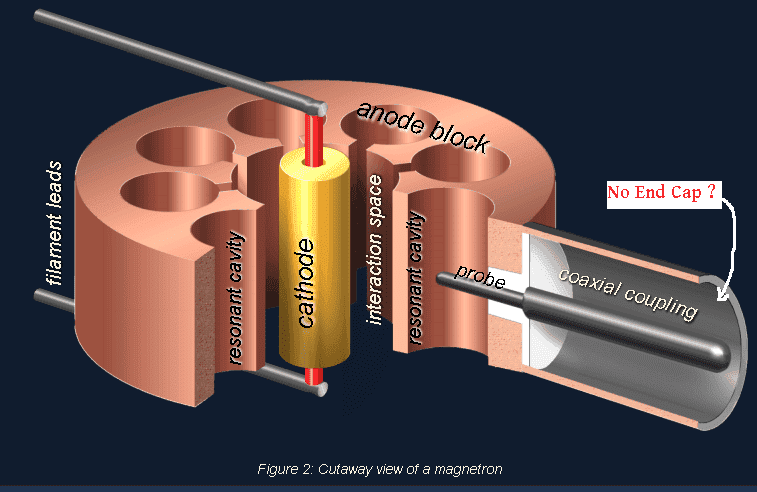
Cutaway 3D diagram of a magnetron showing the cathode, anode block with resonant cavities, interaction space, filament leads, and a coaxial coupling with a probe, with the label No End Cap? pointing to the open end of the coupling.
or might i get away with soldering a copper pipe cap over the end ? With a hole of about same area as in the old endcap?

How hot does that part get ?
What is its purpose - just to short the end of the coaxial coupling ?

Thanks for a reality check,
link to instructive material appreciated.

old jim
 
Attachments
  • Photo of a 2M261-M32 magnetron with its cooling fins and a coaxial output connector on the left, and a circle marking a burnt-away end cap on the right.
    upload_2018-10-25_23-3-54.png
    28.8 KB · Views: 3,037
  • Cutaway 3D diagram of a magnetron showing the cathode, anode block with resonant cavities, interaction space, filament leads, and a coaxial coupling with a probe, with the label No End Cap? pointing to the open end of the coupling.
    upload_2018-10-25_23-11-51.png
    40 KB · Views: 2,702
Physics news on Phys.org
jim hardy said:
Question of you radar guys..
Well, I'm not a radar guy, but...
jim hardy said:
...or might i get away with soldering a copper pipe cap over the end ?

Take a look here... don't know if it will help or not. . :olduhh:

.
 
  • Like
Likes   Reactions: jim hardy
Thanks OCR

i found a "magnetrons for dummies" style Youtube that's sort of qualitative. Here's a snip I've annotated

extrapolating it to the point I'm on thin ice,
i surmise
Frame from a video of a man in safety glasses holding a magnetron, with hand-drawn annotations: a red 0.66 in dimension on the antenna, a blue arrow and curved arrows, a halfwave at 2.45ghz = 2.4 inch label, and a note reading Radiation pattern ..sure looks like a halfwave dipole?

since the endcap is about 1/7th wavelength

I'm going to guess its length isn't critical and try adding a ½ inch copper pipe cap sweat fitting over it.
That will keep me entertained while the replacement magnetron is en route.
It'll either work great or make a shower of sparks ,

Meantime I've learned about the mica 'window' that covers the waveguide at oven wall . I think that was my trouble - it had pizza spatter on it that got turned to charcoal , probably reflecting energy back into the waveguide. Replacement mica sheet is about five bucks on Ebay or Amazon.
Amazon product listing for 3 pieces of 5.1 by 5.1 inch microwave oven repairing mica plates sheets, shown as three thin pale squares, rated 5 stars, priced at $5.79 with Prime badge.


Ahhh i love how it's the small things of the Earth that confound the mighty ! So much to learn so little time ...

old jim
 
Attachments
  • Frame from a video of a man in safety glasses holding a magnetron, with hand-drawn annotations: a red 0.66 in dimension on the antenna, a blue arrow and curved arrows, a halfwave at 2.45ghz = 2.4 inch label, and a note reading Radiation pattern ..sure looks like a halfwave dipole?
    magnetro_nwaveengths.jpg
    44.5 KB · Views: 2,293
  • Amazon product listing for 3 pieces of 5.1 by 5.1 inch microwave oven repairing mica plates sheets, shown as three thin pale squares, rated 5 stars, priced at $5.79 with Prime badge.
    upload_2018-10-26_17-28-17.png
    3.6 KB · Views: 2,130
  • Like
Likes   Reactions: Klystron and Tom.G
jim hardy said:
it had pizza spatter on it that got turned to charcoal
My Wife said:
Told you so, see this!. ↓
Jim Hardy said:
I think that was my trouble

Well...? ! . :oldeyes: .:oldgrumpy: .

Lol, you're welcome... . :oldsmile:
jim hardy said:
Thanks OCR
.
 
Last edited:
OCR said:
Take a look here... don't know if it will help or not. . :olduhh:

Thanks -
one of those videos at your link features a burnt mica window

Photo of a scorched, yellowed mica window with a dark burnt patch and brown discoloration around its centre, from a microwave magnetron.

mine looks very similar

new magnetron is due to arrive Monday.

Tell Mrs OCR i admire her troubleshooting skill !

old jim
 
Attachments
  • Photo of a scorched, yellowed mica window with a dark burnt patch and brown discoloration around its centre, from a microwave magnetron.
    upload_2018-10-27_9-19-54.png
    43.6 KB · Views: 2,075
Microwaves are so inexpensive nowadays. What's the chance Jim that the new window and new magnetron cost as much as a new oven?
 
anorlunda said:
Microwaves are so inexpensive nowadays. What's the chance Jim that the new window and new magnetron cost as much as a new oven?
Part of it is "Beating the system". I've brought this one back to life so many times now i know my way around it .
And it's a pretty nice one with all stainless interior and exterior.

Magnetrons on Ebay cost from around 15 to 165 bucks , so i ordered a $15 one.
The mica window is about five bucks for enough material to make half a dozen of them.
If that doesn't fix it, well, Fair Anne gets to pick out a new one.

old jim
 
  • Like
Likes   Reactions: Tom.G
Quote box labelled 'My Wife said:' containing the text 'Told you so, see this!' followed by a downward arrow.


Thanks OCR

Well i just had to tinker some more.
The metal antenna cap resisted all my soldering tricks, even copper plating with sulfate.
So i decided to investigate by experiment whether my arcing was due to the charred mica waveguide window or to the melted corner on antenna cap .

I filed the jagged molten edges off the cap and reassembled the oven sans mica waveguide window.
To my considerable surprise it works just fine. No arcing and heats water as before the trouble.

I tried a piece of thin cardboard for a waveguide window, no go it's smoking and charring within twenty seconds.

So it looks like i'll have a spare magnetron Monday. Ordering some proper mica window material as soon as sign off here.

Thanks @OCR ,
Mrs. OCR's comment was pivotal.

now i know how important is that little translucent mica waveguide window. (Windowpane?)

.
 
Attachments
  • Quote box labelled 'My Wife said:' containing the text 'Told you so, see this!' followed by a downward arrow.
    upload_2018-10-27_23-3-36.png
    482 bytes · Views: 1,866
jim hardy said:
The metal antenna cap resisted all my soldering tricks, even copper plating with sulfate.
I recently had the same thing happen to mine. Mine was made out of aluminum. But instead of trying to repair it, I did what @anorlunda suggested; bought a new one.
 
  • Like
Likes   Reactions: jim hardy
Well, it's still going after almost a week
Photo of the inside of a microwave oven cavity showing a red arrow labelled Waveguide pointing to a dark rectangular waveguide cover with a mesh screen, next to an orange and black battery package.


sorry for blurry image, my first attempt at taking a picture ever with Fair Anne's flip phone.

Photo inside a microwave oven looking into the waveguide, showing a magnetron antenna cap with a burnt-away area outlined in red and labelled burnt away, beside a perforated metal panel.

It doesn't seem to mind the burnt end.

I think it's time to cut and fit the new waveguide window.

old jim
 
Attachments
  • Photo of the inside of a microwave oven cavity showing a red arrow labelled Waveguide pointing to a dark rectangular waveguide cover with a mesh screen, next to an orange and black battery package.
    magnetron1.jpg
    31.4 KB · Views: 1,696
  • Photo inside a microwave oven looking into the waveguide, showing a magnetron antenna cap with a burnt-away area outlined in red and labelled burnt away, beside a perforated metal panel.
    Magnetron2.jpg
    26.9 KB · Views: 1,874
  • Like
Likes   Reactions: dlgoff
I have troubles with my microwave - the high voltage fuse keeps burning, but all electrical tests I performed showed no problems. So i think it is the charred antenna and antenna cap of the magnetron. I pulled them apart and tried to clean them with steel wool,but this is as far as i could get. Di you think i can clean them with sand paper and then polish them with 1000 grid? Would it work or they have special coating that is now or would be gone after sanding?
 
Attachments
  • Top of a microwave magnetron showing a cylindrical pink insulating cap on a metal base, with a dark, charred and blackened antenna terminal sticking out of it, surrounded by a brass wire-wool ring.
    IMG_20210406_002727.jpg
    35.7 KB · Views: 440
  • Photo of a magnetron antenna and its cap removed from a microwave oven, with a darkened, charred metal antenna tip and a gold-coloured ring around the base on a metal chassis.
    IMG_20210406_002708.jpg
    31.9 KB · Views: 506
kdobrev said:
I have troubles with my microwave - the high voltage fuse keeps burning, but all electrical tests I performed showed no problems. So i think it is the charred antenna and antenna cap of the magnetron. I pulled them apart and tried to clean them with steel wool,but this is as far as i could get. Di you think i can clean them with sand paper and then polish them with 1000 grid? Would it work or they have special coating that is now or would be gone after sanding?
Thread reopened provisionally.

Welcome to PhysicsForums. What is your background in EE or Electrician work? What appliances have you worked on in the past? We take member safety pretty seriously here. Thanks. :smile:
 
  • Like
Likes   Reactions: Klystron
Hmm... I haven't seen a fuse in the high voltage circuit in the few I've taken apart. Can you post a photo of it with an indication of its dimensions... without getting too close to the parts than can kill you?
 
I have a systems engineer bachelor degree in telecommunications. I work as a developer, though. I have repaired this oven once before, and have repaired a lot of (all things i have at home and had broken at some point in the past) This is my first magnetron, but I did my extensive search on safety precautions and the supposed berilium oxide that is in the ceramic. I will take a picture , but it's specs are 0.8A 5000V.
 
Last edited:
  • Like
Likes   Reactions: Tom.G
Here is the burning fuse. It is about 40mm long but that seems irrelevant.
 
Attachments
  • Photo of a removed microwave high-voltage fuse with white plastic end caps and red leads, beside a yellow tape measure, inside a microwave oven next to its transformer. Cap label reads F 800mA 5KV.
    IMG_20210406_100211_19.jpg
    55.3 KB · Views: 380
Last edited:
  • Informative
Likes   Reactions: Tom.G
OK, while waiting I grabbed a pair of pliers, wrapped a fabric around the cap and started pulling and jiggling around. It came off almost not damaged. With just a tiny dent. Then I wet sanded with 400, 1000, 2000 grit sand paper. The internal part if the cap had some really nasty charred parts that I removed with a dremel and a stone.
The cap then was loose on the antenna, but with the help of a hex rock, three pins and pliers I managed to squeeze it back to a tight fit.

This is the result. I will post an update after the test.
 
Attachments
  • Close-up of a microwave magnetron with a green-gold mesh gasket around its metal antenna, a slotted screw-head cap on the antenna, and red wires in the background.
    received_805900150014483.jpeg
    34.6 KB · Views: 465
I tested and the results confuse me more. There is a strange sound coming from the oven, the fuse is not burning out, but it is not heating the glass. Everything points to a diode, but it seems fine. I will buy a replacement tomorrow and test.
 
Diode was changed, but still not heating, so I ended up putting a spare magnetron, that is not for this oven but managed to put it in there securely. It works now.
 
Attachments
  • Interior of a microwave oven showing the high-voltage transformer on the left with a DANGER label, a metal-shielded capacitor, the magnetron with its cooling fins, and red and blue wiring.
    IMG_20210407_233923.jpg
    142.7 KB · Views: 321
  • Interior of a microwave oven with the cover removed, showing the magnetron with its red-wired connections and a white insulated cable, next to a large transformer and a capacitor, with a control board above.
    IMG_20210407_234403.jpg
    112.5 KB · Views: 325
  • Like
Likes   Reactions: Tom.G and Keith_McClary
kdobrev said:
spare magnetron
Photo of a disassembled microwave oven on a cardboard box, showing a Panasonic magnetron with a pink label reading ZMC-2G... above a white plastic fan housing, transformer, capacitor, and a circuit board with wiring.

Always keep a spare magnetron. I have not needed it, but I used the main fuse (the fuse on the newer MW blew (just because)). Also used some of the cable to repair my dryer.