Modeling a ball thrown vertically including drag from air resistance

Click For Summary
SUMMARY

This discussion focuses on modeling the motion of a ball thrown vertically with an initial velocity \( v_0 \) while accounting for air resistance. The key differential equation derived includes a drag constant \( D \) and gravitational acceleration \( g \). The simplified velocity function is expressed as \( v = \frac{v_0 - \frac{g}{\alpha} \tan(\alpha t)}{1 + \frac{v_0 \alpha}{g} \tan(\alpha t)} \), where \( \alpha = \sqrt{\frac{Dg}{m}} \). Participants confirmed the correctness of the approach and suggested further simplifications and graphical analysis to validate the model.

PREREQUISITES
  • Understanding of differential equations
  • Familiarity with concepts of drag force and air resistance
  • Knowledge of gravitational acceleration (g = 9.82 m/s²)
  • Basic proficiency in mathematical modeling and graphing
NEXT STEPS
  • Explore advanced techniques for solving differential equations
  • Research the impact of varying drag coefficients on projectile motion
  • Learn about numerical methods for simulating motion with air resistance
  • Investigate the use of inverse trigonometric functions in physics modeling
USEFUL FOR

Students and professionals in physics, engineering, and applied mathematics who are interested in modeling projectile motion with air resistance, as well as anyone looking to deepen their understanding of differential equations in real-world applications.

MigMRF
Messages
15
Reaction score
0
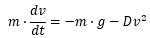
So I'm trying to figure out how to model a ball getting thrown vertically with the starting velocity v_0. So I've come up with a differential equation which I'm pretty sure is correct:
1576515377922.png

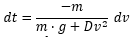
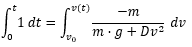
Where D is a constant. So far so good. My problem is solving this. This is my attempt:
1576515472543.png

1576515451893.png

And when i do this and isolate v(t) i get this:
1576515564441.png

First of all, can anyone confirm this? It should only be used between t=0 and when the graph cross the x-axis. Secondly: Is there another waay to solve this.
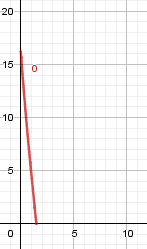
BTW. if anyone were curios the fuction looks like this (for m=0.05 D=0.00085 g=9.82 v_0=16)
1576515835423.png
 
Last edited by a moderator:
Physics news on Phys.org
MigMRF said:
So I'm trying to figure out how to model a ball getting thrown vertically with the starting velocity v_0. So I've come up with a differential equation which I'm pretty sure is correct:
View attachment 254204
Where D is a constant. So far so good. My problem is solving this. This is my attempt:
View attachment 254206
View attachment 254205
And when i do this and isolate v(t) i get this:
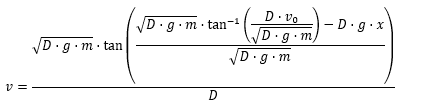
View attachment 254207
First of all, can anyone confirm this?

That looks right (although it has ##x## instead of ##t## in there), but it can be significantly simplified by cancelling terms. Try using the parameter ##\alpha = \sqrt{\frac{D}{mg}}##.

PS You could also then try ##\beta = \tan(g\alpha t)##. That will sort out the inverse tangents.

PPS can you show that your solution tends to ##v = v_0 - gt## as ##D \rightarrow 0##?
 
Last edited:
PeroK said:
That looks right (although it has ##x## instead of ##t## in there), but it can be significantly simplified by cancelling terms. Try using the parameter ##\alpha = \sqrt{\frac{D}{mg}}##.

PS You could also then try ##\beta = \tan(g\alpha t)##. That will sort out the inverse tangents.

PPS can you show that your solution tends to ##v = v_0 - gt## as ##D \rightarrow 0##?
Well not from the math, but it pretty sure it does looking at it from a graphical point of view.
1576522748945.png

In this example I've plottet the same things as before but with an v_0-g*t graph and they are pretty close. When you increase the mass they get closer and closer (drag goes down) while an increase in drag makes them go apart (with drag getting v=0 before nondrag ofc)
 
I simplified things down to:
$$v = \frac{v_0 - \frac g \alpha \tan(\alpha t)}{1 + \frac{v_0 \alpha}{ g} \tan(\alpha t)}$$
Where ##\alpha = \sqrt{\frac{Dg}{m}}##

Which might be a bit easier to work with.
 
  • Like
Likes   Reactions: MigMRF
PeroK said:
I simplified things down to:
$$v = \frac{v_0 - \frac g \alpha \tan(\alpha t)}{1 + \frac{v_0 \alpha}{ g} \tan(\alpha t)}$$
Where ##\alpha = \sqrt{\frac{Dg}{m}}##

Which might be a bit easier to work with.
Thanks! It looks better this way, that's for sure :)
 
MigMRF said:
Thanks! It looks better this way, that's for sure :)

It's not hard to get from your function to that. It might be worth it to check I haven't made any mistakes.
 
I will put it back up that you could also do a u sub where ##u=Dv## and ##a=\sqrt{mg}##. Then use an inverse trig table.
 

Similar threads

  • · Replies 7 ·
Replies
7
Views
7K
  • · Replies 11 ·
Replies
11
Views
2K
  • · Replies 13 ·
Replies
13
Views
3K
  • · Replies 11 ·
Replies
11
Views
3K
  • · Replies 1 ·
Replies
1
Views
2K
  • · Replies 2 ·
Replies
2
Views
2K
  • · Replies 13 ·
Replies
13
Views
3K
  • · Replies 11 ·
Replies
11
Views
4K
  • · Replies 4 ·
Replies
4
Views
17K
  • · Replies 8 ·
Replies
8
Views
18K