Moment of inertia of a disc using rods as differential elements

Click For Summary
SUMMARY

The discussion centers on calculating the moment of inertia of a disc using rods as differential elements, ultimately leading to the conclusion that the correct moment of inertia is \(I = \frac{1}{2}MR^2\). Participants identified that the integral setup was correct, but the evaluation was initially flawed. The use of trigonometric substitution was suggested as a more effective method for solving the integral, highlighting the importance of choosing appropriate differential elements. The original homework requirement to use rods was emphasized, despite the simpler alternative of using rings.

PREREQUISITES
  • Understanding of moment of inertia concepts
  • Familiarity with differential elements in calculus
  • Knowledge of the parallel axis theorem
  • Experience with integral calculus and trigonometric substitution
NEXT STEPS
  • Study the application of the parallel axis theorem in rotational dynamics
  • Learn about trigonometric substitution techniques in integral calculus
  • Explore the derivation of moment of inertia for various shapes, including discs and rings
  • Investigate the implications of choosing different differential elements in physics problems
USEFUL FOR

This discussion is beneficial for physics students, educators, and anyone involved in mechanical engineering or applied mathematics, particularly those focusing on rotational dynamics and moment of inertia calculations.

Hamiltonian
Messages
296
Reaction score
193
Homework Statement
find the moment of inertia of a disc using rods of variable lengths as differential element.(axis perpendicular to plane of disc and through its COM)
Relevant Equations
-
I know there are more convenient differential elements that can be chosen to compute the moment of inertia of a disc(like rings).
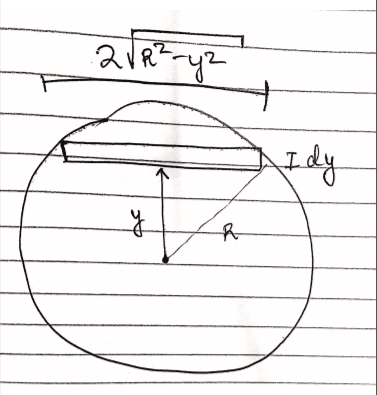
1621106503023.png

the mass of the differential element:
$$dm = (M/\pi R^2) (dA) = (M/ \pi R^2) (2\sqrt{R^2 - y^2})(dy)$$
the moment of inertia of a rod through its COM is ##(1/12)ML^2## hency by applying the parallel axis theorem :
$$dI = (1/12)(dm)(2\sqrt{R^2 - y^2})^2 + (dm)y^2$$
$$I = (\frac{2M}{3\pi R^2})\int_{-R}^{+R} (R^2 + 2y^2)\sqrt{R^2 - y^2}(dy) $$
$$I = (5/12)MR^2$$
where am I going wrong?
 
Physics news on Phys.org
Looks like you set it up correctly. Are you sure you evaluated the integral correctly?
 
  • Like
Likes   Reactions: Delta2 and Hamiltonian
I agree with @TSny , the integral is not correctly performed.
 
  • Like
Likes   Reactions: Hamiltonian
TSny said:
Looks like you set it up correctly. Are you sure you evaluated the integral correctly?
$$I = (\frac{2M}{3\pi R^2})\int_{-R}^{+R} (R^2 + 2y^2)\sqrt{R^2 - y^2}(dy) $$
$$I = (\frac{2M}{3\pi R^2})\int_{-R}^{+R} (R^2\sqrt{R^2 - y^2} + 2y^2\sqrt{R^2 - y^2} ) (dy) $$

$$I = \frac{2M}{3\pi R^2} [R^2 (\frac{\pi R^2}{2}) + 2(\frac{\pi R^4}{8})] = (1/2)MR^2 $$
i used wolfram alpha to do it now i am getting the correct answer thanks!
 
  • Like
Likes   Reactions: TSny
Hamiltonian299792458 said:
$$I = (\frac{2M}{3\pi R^2})\int_{-R}^{+R} (R^2 + 2y^2)\sqrt{R^2 - y^2}(dy) $$
$$I = (\frac{2M}{3\pi R^2})\int_{-R}^{+R} (R^2\sqrt{R^2 - y^2} + 2y^2\sqrt{R^2 - y^2} ) (dy) $$

$$I = \frac{2M}{3\pi R^2} [R^2 (\frac{\pi R^2}{2}) + 2(\frac{\pi R^4}{8})] = (1/2)MR^2 $$
i used wolfram alpha to do it now i am getting the correct answer thanks!
Note that solving the integral involves a trig substitution which effectively converts it to having chosen the more sensible differential element in the first place. Is that a useful exercise?
Perhaps it is a lesson that when a trig substitution helps with an integral one should consider what it means in terms of the original analysis.
 
  • Like
  • Informative
Likes   Reactions: Steve4Physics, Hamiltonian, Delta2 and 1 other person
haruspex said:
Note that solving the integral involves a trig substitution which effectively converts it to having chosen the more sensible differential element in the first place. Is that a useful exercise?
Perhaps it is a lesson that when a trig substitution helps with an integral one should consider what it means in terms of the original analysis.
The original homework statement specifically requires use of "rods of variable lengths as differential element".

Is there a better approach than that used by the OP? Am I missing something obvious?

Edited - typo'.
 
Steve4Physics said:
The original homework statement specifically requires use of "rods of variable lengths as differential element".

Is there a better approach than that used by the OP? Am I missing something obvious?

Edited - typo'.
you could use the differentiable elements as rings.

$$dm = \frac{M}{\pi R^2} 2\pi x dx$$
the moment of inertia of a ring is ##= MR^2##
$$dI = (dm)x^2$$
$$I = \int_0^R \frac{M}{\pi R^2} 2\pi x^3 dx$$
$$I = (1/2)MR^2$$
the resulting integral is much simpler in this case
 
Hamiltonian299792458 said:
you could use the differentiable elements as rings.

$$dm = \frac{M}{\pi R^2} 2\pi x dx$$
the moment of inertia of a ring is ##= MR^2##
$$dI = (dm)x^2$$
$$I = \int_0^R \frac{M}{\pi R^2} 2\pi x^3 dx$$
$$I = (1/2)MR^2$$
the resulting integral is much simpler in this case
Yes, I know! (And in Post #1, you'd already mentioned that you realized this.)

But the original homework asks for an analysis in terms of 'rods'. Whoever set the homework specifically didn't want you to use rings - presumably to make the exercise a little more demanding.

I was pointing out that your method is the only one (as faras I can see) that properly answers the original question. So don't be tempted to hand-in a solution based on the ring method, except perhaps as an addendum to demonstrate that you know that this is better approach.
 
Steve4Physics said:
The original homework statement specifically requires use of "rods of variable lengths as differential element".

Is there a better approach than that used by the OP? Am I missing something obvious?

Edited - typo'.
I'm sure the OP approach satisfies the given requirement in the way the setter expected. Just pointing out that the algebra can't help but switch to the standard route under the covers. I don't think there's a way to avoid it.
 
  • Like
Likes   Reactions: Steve4Physics

Similar threads

  • · Replies 15 ·
Replies
15
Views
1K
  • · Replies 3 ·
Replies
3
Views
3K
  • · Replies 13 ·
Replies
13
Views
3K
Replies
2
Views
2K
Replies
17
Views
2K
  • · Replies 3 ·
Replies
3
Views
1K
  • · Replies 4 ·
Replies
4
Views
4K
  • · Replies 8 ·
Replies
8
Views
2K
Replies
25
Views
2K
  • · Replies 12 ·
Replies
12
Views
2K