Moment of inertia of a disk about an axis not passing through its CoM

Click For Summary
SUMMARY

The discussion centers on calculating the moment of inertia of a disk about an axis not passing through its center of mass (CoM). Two approaches are presented: the first calculates the moment of inertia as ##I_o = 25 MR^2## by treating the disk as a particle at its CoM, while the second uses the parallel axis theorem, resulting in ##I_o = \frac{51MR^2}{2}##. The consensus is that the parallel axis theorem is not applicable in this scenario because the disk retains its orientation while rotating about the rod, indicating it is not simply a particle at its CoM.

PREREQUISITES
  • Understanding of moment of inertia concepts
  • Familiarity with the parallel axis theorem
  • Knowledge of rotational dynamics
  • Basic principles of rigid body motion
NEXT STEPS
  • Study the derivation of the parallel axis theorem in detail
  • Explore advanced rotational dynamics involving rigid bodies
  • Learn about angular momentum and its relation to moment of inertia
  • Investigate practical applications of moment of inertia in engineering contexts
USEFUL FOR

Physics students, mechanical engineers, and anyone studying rotational dynamics or analyzing systems involving rigid bodies and their moments of inertia.

vcsharp2003
Messages
913
Reaction score
179
Homework Statement
A disk of radius R and mass M is connected to a rod that is rotating about O. The rod is rotating about at an angular velocity of ##\omega## about O. What would be the moment of inertia of the rod+disk system about an axis through O and perpendicular to plane of rotation of the rod. Assume the rod is massless and the disk is not rotating about it's center of mass axis.
Relevant Equations
##I=\frac {MR^2} {2}## for a disk about an axis through its cm and perpendicular to the disk
## I_o = I_{cm} + M R^2##
I have come up with two different approaches, but I'm not sure which one is correct since they give different answers.
We use the following equation to get the total moment of inertia.

##I_o## = moment of inertia of disk about O axis + moment of inertia of road about O axis

Approach 1:

Consider the disk as a particle at it's center of mass.
##I_o = M (5R)^2 + 0= 25 MR^2##

Approach 2:

We use parallel axis theorem to get moment of inertia of disk about O axis.

##I_o= \frac {MR^2} {2} + M (5R)^2 + 0 \\= \frac {51MR^2} {2}##
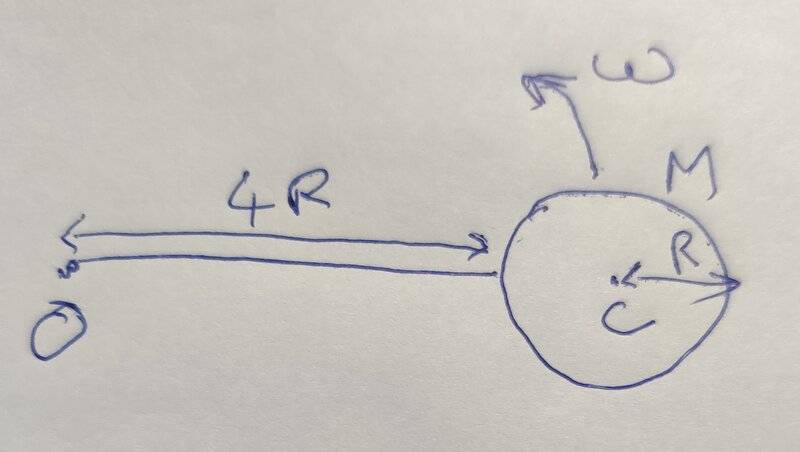
IMG_20220601_154420__01.jpg
 
Last edited:
Physics news on Phys.org
vcsharp2003 said:
Consider the disk as a particle at it's center of mass.
The disk is not a particle at its center of mass.
 
Orodruin said:
The disk is not a particle at its center of mass.
If an object is moving at an angular velocity, and its of uniform density then can we not assume it's like a particle at its cm rotating about O in this scenario?
 
vcsharp2003 said:
If an object is moving at an angular velocity, and its of uniform density then can we not assume it's like a particle at its cm rotating about O in this scenario?
No.
E.g. consider a mass 2m at radius r. MoI=2mr2.
Now split it into mass m at radius 0 and mass m at radius 2r. Centre of mass has not changed but MoI=4mr2.

But I note this in post #1: "the disk is not rotating about its center of mass axis."
Technically, that means it retains the same orientation even though its centre rotates about O. I.e. if the rod is rotating at ##\omega## then the disc is rotating at the same rate in the opposite direction relative to the rod. In that case you can treat it as a point particle.
But maybe it means that it is attached rigidly to the rod and so rotates about its own centre at the same rate that it rotates about O. In that case you need to apply the parallel axis theorem.
 
  • Like
Likes   Reactions: vcsharp2003
haruspex said:
Technically, that means it retains the same orientation even though its centre rotates about O
Yes, it retains its orientation. So, we must assume its a particle.
But still, I cannot explain as to why the parallel axis theorem approach is not correct in this case.
 
How does your diagram fits the description "centered at O"? Is this the original text or/and figure?
 
  • Like
Likes   Reactions: vcsharp2003
nasu said:
How does your diagram fits the description "centered at O"? Is this the original text or/and figure?
Thanks for pointing out the mistake. I have corrected it so it doesn't say that. This is a made up problem by me in which I am trying to understand the right way to find moment of inertia of a system.
 
haruspex said:
Technically, that means it retains the same orientation even though its centre rotates about O. I.e. if the rod is rotating at ω then the disc is rotating at the same rate in the opposite direction relative to the rod. In that case you can treat it as a point particle.
This disk is not rotating about its center of mass axis. It simply moves in a circular orbit and is connected to rod rigidly. Its like a stone tied to the end of a string and the stone is moving in a circular path.
 
vcsharp2003 said:
Yes, it retains its orientation.

vcsharp2003 said:
and is connected to rod rigidly.
You cannot have it both ways. If it retains its orientation as the rod rotates then it must be mounted on an axle, not rigidly attached.
 
  • Like
Likes   Reactions: vcsharp2003
  • #10
haruspex said:
You cannot have it both ways. If it retains its orientation as the rod rotates then it must be mounted on an axle, not rigidly attached.
Ok, I get that. But, why the parallel axis theorem would not be applicable in this problem? I thought it always applies for two parallel axes provided one of the axes is passing through the center of mass of disk.
 
  • #11
vcsharp2003 said:
Ok, I get that. But, why the parallel axis theorem would not be applicable in this problem? I thought it always applies for two parallel axes provided one of the axes is passing through the center of mass of disk.
Yes, but it only applies if the object is rotating as a body about that parallel axis.
More generally, suppose the mass centre of the body rotates at radius r at rate ##\omega_b## about some point, but the orientation of the body rotates at rate ##\omega_c## about the body's mass centre. Then the angular momentum is ##mr^2\omega_r+I_c\omega_c##. The parallel axis theorem is just the special case where the rotation rates are the same.
 
  • Like
Likes   Reactions: vcsharp2003
  • #12
ParallelAxesTheorem.png
 
  • Like
Likes   Reactions: nasu, vcsharp2003 and TSny

Similar threads

  • · Replies 28 ·
Replies
28
Views
2K
Replies
2
Views
2K
  • · Replies 45 ·
2
Replies
45
Views
4K
  • · Replies 13 ·
Replies
13
Views
3K
Replies
25
Views
2K
Replies
52
Views
4K
  • · Replies 21 ·
Replies
21
Views
2K
  • · Replies 12 ·
Replies
12
Views
2K
  • · Replies 5 ·
Replies
5
Views
4K
Replies
8
Views
2K