Moment of inertia of a thin, square plate

  • Thread starter Thread starter simphys
  • Start date Start date
  • Tags Tags
    Moment of inertia
Click For Summary

Homework Help Overview

The discussion revolves around the calculation of the moment of inertia for a thin, square plate, focusing on the integrals involved in the derivation of the moment of inertia about the x-axis.

Discussion Character

  • Exploratory, Conceptual clarification, Mathematical reasoning, Assumption checking

Approaches and Questions Raised

  • Participants are questioning the representation and correctness of the integrals used in the derivation, particularly the presence of terms like ##r^2## and the limits of integration. There are discussions about expressing ##r^2## in terms of ##x## and/or ##y##, and the implications of using multiple integrals.

Discussion Status

The conversation is ongoing, with participants providing insights and corrections regarding the integrals and their setup. Some participants are attempting to clarify the reasoning behind the use of two integrals, while others express confusion about the derivation process and the assumptions made.

Contextual Notes

There appears to be some misunderstanding regarding the dimensionality of the problem, as participants discuss the need to consider mass elements and the integration over the volume of the object. The original poster has not provided a clear attempt at the problem, which is affecting the flow of assistance.
simphys
Messages
327
Reaction score
46
Homework Statement
the moment of inertia about an axis through the center of and perpendicular to a uniform, thin square plate. mass M and dimension L x L.
Relevant Equations
d
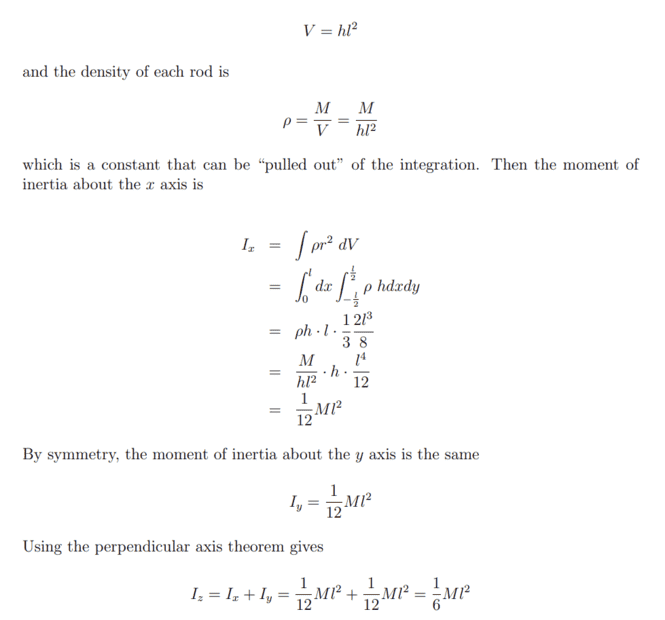
I don't really understand what the 2 integrals (dx and dxdy) for I_x represent. Could I get some explanation here please? Thanks in advance.
1692111880738.png
 
Physics news on Phys.org
The second line in the derivation of ##I_x## has one ##dx## too many. Is that what bothers you?
 
  • Like
Likes   Reactions: simphys
Also, the second line is missing the ##r^2## and the limits of integration for ##x## are not correct. Keep in mind that this integral represents the moment of inertia about the x-axis, and the x-axis lies in the plane of the thin plate. Think about how to express ##r^2## in terms of ##x## and/or ##y##.
 
  • Like
Likes   Reactions: simphys
If you put in the correct $$r^2=x^2+ y^2$$ in the second line then you see that the x and y integrals give you the "perpendicular axis theorem" without issue. Please redo this.
 
  • Like
Likes   Reactions: simphys
TSny said:
Also, the second line is missing the ##r^2## and the limits of integration for ##x## are not correct. Keep in mind that this integral represents the moment of inertia about the x-axis, and the x-axis lies in the plane of the thin plate. Think about how to express ##r^2## in terms of ##x## and/or ##y##.
Yep, that is what I did I expressed in terms of y^2 and then went ahead with that. But I just didn't understand how this solution came about basically.
 
hutchphd said:
If you put in the correct $$r^2=x^2+ y^2$$ in the second line then you see that the x and y integrals give you the "perpendicular axis theorem" without issue. Please redo this.
this is the solution. not mine :)
 
So where is your attempt? How are we to help?
 
  • Like
Likes   Reactions: simphys
hutchphd said:
So where is your attempt? How are we to help?
well.. that is exactly what I don't understand..
I didn't understand why the solution has used two integrals in such a way.. I haven't used a volume integral or smtn. I did differently by using a mass element and summing over that with one definite integral.
 
One must sum each mass element (mass density times volume element) over the entire volume of the object and scaled by the square of the distance to the chosen axis . The world is three dimensional and so is the integral. Show us your work.
 

Similar threads

Replies
2
Views
2K
  • · Replies 3 ·
Replies
3
Views
1K
  • · Replies 16 ·
Replies
16
Views
2K
Replies
25
Views
2K
  • · Replies 13 ·
Replies
13
Views
3K
Replies
52
Views
5K
Replies
3
Views
2K
  • · Replies 27 ·
Replies
27
Views
5K
  • · Replies 28 ·
Replies
28
Views
2K
Replies
8
Views
14K