Moment of inertia of T bar about 3 axes

Click For Summary
SUMMARY

The discussion centers on calculating the moment of inertia (MoI) of a T-shaped bar about three axes. The participants utilize the equation I = Icm + md², where Icm is the moment of inertia about the center of mass, and d is the distance from the center of mass to the axis of rotation. There is a consensus that the initial calculation of the center of mass (Xcm = 0.022 m) is incorrect, with alternative values proposed, including ycm = 2.17 cm. The importance of correctly identifying the axes of symmetry and the center of mass is emphasized for accurate MoI calculations.

PREREQUISITES
  • Understanding of moment of inertia calculations
  • Familiarity with center of mass concepts
  • Knowledge of rotational symmetry in physics
  • Proficiency in using LaTeX for mathematical expressions
NEXT STEPS
  • Study the derivation of the moment of inertia for composite shapes
  • Learn about the parallel axis theorem in physics
  • Explore LaTeX formatting for mathematical equations
  • Investigate the properties of reflective and rotational symmetry in mechanics
USEFUL FOR

Physics students, mechanical engineers, and anyone involved in structural analysis or dynamics who needs to calculate moments of inertia for complex shapes.

so_gr_lo
Messages
69
Reaction score
10
Homework Statement
A bar of length 10cm and diameter 2cm is positioned vertically, it has another bar of length 5cm and diameter 2cm attached at a right angle to its middle. The density is 800 kg m^-3. Find the position of the centre of mass. Then find the moments of inertia about 3 perpendicular axis through its centre of mass.
Relevant Equations
Xcm = m1x1 + m2x2 / m1 + m2

I = mr^2/2 (for a bar)
Using the equation above I get Xcm = 0.022 m. I set the origin be at the left of the vertical rod parallel to its centre of mass as in the diagram. But I’m not sure if the equation is correct for 3d.
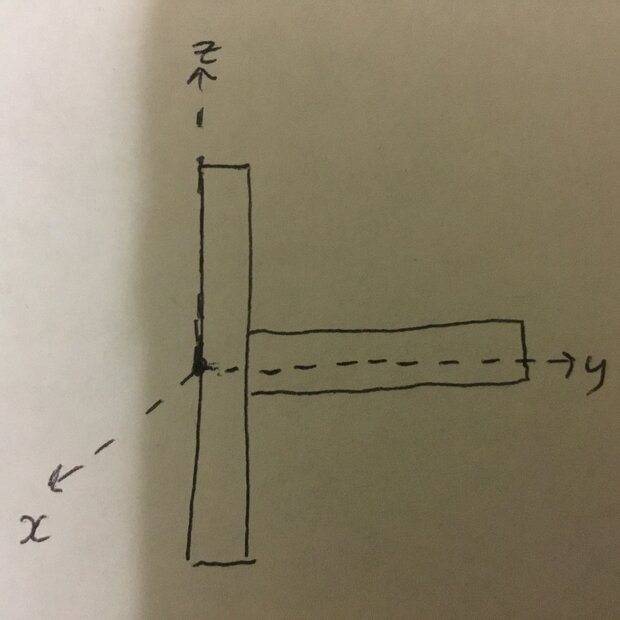
FE34595A-4E91-4D8E-B601-ED7ADCC50F24.jpeg

for the moments of inertia I am using

I = Icm + md^2
= (mr^2)/2 + md^2

where d is the distance from the centre of mass to the axis. Does this equation seem correct?
 
Physics news on Phys.org
so_gr_lo said:
I = Icm + md^2
= (mr^2)/2 + md^2

where d is the distance from the centre of mass to the axis. Does this equation seem correct?
I don't believe so. Please elaborate on your calculations. Also, figure out how to format your mathematics using Latex so it is easily read.

##\bar{x}## looks good.

See LaTeX Guide
 
Last edited:
  • Like
Likes   Reactions: topsquark
so_gr_lo said:
I = mr^2/2 (for a bar)
About what axis?
 
  • Like
Likes   Reactions: topsquark
haruspex said:
About what axis?
Aha! good point.
 
haruspex said:
About what axis?
thats the result for a cylinder about its symmetry axis, not sure if that’s the axis I’m supposed to use
 
  • Like
Likes   Reactions: malawi_glenn
so_gr_lo said:
thats the result for a cylinder about its symmetry axis, not sure if that’s the axis I’m supposed to use
It's not a "which one" its multiple.
 
  • Like
Likes   Reactions: topsquark
so_gr_lo said:
thats the result for a cylinder about its symmetry axis, not sure if that’s the axis I’m supposed to use
I assume you mean its axis of rotational symmetry. There are also two axes of reflective symmetry normal to that one and to each other.
If the rotation is about the axis of rotational symmetry for one, which of its axes is the other rotating about?
 
  • Like
Likes   Reactions: erobz and topsquark
The diagram shows one axis not crossing the center of mass.
Locating that center should be the first step.
 
Lnewqban said:
The diagram shows one axis not crossing the center of mass.
Locating that center should be the first step.
The question specifically asks for the centre of mass and the OP found it correctly in post #1.
The axes the solver chooses for the purpose of analysis need not be those about which the MoI is requested.
 
  • #10
haruspex said:
The question specifically asks for the centre of mass and the OP found it correctly in post #1.
The axes the solver chooses for the purpose of analysis need not be those about which the MoI is requested.
It seems to me that the shown result Xcm = 0.022 m in post #1 is not numerically correct.
Also, according to the shown disposition of the axes in the diagram, the center of mass should not be spatially located on the x axis.

Could you please, explain your following statement a little more for me?:
“There are also two axes of reflective symmetry normal to that one and to each other.“
Sorry, I can only see one.
 
  • #11
Lnewqban said:
It seems to me that the shown result Xcm = 0.022 m in post #1 is not numerically correct.
Also, according to the shown disposition of the axes in the diagram, the center of mass should not be spatially located on the x axis.

Could you please, explain your following statement a little more for me?:
“There are also two axes of reflective symmetry normal to that one and to each other.“
Sorry, I can only see one.
Oh I see. ##x_{cm}## is not the proper label. Per the diagram they found ##y_{cm}##. I think we are assuming ##x_{cm} = 0 = z_{cm}##.
 
  • #12
erobz said:
Oh I see. ##x_{cm}## is not the proper label. Per the diagram they found ##y_{cm}##. I think we are assuming ##x_{cm} = 0 = z_{cm}##.
Yes.
I may be wrong, but I am getting ##y=1.83~cm## as the location for CM measured from the left surface of the 10 cm vertical rod (plane x-z).
 
  • #13
Lnewqban said:
Yes.
I may be wrong, but I am getting ##y=1.83~cm## as the location for CM measured from the left surface of the 10 cm vertical rod (plane x-z).
Do you mean ##18.3 \rm{cm}##? I got ## y_{cm} = 21.7 \rm{cm}## How are you assuming they are connected ( I'm assuming they are basically set next to each other and welded)?
 
  • #14
Lnewqban said:
Could you please, explain your following statement a little more for me?:
“There are also two axes of reflective symmetry normal to that one and to each other.“
I should have written "a plane of rotational symmetry and two planes of reflective symmetry ".
Lnewqban said:
It seems to me that the shown result Xcm = 0.022 m in post #1
I had not noticed @so_gr_lo's confusion between the x and y axes.
 
  • Like
Likes   Reactions: Lnewqban
  • #15
erobz said:
Do you mean ##18.3 \rm{cm}##? I got ## y_{cm} = 21.7 \rm{cm}## How are you assuming they are connected ( I'm assuming they are basically set next to each other and welded)?
It is not entirely clear whether the cross section is circular or square. It says "diameter", but I would have called them rods if circular; bar suggests square. And welding them together would be tricky if rods.
 
  • #16
erobz said:
Do you mean ##18.3 \rm{cm}##? I got ## y_{cm} = 21.7 \rm{cm}## How are you assuming they are connected ( I'm assuming they are basically set next to each other and welded)?
As I understand it (again, perhaps wrongly), the biggest dimensions of the assembled “T” are 7 cm and 10 cm.

D0921E8C-90C3-40BA-BF2D-2BFC1427E3D8.jpeg
 
Last edited:
  • Like
Likes   Reactions: erobz
  • #17
haruspex said:
It is not entirely clear whether the cross section is circular or square. It says "diameter", but I would have called them rods if circular; bar suggests square. And welding them together would be tricky if rods.
I assume circular rods (as in cylinders).

And welding them together would be tricky if rods

I worked in a steel mill... believe me when I say...It can be done quite easily!I think another interpretation is that this is a solid formed piece where the end of the horizontal rod is inserted into the vertical rod up to its midpoint.
 
  • Like
Likes   Reactions: Lnewqban
  • #18
Lnewqban said:
As I understand it (again, perhaps wrongly), the biggest dimensions of the assembled “T” are 7 cm and 10 cm.
No, that's how I assumed it too. Maybe I made a computational mistake.
 
  • #19
erobz said:
No, that's how I assumed it too. Maybe I made a computational mistake.
The mass of the vertical rod is two times the mass of the horizontal one.
 
  • #20
So, ignoring the weld. Here is what I did:

$$ y_{cm} = \frac{\rho \frac{\pi D^2}{4} \cdot 10 \cdot 1 + \rho \frac{\pi D^2}{4} \cdot 5 \cdot ( 2 + 2.5) }{ \rho \frac{\pi D^2}{4} ( 10 + 5 ) } = \frac{10+5\cdot(2+2.5)}{15} \approx 2.17 \rm{cm}$$

I did make a mistake. It was ##2.17 \rm{cm}## not ##21.7 \rm{cm}##. We still get different results as you are getting ##1.83 \rm{cm}## ?
 
Last edited:
  • Like
Likes   Reactions: Lnewqban
  • #21
haruspex said:
I should have written "a plane of rotational symmetry and two planes of reflective symmetry ".
Thank you much, @haruspex
 
  • #22
erobz said:
So, ignoring the weld. Here is what I did:

$$ y_{cm} = \frac{\rho \frac{\pi D^2}{4} \cdot 10 \cdot 1 + \rho \frac{\pi D^2}{4} \cdot 5 \cdot ( 2 + 2.5) }{ \rho \frac{\pi D^2}{4} ( 10 + 5 ) } = \frac{10+5\cdot(2+2.5)}{15} \approx 2.17 \rm{cm}$$

I did make a mistake. It was ##2.17 \rm{cm}## not ##21.7 \rm{cm}##. We still get different results as you are getting ##1.83 \rm{cm}## ?
Your calculation is correct; mine was not.
Please, see attached scaled diagram (PDF format below).
Thank you very much, @erobz
Bars COM.jpg
 

Attachments

  • Like
Likes   Reactions: erobz

Similar threads

  • · Replies 3 ·
Replies
3
Views
1K
  • · Replies 4 ·
Replies
4
Views
2K
Replies
25
Views
2K
Replies
11
Views
3K
  • · Replies 28 ·
Replies
28
Views
2K
Replies
2
Views
2K
  • · Replies 4 ·
Replies
4
Views
2K
  • · Replies 40 ·
2
Replies
40
Views
6K
  • · Replies 13 ·
Replies
13
Views
3K
  • · Replies 3 ·
Replies
3
Views
1K