Moment of inertia (Perpendicular axis theorem)

Click For Summary
SUMMARY

The discussion centers on the application of the perpendicular axis theorem in calculating the moment of inertia for a 2D lamina. The user derived the moment of inertia about the axis of symmetry, denoted as \(I_z = \frac{3m}{10}\frac{(R^5-r^5)}{(R^3-r^3)}\). According to the perpendicular axis theorem, \(I_z = I_x + I_y\) with \(I_x = I_y\), leading to the derived values \(I_x = I_y = \frac{3m}{20}\frac{(R^5-r^5)}{(R^3-r^3)}\). The user expresses confusion regarding the theorem's applicability, noting that it is only valid for 2D laminae.

PREREQUISITES
  • Understanding of moment of inertia calculations
  • Familiarity with the perpendicular axis theorem
  • Knowledge of 2D lamina properties
  • Basic principles of rotational dynamics
NEXT STEPS
  • Study the derivation of the perpendicular axis theorem in detail
  • Explore applications of moment of inertia in various geometries
  • Learn about 3D moment of inertia calculations
  • Investigate the implications of symmetry in physical systems
USEFUL FOR

Students and professionals in physics and engineering, particularly those focusing on mechanics and dynamics, will benefit from this discussion on the moment of inertia and the perpendicular axis theorem.

andyonassis
Messages
4
Reaction score
1
Homework Statement
Find the moment of inertia of frustum perpendicular to axis of symmetry about the top with radius r and bottom with radius R
Relevant Equations
I = (3m/10)[(R^5-r^5)/(R^3-r^3)] (about axis of symmetry)
So i derived the moment of inertia about the axis of symmetry (with height h) and I am confused about the perpendicular axis theorem.
The problem ask to find the moment of inertia perpendicular to axis of symmetry
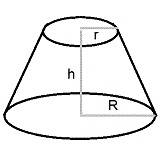
conical-frustum.jpg

So the axis about h, i labelled as z, the two axis that are perpendicular to z, i labelled as x and y.
I already found $$I_{z} = (3m/10)\frac{(R^5-r^5)}{(R^3-r^3)]}$$
So according to perpendicular axis theorem,
$$I_z = I_x + I_y$$
and because of symmetry $$I_x = I_y$

So i derived a solution for Ix and Iy
$$Ix = I_y = (3m/20)\frac{(R^5-r^5)}{(R^3-r^3)]}$$
I'm confused as the theorem also says $$I_x = I_y+I_z$$ and $$I_y = I_x+I_z$$
 
Last edited:
Physics news on Phys.org
Perpendicular axis theorem only applies to 2D lamina!
 
  • Like
Likes andyonassis and Hamiltonian
The book claims the answer is that all the magnitudes are the same because "the gravitational force on the penguin is the same". I'm having trouble understanding this. I thought the buoyant force was equal to the weight of the fluid displaced. Weight depends on mass which depends on density. Therefore, due to the differing densities the buoyant force will be different in each case? Is this incorrect?

Similar threads

Replies
52
Views
4K
Replies
25
Views
2K
  • · Replies 28 ·
Replies
28
Views
2K
Replies
2
Views
2K
  • · Replies 12 ·
Replies
12
Views
2K
Replies
11
Views
3K
  • · Replies 8 ·
Replies
8
Views
1K
  • · Replies 4 ·
Replies
4
Views
2K
Replies
8
Views
2K
  • · Replies 40 ·
2
Replies
40
Views
6K