Moment of inertia with system of rods

Click For Summary
SUMMARY

The discussion focuses on calculating the moment of inertia for a system of three rods arranged in an inverted U shape. The vertical rods have equal mass, while the horizontal rod has a mass three times greater. The correct moments of inertia for various axes are established as follows: (a) 2 ML², (2/3) ML², and 2 ML²; (b) (11/12) ML² and (3/4) ML²; (c) (35/12) ML², (17/12) ML², and (35/12) ML²; (d) (73/60) ML². The discussion highlights the importance of using continuous definitions of rotational inertia rather than treating rods as point masses.

PREREQUISITES
  • Understanding of moment of inertia concepts
  • Familiarity with rotational dynamics
  • Knowledge of integration for continuous mass distributions
  • Basic principles of mechanics involving rigid bodies
NEXT STEPS
  • Study the derivation of moment of inertia for continuous bodies
  • Learn about parallel axis theorem applications in rotational dynamics
  • Explore the differences between point mass and distributed mass calculations
  • Investigate the use of integrals in calculating moments of inertia
USEFUL FOR

Students studying physics, particularly those focusing on mechanics and rotational dynamics, as well as educators seeking to clarify concepts related to moment of inertia in rigid body systems.

symbolic
Messages
2
Reaction score
0

Homework Statement


Three slim rods with the same length L are placed in a inverted U shape, as the figure shows. The masses of the vertical rods are the same, while the third bar has the mass 3 times bigger than the first or the second rod. The rods' thickness should be ignored. Find the moment of inercia of the system in relation to the following axes:

(a) containing each bar;
(b) parallel to the plane of the page and perpendicular to the bars, going through their centers of mass;
(c) perpendicular to the plane of the page, going through the center of mass of each bar;
(d) perpendicular to the plane of the page, going through the center of mass of the system xCM = L / 2 and yCM = 4 L / 5 taking the origin as the lowest point in the left vertical bar;

Answers: (a) 2 ML2, (2/3) ML2 e 2 ML2 ; (b) (11/12) ML2 e (3/4) ML2; (c) (35/12) ML2 , (17/12) ML2 e (35/12) ML2; (d) (73/60) ML2.

(question was translated, let me know if something is difficult to understand)

imag.png


Homework Equations


00162d0dc4ecf6dade58332e43a0161f1185cf62

5dc9293f241ec13cf222a361999f68a639fe4d8b


The Attempt at a Solution


I tried to solve question (a) considering each bar as a point, that failed however.

Calculating Icm of the first bar with an axis going through it

Icm = M(0²) + 3M(L/2)² + M(M(0²)
Icm = 3/4ML²

I tried a few variations of this but couldn't reach the answer 2 ML2, so now I'm stuck. :oldfrown: Any help is appreciated.
 

Attachments

  • imag.png
    imag.png
    1.2 KB · Views: 448
Physics news on Phys.org
For some reason it gives me an errror when I try to edit the topic. Here are the correct answers:

(a) 2 ML², (2/3) ML² e 2 ML² ; (b) (11/12) ML² e (3/4) ML²; (c) (35/12) ML² , (17/12) ML² e (35/12) ML²; (d) (73/60) ML².

and M(M(0²) should be M(0²)
 
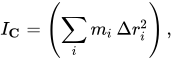
Your discrete definition of rotational inertia also has a continuous form which should be used for continuous bodies, like rods.

The inertia of the middle bar about one of the edge bars comes from that integral over all the mass. The inertia is not the same if you replace the body with a point-mass at its center, which is what your math seems to be doing.

Your math also seems to say that the inertia of one edge bar about the other edge bar is zero?
 

Similar threads

  • · Replies 21 ·
Replies
21
Views
3K
Replies
2
Views
2K
  • · Replies 4 ·
Replies
4
Views
2K
Replies
10
Views
3K
  • · Replies 12 ·
Replies
12
Views
2K
Replies
8
Views
2K
  • · Replies 3 ·
Replies
3
Views
1K
  • · Replies 5 ·
Replies
5
Views
2K
  • · Replies 15 ·
Replies
15
Views
2K
Replies
3
Views
2K