What is the Moment of Inertia of a Slender Rod in a Cable System?

Click For Summary

Homework Help Overview

The problem involves a uniform beam supported by cables, specifically focusing on the effects of cable failure on the forces acting on the system. The subject area pertains to dynamics and rotational motion, particularly the concept of moment of inertia in relation to torque and angular acceleration.

Discussion Character

  • Conceptual clarification, Assumption checking, Mathematical reasoning

Approaches and Questions Raised

  • The original poster attempts to understand the discrepancy in the moment of inertia values used in their calculations compared to those found in an external solution. Some participants discuss the importance of consistency in the choice of axis for torque and moment of inertia.

Discussion Status

The discussion is active, with participants providing insights into the relationship between torque and moment of inertia. There is an acknowledgment of different approaches to the problem, and some guidance has been offered regarding the need for consistency in the axis of rotation.

Contextual Notes

Participants are exploring the implications of using different axes for calculating moment of inertia and torque. The original poster expresses confusion regarding the correct application of these concepts, indicating a potential gap in understanding the underlying principles.

LiviaPimentel
Messages
2
Reaction score
0

Homework Statement


The uniform beam shown in the IMAGE below has a weight W. If it is originally resting while supported on A and B by cables, determine the pull on cable A if cable B suddenly fails. Admit that the beam is a slender rod.
IMAGE:
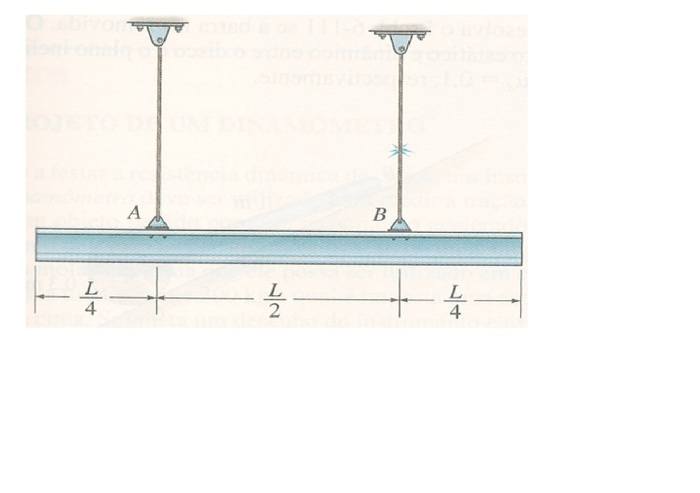
pexels-photo-301014.jpe


Homework Equations


TotalTorque=I*α →TotalTorque= T*L/4=I*α ; α=a/(L/4) ; in which a=acceleration of the rod

W - T = m*a

W-T = m*T*L^2/(16*I)

The Attempt at a Solution


Well, in my attempting of solving the problem, I considered that the moment of inertia utilized
in these equations is equal to m*(L^(2)/3). This is the moment of inertia of a bar that rotates around a point of its end. What I can not understand is why the teacher who provided the solution of this problem on the internet considered that I = m*(L^(2)/12), that is the moment of inertia of a bar that rotates around its center.

Can someone tell me why my way of thinking is wrong? (is it wrong?)

Thanks!
 
Physics news on Phys.org
This problem can be solved by using a basic idea that angular acceleration is same for all possible axes. If you take torque about centre and divide it by MOI about centre , that must be equal to same ratio about point of suspension.

Both axes will have either one of the forces absent from the equation.
 
  • Like
Likes   Reactions: LiviaPimentel
LiviaPimentel said:
why my way of thinking is wrong?
You can do it either way as long as you are consistent. The axis for the MoI must be the same as the axis for the torque.
Your
LiviaPimentel said:
T*L/4=I*α
takes the axis to be the mass centre of the rod, so that fixes the value of I to be used.
If you want to use the MoI about A then use the torque about A, WL/4.
 
  • Like
Likes   Reactions: LiviaPimentel
Thank you, Ashish Dogra and haruspex!
Now I understand it, thanks to you!

=)
 

Similar threads

Replies
2
Views
2K
  • · Replies 8 ·
Replies
8
Views
1K
  • · Replies 13 ·
Replies
13
Views
3K
  • · Replies 11 ·
Replies
11
Views
1K
  • · Replies 28 ·
Replies
28
Views
2K
  • · Replies 12 ·
Replies
12
Views
2K
  • · Replies 4 ·
Replies
4
Views
2K
Replies
11
Views
4K
  • · Replies 21 ·
Replies
21
Views
3K
  • · Replies 16 ·
Replies
16
Views
2K