Moment of intertia for corrugated pipes

Click For Summary
SUMMARY

The discussion focuses on calculating the Moment of Inertia (MOI) for corrugated hollow pipes, specifically a solid wall main pipe with a smaller diameter hollow plastic pipe spirally welded. The MOI is essential for determining pipe stiffness and deflection under load. Participants suggest using unit moment of inertia calculations and parallel axis theory for more accurate results. Additionally, commercially produced pipes often have published tables containing relevant data.

PREREQUISITES
  • Understanding of Moment of Inertia calculations
  • Familiarity with parallel axis theorem
  • Knowledge of pipe stiffness concepts
  • Access to engineering tables for commercially produced pipes
NEXT STEPS
  • Research Moment of Inertia formulas for hollow and corrugated structures
  • Learn about the application of parallel axis theorem in structural engineering
  • Explore pipe stiffness calculations and their implications in design
  • Review engineering tables for standard values of commercially produced corrugated pipes
USEFUL FOR

Engineers, structural analysts, and designers involved in the calculation and design of flexible corrugated pipes and similar structures.

square_1
Messages
2
Reaction score
0
Hi,

I am struggling to find forumula for Moment of Inertia for corrugated hollow pipes somewhat as shown in the picture.

Main Pipe is made of Solid wall construction over which smaller diameter hollow plastic pipe is spairally welded.

Any approximate calculations will also help. Thanks, Aktan
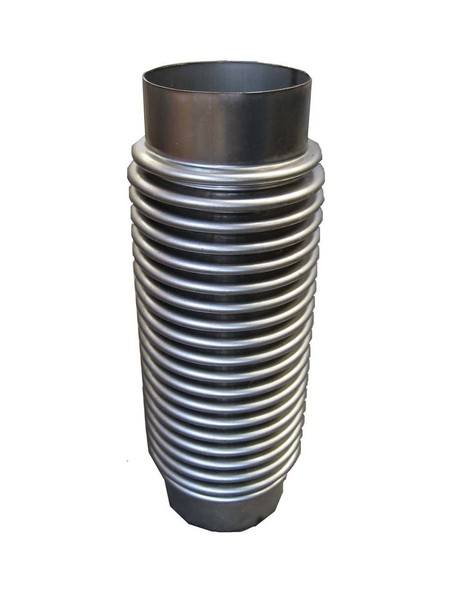
Corrugated-Pipe.jpg
 
Engineering news on Phys.org


That's a bellows that's designed to be flexible, why do you want a MOI for it?


Mech_Engineer said:
That's a bellows that's designed to be flexible, why do you want a MOI for it?

Yes , we have flexible corrugated plastic pipes somewhat similar to given in picture. I require MOI to calculate pipe stiffness, that will be used further to calculate pipe deflection under a given load.

Thanks
 
Normally you'd just calculate the a unit moment of inertia, in^4/in and depending on how perfect you want the value, you either approximate it as the inner tube if it is a simple pipe with the corrugations applied to the outside as stiffeners, and use parallel axis theory to combine. Most commerically produced pipe have tables published with all this data.

http://www.dot.ca.gov/hq/esc/techpu...idge-design-specifications/page/section12.pdf
 

Similar threads

  • · Replies 5 ·
Replies
5
Views
1K
  • · Replies 15 ·
Replies
15
Views
4K
Replies
0
Views
2K
  • · Replies 3 ·
Replies
3
Views
3K
Replies
5
Views
2K
Replies
13
Views
4K
Replies
4
Views
4K
  • · Replies 2 ·
Replies
2
Views
3K
  • · Replies 2 ·
Replies
2
Views
3K
Replies
4
Views
2K