Gunter_ZA
- 2
- 0
Hi,
I need some assistance understanding moments of inertia. I am doing some review for an upcoming exam, however I am slightly stumped by this question. I have already tried googling "moments of inertia" to try and understand the concept better, but I am having issues knowing when to apply which formulas.
I have attached my specific question and the "answer" to the question, hopefully someone can help me understand how to get the answer.
----
Two identical slender rods of length l and mass m are linked together at 90deg, as shown in figure Q4a (image attached), to form a link in a mechanism. Point B is midway between A and C, and points B, D, E, F and G are equally spaced along the lower link.
i) Determine the position of the center of gravity of the link
ii) Find the moment of inertia of the link about the point B
iii) Find the moment of inertia of the link about the point D
iv) Find the radius of gyration about the point G
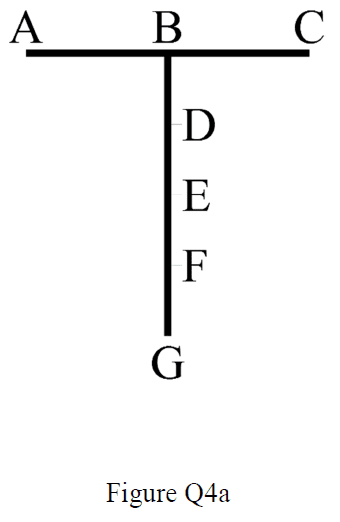
---
ANSWERS:
i) Center of gravity is at D
ii) IB=(5/12)ml2 kg m2
iii) ID=(7/24)ml2 kg m2
iv) k= sqrt(17/24) l m
----
*My attempts*i)I know inherently that the centre of gravity is at D. How do i prove it mathematically?
----
ii)I get the moment of inertial about B like so:
I[subBb[/sub] = (ml2)/3 + ((ml2/3) - (ml2)/4)
But i don't understand why I am supposed to subtract. Is it because the centre of gravity is l/2 below B?
----
iii)For ID I get the answer by doing:
ID = ((ml2)/3 - (ml2)/4) + ((ml2)/(3*16)) + (9ml2)/(16*3)
Why do I subtract (ml2)/4) if that rod is above D?----
iv)I'm trying to use IG to find the radius of gyration:
So for IG
IG = (7/24)ml2 - ml2Here I am using the parallel axis theorem, but why do I subtract the (md2) of the AC rod from the Moment of inertia about D?
I need some assistance understanding moments of inertia. I am doing some review for an upcoming exam, however I am slightly stumped by this question. I have already tried googling "moments of inertia" to try and understand the concept better, but I am having issues knowing when to apply which formulas.
I have attached my specific question and the "answer" to the question, hopefully someone can help me understand how to get the answer.
----
Two identical slender rods of length l and mass m are linked together at 90deg, as shown in figure Q4a (image attached), to form a link in a mechanism. Point B is midway between A and C, and points B, D, E, F and G are equally spaced along the lower link.
i) Determine the position of the center of gravity of the link
ii) Find the moment of inertia of the link about the point B
iii) Find the moment of inertia of the link about the point D
iv) Find the radius of gyration about the point G
---
ANSWERS:
i) Center of gravity is at D
ii) IB=(5/12)ml2 kg m2
iii) ID=(7/24)ml2 kg m2
iv) k= sqrt(17/24) l m
----
*My attempts*i)I know inherently that the centre of gravity is at D. How do i prove it mathematically?
----
ii)I get the moment of inertial about B like so:
I[subBb[/sub] = (ml2)/3 + ((ml2/3) - (ml2)/4)
But i don't understand why I am supposed to subtract. Is it because the centre of gravity is l/2 below B?
----
iii)For ID I get the answer by doing:
ID = ((ml2)/3 - (ml2)/4) + ((ml2)/(3*16)) + (9ml2)/(16*3)
Why do I subtract (ml2)/4) if that rod is above D?----
iv)I'm trying to use IG to find the radius of gyration:
So for IG
IG = (7/24)ml2 - ml2Here I am using the parallel axis theorem, but why do I subtract the (md2) of the AC rod from the Moment of inertia about D?