Momentum and Impulse Problem with a Ball bouncing off a Wall

Click For Summary
SUMMARY

The discussion focuses on the momentum and impulse of a ball bouncing off a wall, specifically addressing the misconceptions around inelastic collisions and the relationship between force, time, and momentum. Participants clarify that during a collision, kinetic energy may not be conserved, and the change in momentum is calculated using the area under the force-time graph. The correct interpretation of instantaneous acceleration is defined by Newton's second law, a = F/m, rather than the area under the force-time graph, which represents impulse. The conversation emphasizes the importance of understanding the initial conditions of the ball's motion to accurately analyze the collision.

PREREQUISITES
  • Understanding of Newton's laws of motion, particularly Newton's second law.
  • Familiarity with the concepts of momentum and impulse in physics.
  • Knowledge of elastic and inelastic collisions and their characteristics.
  • Ability to interpret force-time graphs and calculate areas under curves.
NEXT STEPS
  • Study the principles of elastic and inelastic collisions in detail.
  • Learn how to calculate impulse and momentum using force-time graphs.
  • Explore Newton's second law and its applications in various physical scenarios.
  • Practice problems involving momentum conservation and energy transformations during collisions.
USEFUL FOR

Physics students, educators, and anyone interested in understanding the dynamics of collisions and the principles of momentum and impulse in mechanics.

GiantGoose
Messages
2
Reaction score
0
Homework Statement
See attached.
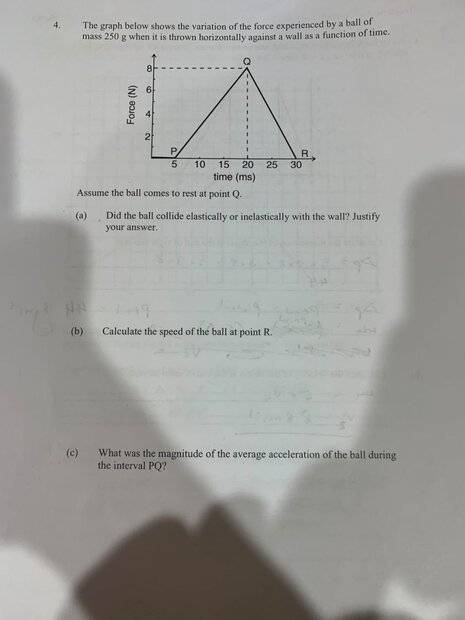
Graph shows variation of force experienced by ball of 250g mass when thrown against a wall. Comes to rest at point Q.
a) Did the ball collide elastically or inelastically with the wall? Justify.
b) Calculate the speed of the ball at point R
c) What was the magnitude of the average acceleration of the ball during the interval PQ?
Relevant Equations
F=ma
change in momentum = final - initial
change in momentum = force x time
a) Assuming it is inelastic as it is accelerating and therefore kinetic energy is not conserved? Intuitively this doesn't feel right...

b) change in momentum = p initial - p final = force x time
p initial = 0 as at rest
p final = 0.25 x v2
force x time = area under graph = 0.1
therefore 0.25 x v2 = 0.1
v2 = 0.4 ms-1

c) After google searching I have discovered that acceleration is the area under the graph of a f against t graph, but I am certain I have not been taught this. Is there are more intuitive way to figure this out?

Many thanks!
279200924_144863504745994_7851415386546830627_n (1).jpg
 
Last edited by a moderator:
Physics news on Phys.org
GiantGoose said:
a) Assuming it is inelastic as it is accelerating and therefore kinetic energy is not conserved? Intuitively this doesn't feel right...
Yes, that is incorrect.

A bouncing ball will experience acceleration. The bounce can be either elastic (equal kinetic energy before and after the bounce) or inelastic (unequal kinetic energy before and after the bounce).

GiantGoose said:
b) change in momentum = p initial - p final = force x time
That would be correct for a constant force. Here we have a force that varies over time. That calls for integration (area under the curve) rather than simple multiplication.

GiantGoose said:
c) After google searching I have discovered that acceleration is the area under the graph of a f against t graph
No. That is not correct.

Instantaneous acceleration is given by ##a = F/m##. This is Newton's second law.

The area under the graph of f against t gives you the change in momentum. If you want average acceleration, you need to divide change in velocity by the time interval over which that change occurs.

Note that change in momentum is useful information because it will help you answer part a).
 
GiantGoose said:
a) Assuming it is inelastic as it is accelerating and therefore kinetic energy is not conserved? Intuitively this doesn't feel right...
This is indeed not sufficient. During the collision, energy can be stored up as potential energy in deformation of the ball etc. You will need to find a different line of argument here. What is significative of an elastic collision of an object with an immovable object (such as a wall)?

GiantGoose said:
p initial = 0 as at rest
Why would the ball be at rest initially? It is being thrown against the wall.

I may be missing something here as your image is really low quality and it is difficult to see what it actually says.

GiantGoose said:
c) After google searching I have discovered that acceleration is the area under the graph of a f against t graph, but I am certain I have not been taught this. Is there are more intuitive way to figure this out?
Then you should not trust your googling skills. The area under an F-t-graph is the total impulse during the considered time, not the acceleration.
 
Thanks for the help. These are the answers I have come to, but i am still not certain about part (a), are they correct, and if not where am I going wrong?

279346061_248875224083514_200547132317447922_n.jpg
279356618_3077873545808453_7024168492697452104_n.jpg


Many Thanks again!
 
It would be more polite and rules-conforming if you were to transcribe your chicken scratching into text.

##\Delta p = 0.06 N##?
A change in momentum does not have units of force. It has units of force times time. Or mass times velocity.

I stopped reading after that.
 
  • Like
Likes Orodruin
GiantGoose said:
Thanks for the help. These are the answers I have come to, but i am still not certain about part (a), are they correct, and if not where am I going wrong?

View attachment 300699View attachment 300700

Many Thanks again!
Per forum rules, images are for diagrams and textbook extracts. Posting your working as images makes it hard for us to refer to parts of it.

You calculated two changes in momentum (quoting the wrong units) but gave them the same name, ##\Delta p##. That leads to confusion.

You noted these two changes in moment are different and concluded that the velocity had changed. I hope that is not exactly what you meant.
Momentum and velocity are vectors, so even in one dimension the sign matters. Had the collision been perfectly elastic, would you expect the velocities to be the same?
Is it possible for a mass to undergo two different momentum changes yet end up with unchanged velocity?

In (c), you have two errors.
You have two velocities, zero and -0.24m/s. In (v-u)/t, which is u and which is v?
Then how did -0.24 turn into +24?
 
Now I'm confused, what am I missing?

For "part a"
I don't think we can show this. If the collision is perfectly elastic, then we expect the change in momentum to be ## 2 m v_P ##

This implies to answer the question we have to compare:

$$ \int_{\rm{5 ms}}^{\rm{20ms}} F_{PQ} \, dt + \int_{ \rm{20 ms}}^{\rm{30 ms} } F_{QR} \, dt < 2 m v_P $$

But, we don't know the momentum of the ball before the collision? Unless I'm missing it in the picture somewhere.

and for the same reasons we can't calculate "part b" either?
 
erobz said:
we don't know the momentum of the ball before the collision?
We are told the ball is instantaneously at rest at point Q.
 
  • #10
haruspex said:
We are told the ball is instantaneously at rest at point Q.
Oh...I didn't see that. I realized that must be the case, but it didn't click for some reason to use that fact to find the initial momentum.
 

Similar threads

Replies
10
Views
1K
  • · Replies 19 ·
Replies
19
Views
3K
Replies
7
Views
2K
Replies
9
Views
4K
Replies
14
Views
3K
  • · Replies 7 ·
Replies
7
Views
5K
Replies
3
Views
4K
  • · Replies 24 ·
Replies
24
Views
4K
  • · Replies 13 ·
Replies
13
Views
8K
  • · Replies 1 ·
Replies
1
Views
3K
