Understanding Momentum Conservation in Simple Harmonic Motion

Join the discussion
Ask a follow-up here, or get your own question answered by working scientists, mathematicians and engineers — people, not an autocomplete.
Real named experts · corrections over time · the nuance an AI answer skips
2 replies · 2K views
Prabs3257
Messages
65
Reaction score
4
Homework Statement
A block A of mass m is in equilibrium after being suspended from the ceiling with the help of a spring of force constant k. The block B of mass m strikes the block A with a speed v and sticks to it.The value of v for which the spring just attains its natural length is
Relevant Equations
Momentum conservation
I first got the velocity of the combined mass with conservation of momentum and as it was in the mean position the velocity can be written as v = wA ( w= angular frequency , A = amplitude ) as we have to take it back to natural length i put A as the initial extension but i am getting a wrong ans can someone please tell me what i did wrong . Please refer to my work in the attachment below
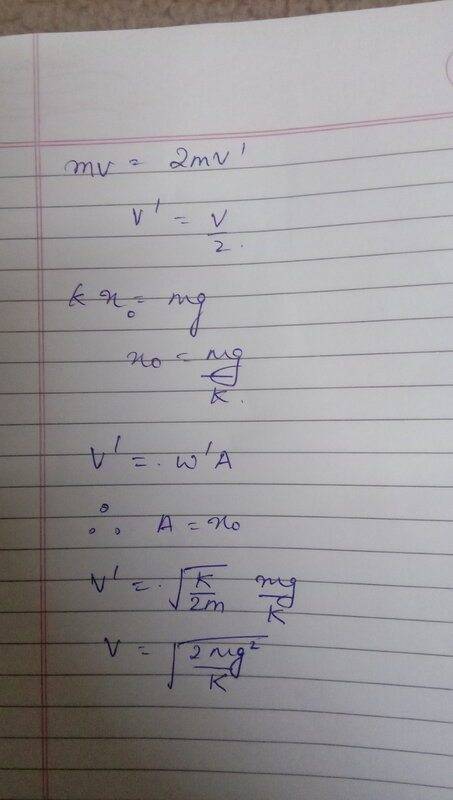
IMG-20200718-WA0001.jpeg
 

Attachments

  • Screenshot_20200718_015323.jpg
    Screenshot_20200718_015323.jpg
    31.9 KB · Views: 213
Physics news on Phys.org
As soon as the second mass coalesces with the first, the new mass starts to perform simple harmonic motion about a new equilibrium position. Determine the position of this new equilibrium and then use that ##\frac{v}{2} = \omega_2 \sqrt{A_2^2 - x^2}## for the necessary new amplitude ##A_2## so that it just reaches natural length at the top of the motion.
 
etotheipi said:
As soon as the second mass coalesces with the first, the new mass starts to perform simple harmonic motion about a new equilibrium position. Determine the position of this new equilibrium and then use that ##\frac{v}{2} = \omega_2 \sqrt{A_2^2 - x^2}## for the necessary new amplitude ##A_2## so that it just reaches natural length at the top of the motion.
Thanks a lot man i got the answer
 
  • Like
Likes   Reactions: etotheipi