Xforce
- 73
- 6
Some days ago, Elon said they will have a 18-diameter spacecraft later.
People online think it as a enlarged version of Starship/Superheavy, exactly twice the size, 10 times the power. However, there is no way that thing can even lift off ground (twice the height means one half the TWR) , and even it does, it will soon undergo a rapid unscheduled disassembly (large size means more parts, or simply larger parts as most people thought, they may not have the structural strength to stand several g’s.
The development of SpaceX launch vehicles, are always bigger, more power and cheaper (per kilogram launched)
Starting from the insignificant Falcon 1 their first generation system, 1.7 meters in diameter and 21.3 meters tall, able to send 0.7 tons to LEO. Fully expendable, means high cost per mass.
Then their second generation system, the current workhorse which is Falcon 9 /Falcon heavy. Falcon 9/H are both 70 meters tall. But the FH is basically 3 falcon 9 boosters packed together, so it gives the same height and the same generation system. The diameter of Falcon 9 is 3.7m, able to deliver 23 tons on their block 5. The FH is 3.7m*12m (3 packed together) and able to get a Tesla roadster to Earth escape trajectory or 54.4 tons to LEO. Partially, or the the first stage is reusable.
Later, there will be the third generation system ITS/BFR/Starship, 9 meters in diameter and 120 meters tall (65m for booster, 55m for the spaceship) in the newest design. It will be the most powerful rocket in human history (more thrust than Saturn V), and fully reusable, so the cost is around $7m per launch (very cheap for comparison with other rockets with similar capabilities) and gets up to 100 tons to orbit. With orbital refueling, it can get a delivery to Mars at around $140k/ton.
Let’s review the changes/ improvements for each generation and goes on.
Diameter(meters): 1.7—(*2.176)>3.7—(*2.42)>9—(*2)>18
Height(meters):21.3—(*3.286)>70—(*1.714)>120—>~150-180 (if two-staged) ~75-100 (if SSTO)
Payload to LEO (kg) : 700—(*32.86/77.86)>23000/54500—(*4.35/1.835)>100000—(*3-5)>~300000-500000
Reusability: expendable—>partial reusable—>fully reusable—>SSTO?
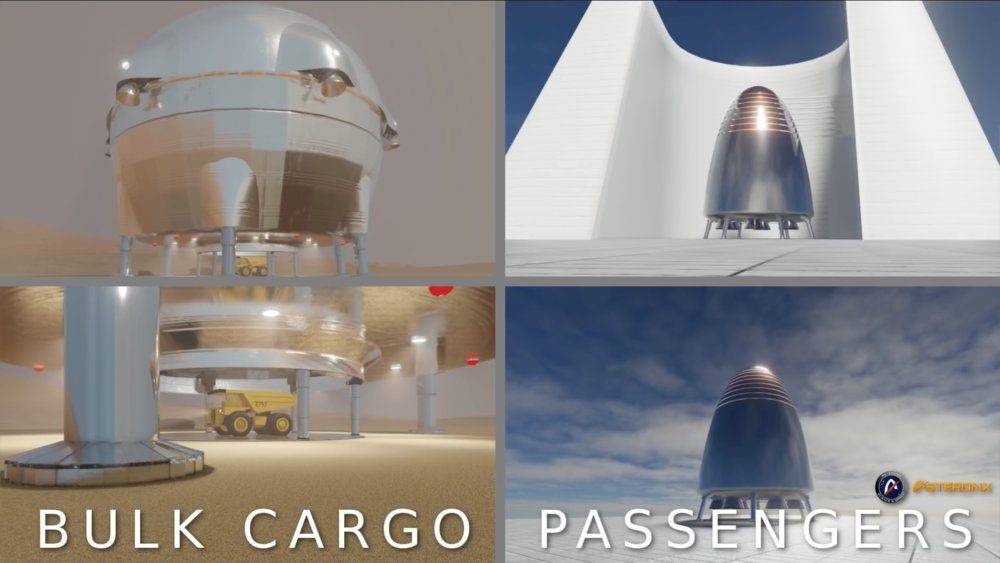
The image inserted is from AsteronX, I believe that a less height-to-diameter ratio fits more for a large rocket.
I have also heard that SpaceX is planning to use thermal rockets, and even fusion torch drives on their future launch vehicles.
People online think it as a enlarged version of Starship/Superheavy, exactly twice the size, 10 times the power. However, there is no way that thing can even lift off ground (twice the height means one half the TWR) , and even it does, it will soon undergo a rapid unscheduled disassembly (large size means more parts, or simply larger parts as most people thought, they may not have the structural strength to stand several g’s.
The development of SpaceX launch vehicles, are always bigger, more power and cheaper (per kilogram launched)
Starting from the insignificant Falcon 1 their first generation system, 1.7 meters in diameter and 21.3 meters tall, able to send 0.7 tons to LEO. Fully expendable, means high cost per mass.
Then their second generation system, the current workhorse which is Falcon 9 /Falcon heavy. Falcon 9/H are both 70 meters tall. But the FH is basically 3 falcon 9 boosters packed together, so it gives the same height and the same generation system. The diameter of Falcon 9 is 3.7m, able to deliver 23 tons on their block 5. The FH is 3.7m*12m (3 packed together) and able to get a Tesla roadster to Earth escape trajectory or 54.4 tons to LEO. Partially, or the the first stage is reusable.
Later, there will be the third generation system ITS/BFR/Starship, 9 meters in diameter and 120 meters tall (65m for booster, 55m for the spaceship) in the newest design. It will be the most powerful rocket in human history (more thrust than Saturn V), and fully reusable, so the cost is around $7m per launch (very cheap for comparison with other rockets with similar capabilities) and gets up to 100 tons to orbit. With orbital refueling, it can get a delivery to Mars at around $140k/ton.
Let’s review the changes/ improvements for each generation and goes on.
Diameter(meters): 1.7—(*2.176)>3.7—(*2.42)>9—(*2)>18
Height(meters):21.3—(*3.286)>70—(*1.714)>120—>~150-180 (if two-staged) ~75-100 (if SSTO)
Payload to LEO (kg) : 700—(*32.86/77.86)>23000/54500—(*4.35/1.835)>100000—(*3-5)>~300000-500000
Reusability: expendable—>partial reusable—>fully reusable—>SSTO?
The image inserted is from AsteronX, I believe that a less height-to-diameter ratio fits more for a large rocket.
I have also heard that SpaceX is planning to use thermal rockets, and even fusion torch drives on their future launch vehicles.
