More Logic statements and arguments

  • Topic:
  • Thread starter ertagon2
  • Start date
  • Tags Tags
    Logic
2 replies · 2K views · last reply
ertagon2
Messages
36
Reaction score
0
So once again this is my homework:
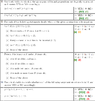
View attachment 7706
If you could please check these answers and help me with Q.9 part 1

Q.8 is just checking if both expressions give the same values right ?
Q.9 part 1 I'm in the blind here
Q.9 part 2 seems logical
Q.10 So if i get this right... for the statement/argument to beright the part before $\therefore$ must give me 1 when $\land$ with part after $\therefore$

This is my truth table for Q.10
https://i.imgur.com/wnthwac.jpg
 
Attachments
  • Homework table with logic questions 8, 9 and 10 showing radio-button answers, such as NO for the equivalence checks in question 8 and option a selected for the negation in question 9.
    maths 3.png
    20.9 KB · Views: 175
Hi ertagon2,

Q8 is correct.

For Q9 part 1, the negation of a statement $\forall x : (\text{something})$ is $\exists x : \neg(\text{something})$. This means that you should have a statement equivalent to

$$\exists x\in D : \neg((x\le0)\vee(x\ge2))$$
​

One of the choices is indeed equivalent to that statement : do you see which one ?

Q9 part 2 is correct : the negation of $A\wedge B$ is $\neg A\vee\neg B$.

For Q10, if I'm not mistaken, both arguments are correct. The rule is that the statement after $\therefore$ (the conclusion) must be true whenever all the statements before $\therefore$ (the premises) are true. You need only check the lines in which all the premises are true; the other lines should be ignored.
 
castor28 said:
Hi ertagon2,

Q8 is correct.

For Q9 part 1, the negation of a statement $\forall x : (\text{something})$ is $\exists x : \neg(\text{something})$. This means that you should have a statement equivalent to

$$\exists x\in D : \neg((x\le0)\vee(x\ge2))$$
​

One of the choices is indeed equivalent to that statement : do you see which one ?

Q9 part 2 is correct : the negation of $A\wedge B$ is $\neg A\vee\neg B$.

For Q10, if I'm not mistaken, both arguments are correct. The rule is that the statement after $\therefore$ (the conclusion) must be true whenever all the statements before $\therefore$ (the premises) are true. You need only check the lines in which all the premises are true; the other lines should be ignored.

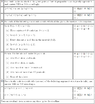
Here's the solution for future generations.
View attachment 7710
 
Attachments
  • Screenshot of an online quiz with truth-table equivalence questions, a negation-selection question on quantified statements, and argument validity questions, with radio buttons and bracketed scores marked.
    maths4.png
    20.7 KB · Views: 189