Math Amateur
Gold Member
MHB
- 3,920
- 48
I am reading Barrett O'Neil's book: Elementary Differential Geometry ...
I need help with some more issues/problems with the example on wedge products of differential forms in O'Neill's text on page 31 in Section 1.6 ..The example reads as follows:
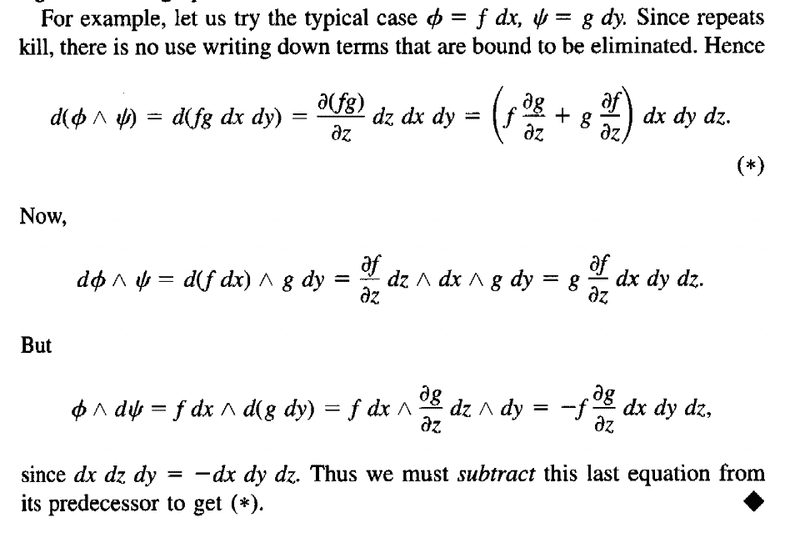 In my working of the example above ... trying to understand (*) ... I proceeded as follows ... but had some questions almost immediately ...
We have \phi = f \ dx and \psi = g \ dyso we can write (can we?)d ( \phi \wedge \psi ) = d( f \ dx \wedge \ g \ dy )= d (f \ dx \ g \ dy )But is this last step correct? That is is the wedge product of these elements just a concatenation? If so, why?
Continuing ...
d (f \ dx \ g \ dy ) = d( fg \ dx \ dy )
Is this correct? Why?
It assumes all these type of elements commute ... is that correct? Why?... I am also perplexed by what is happening (and the justification) in O'Neill's step in (*) where he writes:
d(fg \ dx \ dy ) = \partial (fg) / \partial z \ dz \ dx \ dyCan someone explain and justify this step please ... preferably by providing all the intervening steps and their justification ...
Hope someone can help with these questions/issues/problems ...
Peter
I need help with some more issues/problems with the example on wedge products of differential forms in O'Neill's text on page 31 in Section 1.6 ..The example reads as follows:
We have \phi = f \ dx and \psi = g \ dyso we can write (can we?)d ( \phi \wedge \psi ) = d( f \ dx \wedge \ g \ dy )= d (f \ dx \ g \ dy )But is this last step correct? That is is the wedge product of these elements just a concatenation? If so, why?
Continuing ...
d (f \ dx \ g \ dy ) = d( fg \ dx \ dy )
Is this correct? Why?
It assumes all these type of elements commute ... is that correct? Why?... I am also perplexed by what is happening (and the justification) in O'Neill's step in (*) where he writes:
d(fg \ dx \ dy ) = \partial (fg) / \partial z \ dz \ dx \ dyCan someone explain and justify this step please ... preferably by providing all the intervening steps and their justification ...
Hope someone can help with these questions/issues/problems ...
Peter
