Motion equation problem -- Car accelerating with a constant power engine

Click For Summary
The discussion focuses on solving a motion equation problem involving a car with a constant power engine. Participants clarify that SUVAT equations are inappropriate due to the non-constant acceleration associated with constant power. A differential equation is suggested to properly express the relationship in this scenario. The second method used by the original poster is acknowledged as correct, while the first method is deemed incorrect. The conversation emphasizes the importance of recognizing the impact of varying acceleration when dealing with power.
Weber_per_metermeter
Messages
2
Reaction score
1
Homework Statement
In horizontal straight line path, there's a car, weighing 600kg, fully powered with P=25kW, that is constant during motion. Car is starting from rest state (v0=0). What is the speed intensity after s=125m of driving? Enviromental resistance and friction are negligible.
Relevant Equations
P=F*v=m*a*v
v^2=v0^2+2as
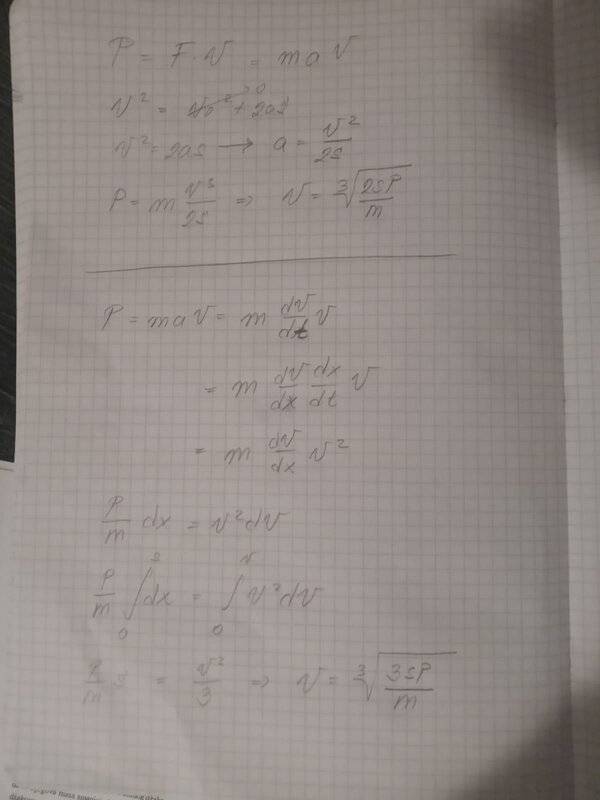
So I tried to solve this in two methods, but I keep getting different results, and I don't know why.
IMG-20201015-WA0010.jpg
 
Physics news on Phys.org
It's hard to read, but you seem to be using SUVAT equations. Those only apply when acceleration is constant. Here, power is constant.
Write the differential equation that expresses that.

Edit: managed to get a clearer image of your work, and I see you did use the right method in the second attempt, as @TSny notes.
 
Last edited:
  • Like
Likes Lnewqban, Weber_per_metermeter and Delta2
Your first method is not correct due to the reasons @haruspex mentioned. Your second method looks OK to me.
 
  • Like
Likes Lnewqban, Weber_per_metermeter and Delta2
Thank you for your answer. Now that you mentioned it, of course its due to non constant acceleration :D
Great work!
 
  • Like
Likes Lnewqban
The book claims the answer is that all the magnitudes are the same because "the gravitational force on the penguin is the same". I'm having trouble understanding this. I thought the buoyant force was equal to the weight of the fluid displaced. Weight depends on mass which depends on density. Therefore, due to the differing densities the buoyant force will be different in each case? Is this incorrect?

Similar threads

  • · Replies 3 ·
Replies
3
Views
974
Replies
3
Views
1K
Replies
5
Views
2K
  • · Replies 6 ·
Replies
6
Views
3K
Replies
8
Views
4K
  • · Replies 20 ·
Replies
20
Views
2K
  • · Replies 6 ·
Replies
6
Views
1K
  • · Replies 4 ·
Replies
4
Views
3K
Replies
9
Views
5K
  • · Replies 5 ·
Replies
5
Views
2K