Motion equation problem -- Car accelerating with a constant power engine

Click For Summary

Homework Help Overview

The discussion revolves around a motion equation problem involving a car accelerating with a constant power engine. Participants are exploring the implications of constant power on acceleration and the appropriate equations to use in this context.

Discussion Character

  • Conceptual clarification, Assumption checking

Approaches and Questions Raised

  • Participants discuss two methods attempted by the original poster, noting discrepancies in results. There is a focus on the application of SUVAT equations and the necessity of a differential equation to express the relationship between power and acceleration.

Discussion Status

Some participants have provided feedback on the methods used, indicating that the first method may not be appropriate due to the nature of acceleration being non-constant. The second method appears to be more aligned with the problem context, although there is no explicit consensus on the best approach yet.

Contextual Notes

There is an acknowledgment of the challenges posed by the constant power condition, which affects the assumptions about acceleration. Participants are working with the understanding that traditional equations may not apply directly in this scenario.

Weber_per_metermeter
Messages
2
Reaction score
1
Homework Statement
In horizontal straight line path, there's a car, weighing 600kg, fully powered with P=25kW, that is constant during motion. Car is starting from rest state (v0=0). What is the speed intensity after s=125m of driving? Enviromental resistance and friction are negligible.
Relevant Equations
P=F*v=m*a*v
v^2=v0^2+2as
So I tried to solve this in two methods, but I keep getting different results, and I don't know why.
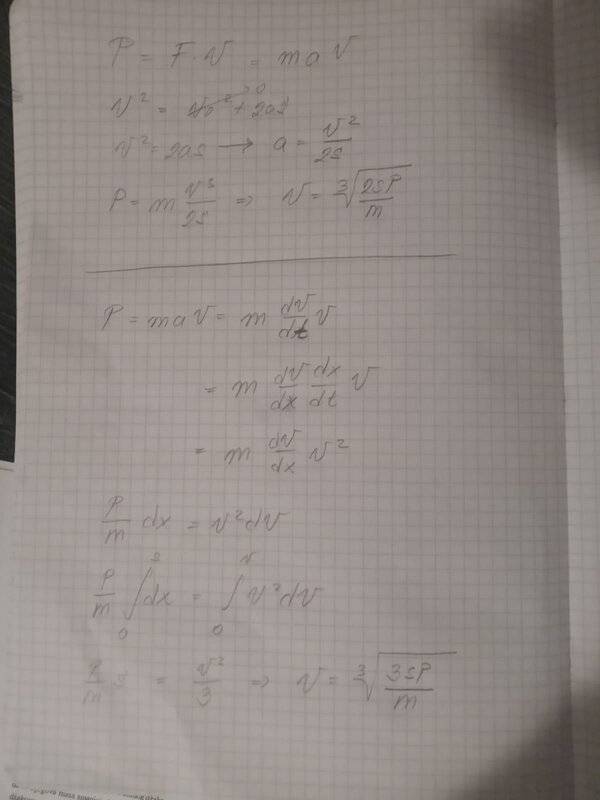
IMG-20201015-WA0010.jpg
 
Physics news on Phys.org
It's hard to read, but you seem to be using SUVAT equations. Those only apply when acceleration is constant. Here, power is constant.
Write the differential equation that expresses that.

Edit: managed to get a clearer image of your work, and I see you did use the right method in the second attempt, as @TSny notes.
 
Last edited:
  • Like
Likes   Reactions: Lnewqban, Weber_per_metermeter and Delta2
Your first method is not correct due to the reasons @haruspex mentioned. Your second method looks OK to me.
 
  • Like
Likes   Reactions: Lnewqban, Weber_per_metermeter and Delta2
Thank you for your answer. Now that you mentioned it, of course its due to non constant acceleration :D
Great work!
 
  • Like
Likes   Reactions: Lnewqban

Similar threads

  • · Replies 3 ·
Replies
3
Views
1K
Replies
3
Views
1K
Replies
5
Views
2K
  • · Replies 6 ·
Replies
6
Views
3K
  • · Replies 20 ·
Replies
20
Views
2K
Replies
8
Views
4K
  • · Replies 6 ·
Replies
6
Views
1K
  • · Replies 4 ·
Replies
4
Views
3K
Replies
9
Views
5K
  • · Replies 5 ·
Replies
5
Views
2K