Motion of Particles in Uniform Gravitational Field

Join the discussion
Registration is free. Start your own thread to ask a follow-up.
4 replies · 4K views
DrunkenOldFool
Messages
20
Reaction score
0
Two particles move in a uniform gravitational field with an acceleration $g$. At the initial moment the particles were located at one point and moved with velocities $v_1 = 3 \text{ms}^{-1}$ and $v_1 = 4 \text{ms}^{-1}$ horizontally in opposite directions. Find distance between the particles when their velocities become mutually perpendicular.
 
Physics news on Phys.org
DrunkenOldFool said:
Two particles move in a uniform gravitational field with an acceleration $g$. At the initial moment the particles were located at one point and moved with velocities $v_1 = 3 \text{ms}^{-1}$ and $v_1 = 4 \text{ms}^{-1}$ horizontally in opposite directions. Find distance between the particles when their velocities become mutually perpendicular.
The two horizontal components of velocity are constant, and the vertical components are always equal. Now draw a velocity diagram for when the two velocities are perpendicular, and solve the diagram for the vertical component of velocity (it should come to \(2 \sqrt{3}\) m/s if my scratch algebra and arithmetic are correct).

Now you can find the time \(t\) it took the vertical component to reach this value, and the separation is \(7t\) m.

CB
 
Last edited:
Let the velocities of the particles (say $\vec{v_{1}}'$ and $\vec{v_2 }'$) become perpendicular after time $t$. By equation of motion,

$$ \vec{v_{1}'}=\vec{v_{1}}+\vec{g}t \\ \vec{v_{2}'}=\vec{v_{2}}+\vec{g}t$$

As $\vec{v_1 ' }$ and $\vec{v_2 '}$ are perpendicular, we can write

$$ \begin{align*} \vec{v_1 ' } \cdot \vec{v_2 ' } &=0 \\ (\vec{v_{1}}+\vec{g}t) \cdot (\vec{v_{2}}+\vec{g}t) &= 0 \\ -v_1 v_2 +g^2 t^2 &=0 \\ t &= \frac{\sqrt{v_1 v_2}}{g}\end{align*}$$

Let $x_1$ and $x_2$ be the horizontal distances covered by particles 1 and 2 in time $t$ respectively. Note that the acceleration in horizontal direction is zero.

$$x_1 = v_1 t = v_1 \frac{\sqrt{v_1 v_2}}{g} \\ x_2 = v_2 t = v_2 \frac{\sqrt{v_1 v_2}}{g}$$

The total separation between the particles is

$$x_1+x_2= (v_1+v_2)\frac{\sqrt{v_1 v_2}}{g}$$
 
Last edited by a moderator:
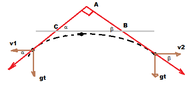
This is my try.

View attachment 277

considering the triangle $ABC$,

$$\begin{align*}
\alpha &=90^\circ - \beta \\
\tan{\alpha} &= \tan (90^\circ -\beta ) \\
\tan{\alpha} &= \cot \beta \\
\frac{gt}{v_1}&=\frac{v_2}{gt}\\
g^2t^2 &=v_1\times v_2\\
\therefore t &= \frac{\sqrt{v_1v_2}}{g} \qquad since \; t>0 \\ \end{align*}

$$

the rest is as same as sbhatnagar's
 
Attachments
  • projectile.png
    projectile.png
    2 KB · Views: 154