mikejm
- 40
- 2
Let's say you have a simple structure with two equal masses connected by a massless rigid baton of length L. Like this:
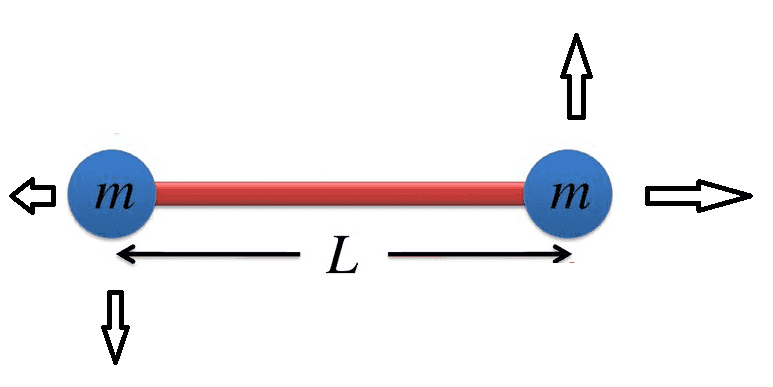
Imagine this structure is totally free in space. It is not hinged in any way. Then forces act on each mass in 2D (x,y). If you have the x and y force vectors acting on each mass, and knowing the two masses are linked, can you calculate the net acceleration of each mass that results?
ie. If you have:
L = length connecting masses
Fm1X = x-axis force on mass 1
Fm1Y = y-axis force on mass 1
Fm2X = x-axis force on mass 2
Fm2Y = y-axis force on mass 2
And the initial (x,y) coordinates of the two masses and their initial velocities, can you calculate the accelerations and new velocities after a certain increment of time?
Numerical solution is fine. Would want to be able to solve such a problem at an audio sample rate recursively for 100 similar elements per sample or so. At each sample I'd recalculate the x and y forces acting on each mass, then need to determine their new velocities/accelerations for the next time increment.
Obviously this would be trivial for a mass that is not connected to another in this way. I'm not sure how to take into account that they must remain a fixed distance apart (ie. linked by the "baton").
Thanks.
Imagine this structure is totally free in space. It is not hinged in any way. Then forces act on each mass in 2D (x,y). If you have the x and y force vectors acting on each mass, and knowing the two masses are linked, can you calculate the net acceleration of each mass that results?
ie. If you have:
L = length connecting masses
Fm1X = x-axis force on mass 1
Fm1Y = y-axis force on mass 1
Fm2X = x-axis force on mass 2
Fm2Y = y-axis force on mass 2
And the initial (x,y) coordinates of the two masses and their initial velocities, can you calculate the accelerations and new velocities after a certain increment of time?
Numerical solution is fine. Would want to be able to solve such a problem at an audio sample rate recursively for 100 similar elements per sample or so. At each sample I'd recalculate the x and y forces acting on each mass, then need to determine their new velocities/accelerations for the next time increment.
Obviously this would be trivial for a mass that is not connected to another in this way. I'm not sure how to take into account that they must remain a fixed distance apart (ie. linked by the "baton").
Thanks.
Last edited: