Would a Centrifugal Fan Be Better for Moving Air Through a Small Hose?

  • Thread starter Thread starter SentinelAeon
  • Start date Start date
  • Tags Tags
    Fan Hose
Click For Summary
SUMMARY

The discussion centers on optimizing airflow through a small garden hose (2cm diameter) connected to a plastic box using fans. Participants agree that a centrifugal fan, designed for higher static pressure and lower flow, is preferable to an axial fan (9.2cm) for this application. The centrifugal blower can develop pressure effectively, making it suitable for overcoming the resistance of the narrow hose. Additionally, using both intake sides of the blower and ensuring a smooth transition between the blower and hose will enhance airflow efficiency.

PREREQUISITES
  • Understanding of centrifugal and axial fan characteristics
  • Familiarity with pressure-flow diagrams for fans
  • Knowledge of airflow dynamics in constrained environments
  • Experience with airflow measurement tools, such as water manometers
NEXT STEPS
  • Research centrifugal blower specifications and performance curves
  • Learn about designing smooth transitions for airflow systems
  • Investigate the use of water manometers for measuring airflow
  • Explore the effects of fan blade design on airflow efficiency
USEFUL FOR

Engineers, hobbyists, and DIY enthusiasts involved in airflow optimization, particularly those working with small-scale ventilation systems or cooling solutions.

SentinelAeon
Messages
31
Reaction score
3
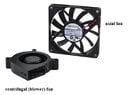
I have a plastic box and i am trying to move as much air through it as i can. I use a small garden hose to connect the box with some wall mounted fan (see the image attached). Given the small diameter of hose (2cm) and big fan (9.2cm) i am wondering if it would be better to use a smaller fan. Also, i am using axial fan intended for high flow and low static pressure (image of both fans in the attachment). Would in this case it be better to use a centrifugal fan intended for lower flow but higher static pressure ? Any data on this subject would be great, even links, so i can figure out the optimal setup given the small diameter of the hose.

edit: I found a video that explains the issue i am having and offers some results. But i am still interested in hearing your opinion.


Attachments
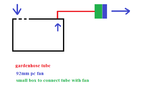
  • setup.png
    setup.png
    2.7 KB · Views: 166
  • CUI-blowers-and-fan.jpg
    CUI-blowers-and-fan.jpg
    17.1 KB · Views: 130
Last edited:
Engineering news on Phys.org
SentinelAeon said:
Would in this case it be better to use a centrifugal fan intended for lower flow but higher static pressure ?
Definitely YES.

It takes pressure to push air through a hose. The large area fan is designed to operate with very low pressure and high volume.

A centrifugal blower will develop pressure until the flow reaches the operating point on the pressure-flow diagram for that blower design and RPM.

Google images for "pressure-flow diagrams" that come with different centrifugal blowers.

Alternatively, there is a third option. A positive displacement pump would move a set volume of compressed air at whatever pressure was required for it to move, or it would burst the air receiver or hose, or blow the over-pressure safety valve.
 
  • Like
Likes   Reactions: russ_watters
I installed a centrifugal blower and will start the test soon and will report the findings. Its a small blower fan, similar to what was used on older graphic cards. So while i verified that it is really good at blowing through a small diameter hose, i am now wondering whether it will be able to beat 2x 92mm axial fans, considering that its a mere 45mm blower fan. But i can always get a bigger one, or just use 2 or 3 of them. Or use higher speed since its considerably more silent. Those 92mm fans are like 0.6A each and when you constrain them by connecting a small hose to them, they become incredibly loud.

Btw this blower fan has 2 intake sides. Right now i only used 1 side and covered the other side. In future i will try to set it up in a way that it uses both sides, but when checking by hand, it certanly didnt feel like covering 1 side resulted in 50% less airflow. Maybe 25%.
 
SentinelAeon said:
Those 92mm fans are like 0.6A each and when you constrain them by connecting a small hose to them, they become incredibly loud.
Because there is too little airflow for that fan design, the blades are stalled, and the resulting inefficient turbulence is making the noise. You may sometimes notice that when stalled, the fan will spin faster, and use less power.

SentinelAeon said:
Btw this blower fan has 2 intake sides. Right now i only used 1 side and covered the other side. In future i will try to set it up in a way that it uses both sides, but when checking by hand, it certanly didnt feel like covering 1 side resulted in 50% less airflow. Maybe 25%.
That is to be expected, since the airflow is limited by the narrow hose outlet much more than by the fan inlet.
To get the greatest flow, open both inlet sides to the centrifugal blower.

Flow will be optimum when there is a taper, or a horn, between the blower and the inlet to the hose. Airflow there must be smooth without step changes in the airflow section, direction, or air velocity.
 
  • Like
Likes   Reactions: russ_watters
SentinelAeon said:
So while i verified that it is really good at blowing through a small diameter hose, i am now wondering whether it will be able to beat 2x 92mm axial fans, considering that its a mere 45mm blower fan.
If your blower does not move enough air, here's how to look for a better blower. Or you can use this method to see why that little centrifugal blower moves more air through the hose than the larger axial fan.

You predict the effect of any other fan or blower by comparing the fan curves. The figure below is from the datasheet of a randomly chosen 51mm by 51mm by 15mm centrifugal blower. The three black curves are for three different operating RPM.
Fan Curve.jpg

The red curve represents a possible system curve. The system curve is the relation between pressure and flow rate for the system. Your system is the hose and the connections to the blower and the box. The actual flow rate is where the system curve intersects the fan curve. You can find that point by drilling a small hole at the fan discharge and connecting a water manometer (search the term). A water manometer is simply a piece of clear plastic tubing and a ruler. The system curve is a quadratic curve that starts at 0, 0.
 

Similar threads

  • · Replies 11 ·
Replies
11
Views
5K
  • · Replies 5 ·
Replies
5
Views
3K
Replies
6
Views
5K
Replies
5
Views
3K
  • · Replies 2 ·
Replies
2
Views
2K
  • · Replies 6 ·
Replies
6
Views
2K
Replies
10
Views
5K
  • · Replies 11 ·
Replies
11
Views
7K
  • · Replies 20 ·
Replies
20
Views
11K
  • · Replies 10 ·
Replies
10
Views
4K