My new solar cooker/solar drier 1/5 scale model: It's smoking!

  • Context: Misc. 
  • Thread starter Thread starter Brian in Victoria BC
  • Start date Start date
Click For Summary

Discussion Overview

The discussion revolves around the design and functionality of a 1/5 scale model solar cooker and solar drier. Participants explore the mechanics of the cooker, its potential applications, and considerations for scaling up the design. The conversation includes technical aspects of solar tracking and heat concentration, as well as the suitability of the model for educational purposes.

Discussion Character

  • Exploratory
  • Technical explanation
  • Conceptual clarification
  • Debate/contested
  • Homework-related

Main Points Raised

  • One participant describes a solar cooker design that aims to avoid the issue of sunlight flashing into users' eyes by using an equatorial mount and a reflective parabolic dish.
  • Another participant questions the setup of the equatorial mount, suggesting that the configuration may have been incorrect for the time of year, hinting at the importance of solar declination.
  • A participant notes that the model could produce significant heat and discusses the implications of focusing the sunlight on a smaller area for better heat transfer.
  • Concerns are raised about the safety of scaling up the design to a four-foot reflector, with one participant suggesting that it could pose a hazard due to high power output.
  • Participants discuss the use of a Fresnel reflector and the potential for a stationary target pot to simplify the design while maintaining efficiency.
  • There are suggestions for making the project suitable for educational purposes, including using inexpensive materials and involving students in the design process.

Areas of Agreement / Disagreement

Participants express a mix of agreement and differing opinions regarding the design and functionality of the solar cooker. While some agree on the potential benefits of the model for educational purposes, others raise concerns about safety and the effectiveness of the design. The discussion remains unresolved on several technical aspects, including the optimal configuration for the equatorial mount and the best approach to scaling up the project.

Contextual Notes

Participants mention various assumptions about solar tracking and heat concentration, but these assumptions are not fully explored or resolved. The discussion includes references to specific design choices and their implications, which may depend on further experimentation and clarification of the model's mechanics.

Who May Find This Useful

This discussion may be of interest to individuals involved in solar energy projects, educators looking for science project ideas, and hobbyists interested in solar cooking technology.

Brian in Victoria BC
Messages
31
Reaction score
29
TL;DR
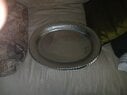
Its a model of an upcoming solar cooker. Its made of wood and 3 silvery plastic plates. Might be useful as a school science project.
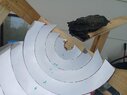
I "designed" this idea over a decade ago but never build a working model. The idea is to make something much simpler and easier to use than typical parabolic dish solar cookers. The biggest issue is that people use the full dish and then it is very easy to get a flash of sunlight in your eyes when you are stirring the pot. This doesn't have that issue.

It's a solar cooker with a reflective parabolic dish on equatorial mount that if it moves at 15 degrees per hour keeps the light focused (more or less) on the same spot all day. The focused spot will be either under a cooking pot or directed into the bottom of a solar dehydrator or solar box cooker. The box cooker will be opened and closed from the back so nobody gets flashes of stray light in their eyes. Same with the pot, I will have to make some sort of shield to protect peoples eyes as they put the pot on and off the hot spot.

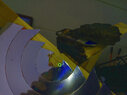
This is made for my latitude, 48 degrees north. At the north pole, it would stand vertical and at the equator it would be fully horizontal. (The angle of equatorial mount is the same as your latitude) Anyway, I wasn't expecting it to burn paper or wood so it actually get quite hot.

Last year's tracking solar cooker won a prize on Instructables, but I made it specifically not to get very hot in one spot, and let it be hot all around a big cook pot. Now I realize that this was a mistake. If you get a smaller hot spot and have it on the bottom, you will get more rapid heat transfer. This is like using high voltage versus low voltage.

Anyway, the full scale version will have a reflector about 4 ft by 4 ft. I'm just working out the size now so I can cut it out of a 4 by 8 sheet of chloroplast corrugated plastic without too much waste. I think this would be a great science project for a school.
 

Attachments
  • 20250402_170438.jpg
    20250402_170438.jpg
    37.7 KB · Views: 51
  • 20250402_170425.jpg
    20250402_170425.jpg
    41.2 KB · Views: 44
  • 20250331_213139.jpg
    20250331_213139.jpg
    25.9 KB · Views: 44
  • 20250331_144929.jpg
    20250331_144929.jpg
    57.5 KB · Views: 35
Last edited by a moderator:
  • Like
Likes   Reactions: AlexB23, Hornbein, Drakkith and 1 other person
Physics news on Phys.org
I made the model to make sure no material was wasted when scaling up. And it was set up very quickly. A few days later, I noticed a glaring mistake in the set up! Hint: it is equatorial mount and it was around April 4th. Can you spot my mistake?
 
Brian in Victoria BC said:
I made the model to make sure no material was wasted when scaling up. And it was set up very quickly. A few days later, I noticed a glaring mistake in the set up! Hint: it is equatorial mount and it was around April 4th. Can you spot my mistake?
I get the basic idea - kind of a "Fresnel mirror" that tracks the sun - but none of your pics shows any of the mount config, so I don't know what pitfall you encountered (eg. does the whole contraption - mirror and target rotate? Or just the mirror?).

I can't think of any significant geometry peculiar to circa April 4, unless you mean Daylight savings - but that would have no effect on your contraption unless it used a timer of some sort. Something to do with the analemma path?

Oh wait. I get it. Easter. You suddenly have a 20lb. turkey to cook in your 1/5 scale cooker.
 
I had adjusted the model down to do the declination, instead of up. So in the demonstration, the spot of heat would have been more concentrated and hotter if I had done it correctly.
 
Brian in Victoria BC said:
I had adjusted the model down to do the declination, instead of up. So in the demonstration, the spot of heat would have been more concentrated and hotter if I had done it correctly.
If you want 'normal cooking' temperatures and if you can produce a few hundred W of heat then you don't need good focussing. If the main part of the reflected image of the Sun is well within the area of the cooking pot then you will avoid burning and minimise lost heat (IR) from the local hot spot. A Fresnel reflector works well, as you will no doubt have seen in your searches. A simple tracking solar mount should need minima long -term adjustment. You can easily correct for the analemma problem (if necessary with a fuzzy heated spot) when you want to set up each cooking operation.

Brian in Victoria BC said:
TL;DR Summary: Its a model of an upcoming solar cooker. Its made of wood and 3 silvery plastic plates. Might be useful as a school science project.

I think this would be a great science project for a school.
I like your offset reflector design; very basic and well adequate. I would warn against a four foot square for a school project; nearly 1kW would be a safety hazard. To make the system as light as possible (to allow minimal motor power) then you could keep the target pot near the axis of rotation and it could be stationary. That may call for a longer focal length for the reflector.
 
sophiecentaur said:
If you want 'normal cooking' temperatures and if you can produce a few hundred W of heat then you don't need good focussing. If the main part of the reflected image of the Sun is well within the area of the cooking pot then you will avoid burning and minimise lost heat (IR) from the local hot spot. A Fresnel reflector works well, as you will no doubt have seen in your searches. A simple tracking solar mount should need minima long -term adjustment. You can easily correct for the analemma problem (if necessary with a fuzzy heated spot) when you want to set up each cooking operation.


I like your offset reflector design; very basic and well adequate. I would warn against a four foot square for a school project; nearly 1kW would be a safety hazard. To make the system as light as possible (to allow minimal motor power) then you could keep the target pot near the axis of rotation and it could be stationary. That may call for a longer focal length for the reflector.
Hi Sophie The target spot is at the axis of rotation and the target spot stationary. The reason for the offset paraboloid is so that there is easy access to the target spot at all times. The amount of power used for tracking is tiny. Instead of a motor to run the rotation, I use an Airlift pump/waterwheel/winch. I use low pressure air that steadily increases in pressure to do the timing. Ideally, a battery operated "thing" or clockwork with a stepper motor could do the timing but I cannot make it. The timer needs to have adjustable speed because I use wooden wheels of slightly different diameters. If a company made my type of solar reflector, they could standardize the timer.
 
  • Like
Likes   Reactions: sophiecentaur
sophiecentaur said:
If you want 'normal cooking' temperatures and if you can produce a few hundred W of heat then you don't need good focussing. If the main part of the reflected image of the Sun is well within the area of the cooking pot then you will avoid burning and minimise lost heat (IR) from the local hot spot. A Fresnel reflector works well, as you will no doubt have seen in your searches. A simple tracking solar mount should need minima long -term adjustment. You can easily correct for the analemma problem (if necessary with a fuzzy heated spot) when you want to set up each cooking operation.


I like your offset reflector design; very basic and well adequate. I would warn against a four foot square for a school project; nearly 1kW would be a safety hazard. To make the system as light as possible (to allow minimal motor power) then you could keep the target pot near the axis of rotation and it could be stationary. That may call for a longer focal length for the reflector.
The model has roughly 1 sq ft reflector area. I think that would be ok for a school project. There are lots of plastic Fresnel lenses of similar size. I think just making a lens of that size using plastic plates from the dollar store might empower the children. Making the entire model would empower them more. Designing the whole thing including the size of target, even more.
 
  • Like
Likes   Reactions: sophiecentaur
Brian in Victoria BC said:
I think just making a lens of that size using plastic plates from the dollar store might empower the children.
That could be a good project if the plastic reflector plates are conveniently flexible enough and if you could give them an already shaped fresnel shaped former to mount their strips. That would mean you do the actual hard work but they get the resulting reflecting structure. So many kids are unused to practical things these days and their building skills are usually limited to Lego models. They can be brilliant at that but you may find 'assembly' is more successful than 'fabricating' for your school exercise. Your kids may be different though, lucky for you if they are.
I acquired an old satellite reflector dish and stuck kitchen foil strips on it. The resulting optics was quite adequate for concentrating sunlight and the dish itself was pretty lightweight - suitable for your wooden structure. It's always a matter of grabbing what you have to hand and making as little as possible. A few years ago there were loads of OHP table fresnel lenses to play with but no more., alas.
 

Similar threads

  • · Replies 11 ·
Replies
11
Views
3K
  • · Replies 5 ·
Replies
5
Views
4K