Mystery Generation of Dust Patterns from Grinding Wheels -- I can't explain it

Click For Summary

Discussion Overview

The discussion centers around the phenomenon of dust patterns generated from a slow-running wet grindstone, exploring the mechanisms behind the formation of these patterns and the factors influencing their complexity. Participants consider various theories, including vibration effects, surface interactions, and potential influences from the environment.

Discussion Character

  • Exploratory
  • Debate/contested
  • Technical explanation

Main Points Raised

  • One participant describes the dust patterns as complex and repeatable, noting that they appeared similarly on different surfaces, including a fiberglass tray.
  • Another participant suggests that the patterns may be related to cymatics, where sound vibrations create visible patterns in a medium.
  • Some participants propose that the patterns could be caused by standing waves in the water puddle, while others question whether they might be due to residual marks from the grinder's feet.
  • There is speculation about the influence of cleaning products on the surfaces and whether they could affect the visibility of the patterns.
  • One participant raises the idea that the patterns resemble prints left by drinking glasses, suggesting that the interaction between the grindstone dust and these prints could explain the observed formations.
  • Another participant introduces the possibility that the circles could be a result of microscopic abrasions from containers placed on the surfaces, leading to variations in texture that interact with the dust and water.
  • There is a suggestion to test the effect of adding detergent to the water puddle to see if it alters the pattern formation.

Areas of Agreement / Disagreement

Participants express various hypotheses regarding the cause of the dust patterns, with no consensus reached. Multiple competing views remain, including theories related to vibration, surface interactions, and the influence of cleaning products or container marks.

Contextual Notes

Participants acknowledge limitations in their observations, such as the loss of photographic evidence and the potential impact of surface characteristics on the patterns. The discussion remains open-ended with unresolved questions about the underlying mechanisms.

Who May Find This Useful

Individuals interested in experimental physics, materials science, or those exploring the effects of vibrations and surface interactions in practical applications may find this discussion relevant.

Rob Benham
Messages
29
Reaction score
1
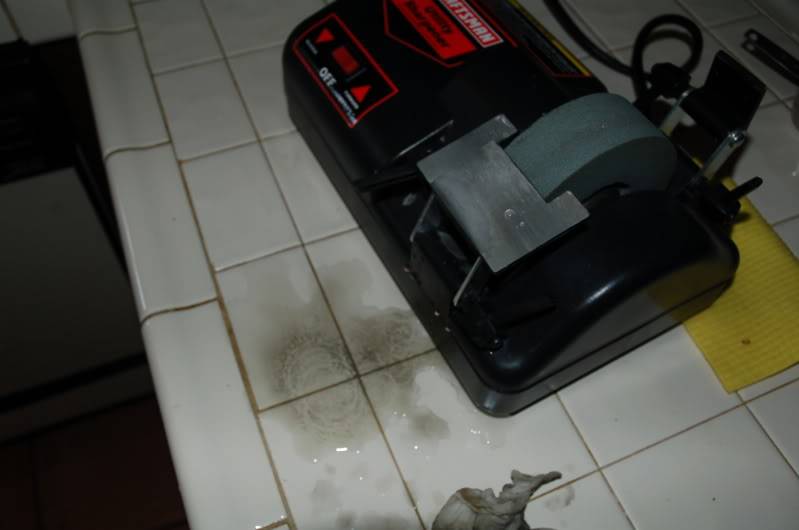
I'm not sure where to post this, but I wanted to show this just because of the incredible nature of the phenomenon.

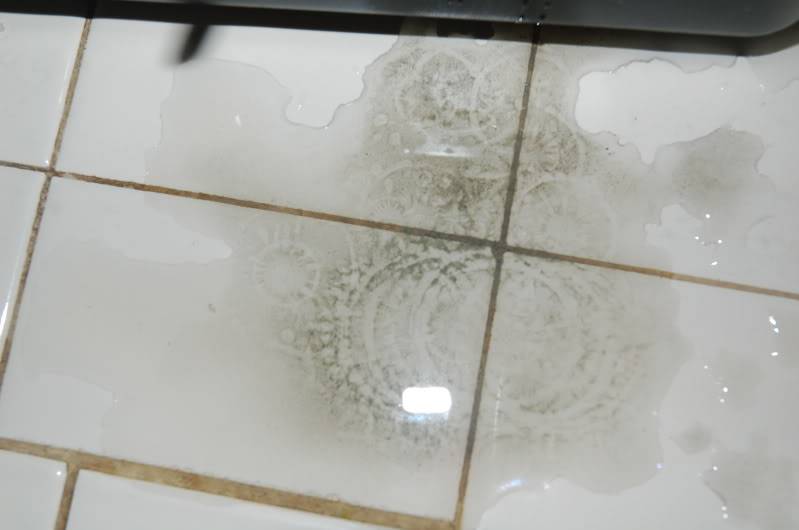
It's just the dust from a slow running wet grindstone. I assume just vibration, but the more carefully you look the more unbelievable it becomes.

As the grindstone ran, some of the water spilled over the edge of the reservoir carrying the grit. I put a HUGE magnet next to it and repeated the experiment. It made no difference. I also did it on a fiberglass tray. Same again. So the vibration factor would have been very different.

The photos are not very good, but the more you look, the more complexity you can see.
DSC_0014.jpg


DSC_0013.jpg
 
Physics news on Phys.org
I assumed something like that, but to be repeated on a totally different surface belies the patterned resonance of a specific diaphragm.

The varied nature of the wheels hints at a pattern generation of some complexity, but when I swamped any magnetic influence, I was stumped.
 
Rob Benham said:
I assume just vibration
Are you sure these aren't some fatty marks on the surface (e.g. from the foot of the grinder)? Otherwise it might indeed be sound propagating in the water puddle, creating some standing waves.
 
  • Like
Likes   Reactions: Jon Richfield
The 'experiment' was fully repeatable, and the pattern very similar on the fiberglass (dining) tray. In each case over a couple of days, five times at least, a set of 'crop circles' were produced. Each time a subtly different pattern was generated.

It is to my lasting regret that I didn't research this more fully but I was racing to get house sold.

The only common factor I can think of is the liberal use of a sterilization spray on both work surface and tray but I doubt that would have caused the beautiful symmetry seen in the circles.
 
  • Like
Likes   Reactions: Jon Richfield
Nice example of cymatics.
 
Yes, in the last few seconds it shows an image that has remarkable similarity. I guess loading the rotational speed while doing work would account for the changes, though it's hard to understand why it didn't alter the symmetry of the individual circles as the speed changed.
 
Does the grindstone have round rubber feet about the same size as the circles?
 
No, they may have been 15mm diameter, while the circles varied between 15 and 40mm.

The grindstone remained roughly in the same position for that working day and the circles appeared in spilled water as in the second picture.

What still puzzles me is that the fiberglass tray (not shown) would have had a quite different resonance characteristics to the tiled work-surface.
 
  • #10
I'm not clear about this: did you move the grindstone back to find this puddle underneath, or did the puddle and patterns form in front of the grinder while you worked?
 
  • #11
I think you've found a way to lift the latent prints of drinking glasses on surfaces they regularly visit.
 
  • #12
zoobyshoe, the latter. Much as the second picture but often with a very much bigger spillage and proportionate increase in number of patterns.

stedwards, My mind's wide open, but we were living on site and my wife's dæmonic attack with cleaners at the end of each working day would have scotched that idea - probably - though as mentioned, the fluids themselves are a common denominator with the surface and fiberglass tray.

The work-surface is fairly typical where I was in Texas, and at first I'd wondered if the patterns were caused by the tile manufacturing process. Hence the run on the tray. Sadly, I had a network drive fail while we were selling up and then my main hard-drive did not survive being carried in hand baggage on the UK flight. Security scanning? :-( So, many pictures lost. I'll search, but it will take a while.

The last moments of the above video do show a real likeness (shown under titles etc.) and do make me lean towards that answer, but I'm still not totally convinced.
 
  • #13
I like them because they look like eroded petroglyphs or Central American rock carvings of weird mojo symbols, and maybe some figures. At the same time, there's this other "crystaline" dynamic, like some kind of crystals are forming over the old, eroded carvings. If you find better pics, I'd like to see.
 
  • #14
stedwards said:
I think you've found a way to lift the latent prints of drinking glasses on surfaces they regularly visit.
More I think about it, the more this explanation makes sense. The big "series" of same sized rings toward the bottom of the pic looks exactly like "prints" from a drinking cup that's been picked up and set down repeatedly. I don't see that kind of overlapping pattern in those Chladni figures. I haven't ever seen it in fractals, either. (Not that I have an exhaustive knowledge of Chladni figures or fractals. Far from it.)

Notice, too, that some of the circles jump over the grout lines and continue on the other tiles. That might be explained by the fact the plywood underneath the tile is the dominant vibrating surface, but I doubt it could vibrate normally with the tiles glued to it. If Rob's wife has cleaned the surfaces a lot, there wouldn't be any "prints" from liquids in a drink.

What occurred to me as an alternative is that the drink containers could have abraded some fine finish that might exist on the tile (and plastic tray) surfaces and left rings of duller finish. Ceramic coffee cups have unglazed ceramic rings on the bottom which are abrasive. (I once read a piece by a knife sharpener who advised that, if you find yourself without a whetstone you can use those unglazed ceramic rings on the bottom of coffee cups to sharpen knives.) I think it's plausible a coffee cup would produce microscopic abrasions when set down on an otherwise very smooth surface.

But notice there are at least three different sizes of circle. If an abraded surface hypothesis were correct, we would expect there to be containers of two other sizes that were set down here at some point. Anything made of glass (bottle, jar) would fit the bill, and I think the bottom rim of any steel can would be a proper suspect, like a can full of old bolts and nuts.

Once those abrasion rings are there, then the vibrated mix of grindstone dust and water might arrange itself in reaction to them. Which, if true, would mean Rob has, as you say, discovered a way to reveal the "history" of a tile surface.
 
  • #15
Mmm . . . well I was hoping that I'd found a way to detect the quantum foam of the Universe, but I suppose a more mundane answer will likely be the truth. My son in Texas has made a sterling effort to save the contents of the Black Armor network drive. I'll suggest some files and ask if he can find more pictures.

The circles on the tray were virtually identical and formed within moments of the next test. I just can't see this 'information' being the same despite being carried out on top of the same kitchen counter.

I'll revive the thread on the (not so serious) section of a pilot's forum and see if any US members has one of these stones. A long shot, but I've piqued my own interest again.
 
Last edited:
  • #16
Rob Benham said:
Mmm . . . well I was hoping that I'd found a way to detect the quantum foam of the Universe, but I suppose a more mundane answer will likely be the truth.

The jury is still out. The drinking glass and food vessel theory doesn't seem to account for the equally spaced markings radiating from the circles.
 
  • #17
As mentioned before, the liquid is the same in both cases, so the surface tension and viscosity of the liquid would have also been the same.

It would have been interesting to see if the same pattern formed after adding a small amount of detergent to the puddle to alter the surface tension..
 
  • #18
Why didn't I think of that? A perfect next step. :frown:
 

Similar threads

  • · Replies 5 ·
Replies
5
Views
5K
  • · Replies 69 ·
3
Replies
69
Views
17K
  • · Replies 1 ·
Replies
1
Views
3K
Replies
7
Views
5K
Replies
4
Views
2K
  • · Replies 28 ·
Replies
28
Views
10K
  • · Replies 26 ·
Replies
26
Views
7K
  • · Replies 62 ·
3
Replies
62
Views
12K
  • · Replies 25 ·
Replies
25
Views
6K
Replies
14
Views
11K