Need help regarding the derivation of a 2-particle wavefunction

Click For Summary

Homework Help Overview

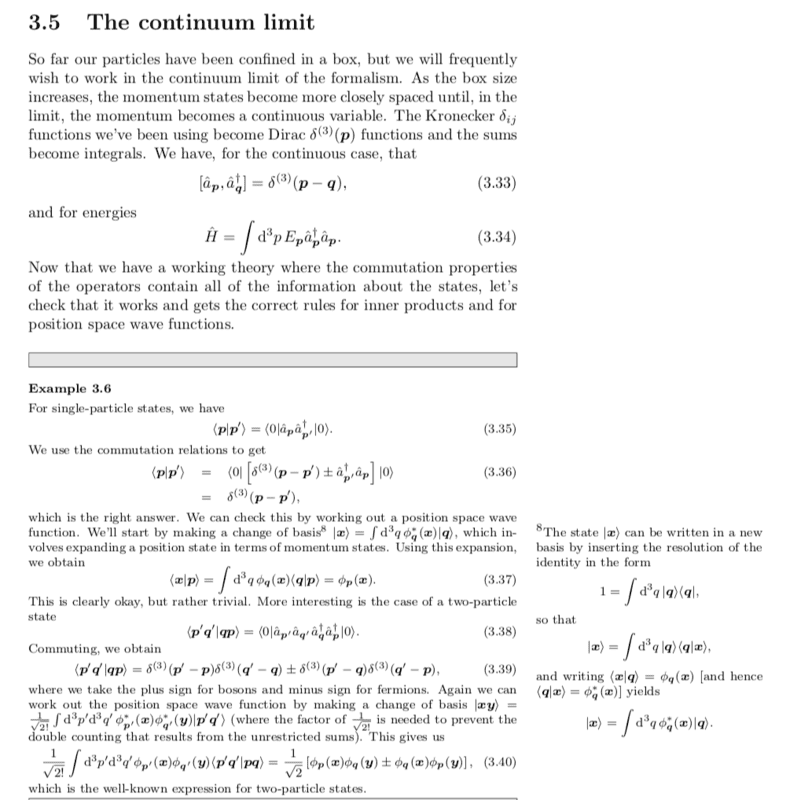
The discussion revolves around the derivation of a two-particle wavefunction as presented in equation 3.40 of Blundell's Quantum Field Theory book. Participants are exploring the implications of symmetrization or antisymmetrization in the context of quantum states and the normalization factors involved in the derivation.

Discussion Character

  • Conceptual clarification, Assumption checking, Mixed

Approaches and Questions Raised

  • Participants are attempting to understand the necessity of the normalization factor of ##1/\sqrt{2!}## in the context of two-particle states. There is a discussion about the implications of assuming that two-particle states can be expressed as simple tensor products and the need for symmetrization or antisymmetrization. Questions are raised about the preservation of normalization in Fourier transforms and the correct form of the two-particle states.

Discussion Status

The discussion is ongoing, with participants providing insights and questioning assumptions related to the normalization of two-particle states. Some have offered clarifications regarding the symmetrization of states and the role of normalization factors, but no consensus has been reached on the interpretation of Blundell's remarks or the correct formulation of the wavefunction.

Contextual Notes

Participants are navigating the complexities of quantum mechanics and quantum field theory, particularly in relation to the definitions and properties of two-particle states. There is an acknowledgment of the need for proper normalization in the context of symmetrized or antisymmetrized states, but the exact implications and definitions remain under discussion.

WWCY
Messages
476
Reaction score
15
Homework Statement
From Blundell's QFT
Relevant Equations
Fourier transforms
I have an issue trying to understand the derivation of equation 3.40 (screenshot attached) of Blundell's QFT book. Here's my attempt.

##| x,y \rangle = |x\rangle \otimes |y\rangle = \Big( \int dp' \phi_{p'}(x)|p'\rangle \Big) \otimes \Big( \int dq' \phi_{q'}(y)|q'\rangle \Big)## which gives ##\int dp' \int dq' \phi_{p'}(x) \phi_{q'}(y) |p',q'\rangle##.

I can't seem to understand the argument by Blundell that "the factor of ##1/\sqrt{2!}## is needed to prevent double counting that results from unrestricted sums". Why does the factor of ##1/\sqrt{2!}## not "pop out" on its own? Aren't Fourier transforms supposed to preserve normalisation?Cheers.
Screenshot 2019-06-19 at 6.10.16 AM.png
 
Physics news on Phys.org
could someone assist? Many thanks
 
Since no one has responded yet, I will try to help a little. I am not very familiar with this topic.

WWCY said:
##| x,y \rangle = |x\rangle \otimes |y\rangle = \Big( \int dp' \phi_{p'}(x)|p'\rangle \Big) \otimes \Big( \int dq' \phi_{q'}(y)|q'\rangle \Big)## which gives ##\int dp' \int dq' \phi_{p'}(x) \phi_{q'}(y) |p',q'\rangle##.

You assumed here that ##|x,y \rangle = |x\rangle \otimes |y\rangle ## and ##|q,p \rangle = |p \rangle \otimes |q\rangle ##. But I don't think that's right. ##| x,y \rangle ## and ##| q,p \rangle## are two-particle states that are already symmetrized or antisymmetrized for bosons or fermions.

For example, the definition of ##| p,q \rangle## is ##| p,q \rangle = \hat a_p ^\dagger \hat a_q^ \dagger | 0 \rangle##. Using the commutation relations for the operators, you see that ##| p,q \rangle = \pm | q, p \rangle##, (+ for bosons, - for fermions). But, ##|p \rangle \otimes |q\rangle\neq \pm |q \rangle \otimes |p\rangle##.

I can't seem to understand the argument by Blundell that "the factor of ##1/\sqrt{2!}## is needed to prevent double counting that results from unrestricted sums". Why does the factor of ##1/\sqrt{2!}## not "pop out" on its own? Aren't Fourier transforms supposed to preserve normalisation?
Here, I don't think I can help much. As I see it, the factor of ##1/\sqrt{2!}## is part of the definition of ##|x,y \rangle##. I'm not sure of the interpretation of Blundell's remark about preventing double counting. But, with the factor of ##1/\sqrt{2!}##, you can see that you get the properly normalized result in Blundell's (3.40).
 
  • Like
Likes   Reactions: WWCY
Hi, thanks for the reply!

I completely forgot about the part regarding anti-symmetry/symmetric states.

However, would it make any sense if I performed the Fourier transforms on this (symmetric) state? ##|x,y\rangle = \frac{1}{\sqrt{2}} ( |x \rangle |y\rangle + |y \rangle |x\rangle )##
 
WWCY said:
Hi, thanks for the reply!

I completely forgot about the part regarding anti-symmetry/symmetric states.

However, would it make any sense if I performed the Fourier transforms on this (symmetric) state? ##|x,y\rangle = \frac{1}{\sqrt{2}} ( |x \rangle |y\rangle + |y \rangle |x\rangle )##

If you take ##|p, q \rangle## as corresponding to ##\frac{1}{\sqrt{2}}( |p \rangle |q \rangle + |q \rangle ||p \rangle)## and ##|x, y \rangle## as corresponding to ##\frac{1}{\sqrt{2}} (|x \rangle |y \rangle + |y \rangle |x \rangle )##, then ## \langle y, x | p, q \rangle## will not yield the factor of ##\frac{1}{\sqrt{2}}## in Blundell's (3.40). If you want to get that factor, it appears that you would have to take ##|x,y\rangle## as corresponding to ## \frac{1}{2} ( |x \rangle |y\rangle + |y \rangle |x\rangle )## which has an overall factor of ##\frac{1}{2}## instead of ##\frac{1}{\sqrt{2}}##. This corresponds to the extra factor of ##\frac{1}{\sqrt{2!}}## that Blundell includes in his definition of the change of basis from the basis ##|p, q \rangle ## to the basis ##|x, y \rangle##.
 

Similar threads

Replies
2
Views
2K
  • · Replies 12 ·
Replies
12
Views
2K
  • · Replies 0 ·
Replies
0
Views
2K
  • · Replies 4 ·
Replies
4
Views
3K
Replies
3
Views
2K
Replies
1
Views
2K
Replies
3
Views
2K
  • · Replies 1 ·
Replies
1
Views
7K
Replies
27
Views
4K
  • · Replies 5 ·
Replies
5
Views
2K