Need to determine best placement and stroke length of a pneumatic cylinder

Click For Summary

Discussion Overview

The discussion revolves around the optimal placement and stroke length of pneumatic cylinders for a device designed to tilt a 500-pound load by 20 degrees. Participants explore various configurations, geometrical considerations, and structural integrity related to the design of the platform and the pneumatic system.

Discussion Character

  • Exploratory
  • Technical explanation
  • Debate/contested
  • Mathematical reasoning

Main Points Raised

  • One participant describes a device consisting of a hinged platform and inquires about the effective placement of the pneumatic cylinder.
  • Another suggests mounting the cylinder at a 45-degree angle and considers using a longer stroke, though they express uncertainty about the exact length needed.
  • Several participants discuss the dimensions of the cylinders, noting the importance of ensuring that the extended and retracted lengths are appropriate for the design.
  • A participant mentions that the geometry of the setup requires a force greater than what the cylinder can provide at 100 PSI, suggesting that the cylinder may need to be mounted higher or more horizontally.
  • There is a discussion about the structural integrity of the uprights supporting the load, with one participant expressing doubt about their strength.
  • Another participant emphasizes the need to account for the rod area in force calculations when using the pneumatic cylinder, noting that it can push harder than it can pull.
  • Some participants reference an online calculator for determining the necessary stroke length based on geometric considerations.
  • There are multiple mentions of the air pressure available for the system, with a consensus that it is 100 PSI.

Areas of Agreement / Disagreement

Participants express various viewpoints on the optimal configuration and stroke length for the pneumatic cylinders, with no clear consensus reached. There are differing opinions on the structural adequacy of the design and the necessary calculations for force and geometry.

Contextual Notes

Participants highlight the importance of considering the geometry and structural support in the design, as well as the limitations of the pneumatic system based on the available air pressure and cylinder specifications.

Who May Find This Useful

This discussion may be of interest to individuals involved in mechanical design, engineering, or those working with pneumatic systems, particularly in applications requiring load manipulation and tilting mechanisms.
WilliamHerron
Messages
19
Reaction score
2
TL;DR
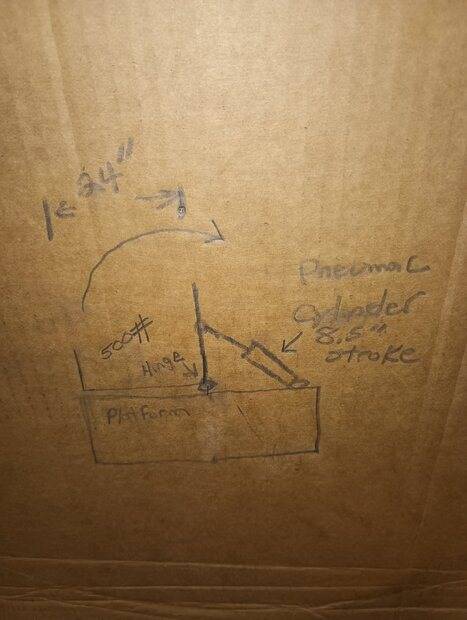
I'm making a device that will use pneumatic cylinders to tilt a 500# load 20 degrees.
I'm making a device that will tilt a 500# load 20 degrees.

Going to consist of a hinged 24" x 24" platform (that the load sets on).

The platform will tilt to the right(clockwise) according to sketch.

The upright post that the cylinder is attached to could be any length.

The cylinder will retract to lift the platform and load.

What would be the most effective placement of the cylinder?

I currently have a couple 2" bore... 8.5" stroke cylinders... will this be sufficient.. or should I use longer stroke cylinders?Thanks much!
IMG_20221004_125249480.jpg
 
Engineering news on Phys.org
I feel that my best bet would be to mount the extended cylinder at a 45degree angle...and go with a longer stroke(Not sure how much longer) but, I'm not sure.
 
How long are the cylinders themselves? Obviously, you'll have to ensure the extended and retracted length is going to be in-range.

Is this a Hallowe'en thing? Maybe I'm just primed for the season but I envision a Frankenstein's Monster contraption on a porch. :)
 
  • Like
Likes   Reactions: WilliamHerron
DaveC426913 said:
How long are the cylinders themselves? Obviously, you'll have to ensure the extended and retracted length is going to be in-range.

Is this a Hallowe'en thing? Maybe I'm just primed for the season but I envision a Frankenstein's Monster contraption on a porch. :)

The cylinder is about 14" retracted ..and 22.5" extended.I wish it was that cool..

Hah
 
About right?
1664905977731.png

1664906386219.png
 
Last edited:
Absolutely!I'm using 2 - 2" bore cylinders.

Is the stroke length long enough to get the ideal starting angle?(your sketch looks a bit better than mine... hah... Whatd you use?)
 
WilliamHerron said:
(your sketch looks a bit better than mine... hah... Whatd you use?)
I just Photoshopped it. It's what I do.
WilliamHerron said:
Is the stroke length long enough to get the ideal starting angle?

I cannot speak to the engineering aspect; that will have to wait for someone qualified to weight in.

But speaking simply to the geometry, anything between 9.9" and 15.9" will do the trick:

Pulled from this online calculator:

https://www.omnicalculator.com/math/triangle-45-45-90
1664906730137.png

1664906774556.png
 
9.9 to 15.9...Are you saying that needs to be the length from the hinge to where the cylinder mounts to platform?
(And, I guess thatd give the 45degree angle)
 
  • Like
Likes   Reactions: DaveC426913
Question: that upright seems to be the weak component. Are you confident it can be secured to the base sufficiently strong to torque 500 pounds?
 
  • Like
Likes   Reactions: Lnewqban
  • #10
i am going to have 2 uprights.

2" x 2" tube steel... 3/16" thick walls.
I'll add a bit of reinforcing to the bottom of ONE of the uprights. (I really can't add anything to the left of one of the uprights)

I'm going to tie the 2 uprights together with a couple pieces of 2"x2". probably one at the top.. and one in middle.

Confident?

Nope.

:|
 
  • #12
WilliamHerron said:
9.9 to 15.9...Are you saying that needs to be the length from the hinge to where the cylinder mounts to platform?
(And, I guess thatd give the 45degree angle)
Sorry, no. I have not accounted for the range of the piston. It can't be as small as 9.9". That won't allow for any retraction of the piston.

Practically, the best bet is to go with something just shy of 15.9" so it's at almost max extension when load is flat.
 
  • #14
WilliamHerron said:
Sorry about that. I do not know how to merge posts.
No need to be sorry.
Just saying that you had good progress and advice in that previous one, and that the cylinders seem to be just a continuation.

I would complete a design of the platform and frame prior to the actuator’s location and points of anchoring to it.
Sometimes, what seems possible finds unforeseen conditions mandate by structure and available space.
 
  • Like
Likes   Reactions: WilliamHerron
  • #15
(possibly) important note:

When using an air cylinder to retract, the rod area must be subtracted from the cylinder area in the force calculation (a cylinder can push harder than it can pull). Your cylinder can push 315 LB with 100 PSIG air. The geometry in your/Dave's sketch requires a larger force than that (approx 350 LB) to init motion. I think that the cylinder is going to have to be mounted higher / more horizontal (assuming 100 PSI). If you have higher air pressure, you might be OK - need rod size to calc cylinder force.

Edit: a whole bunch happened real fast while I was typing. This was going to be post #6...
 
  • Informative
  • Like
Likes   Reactions: WilliamHerron and DaveC426913
  • #16
Dullard said:
(possibly) important note:

When using an air cylinder to retract, the rod area must be subtracted from the cylinder area in the force calculation (a cylinder can push harder than it can pull). Your cylinder can push 315 LB with 100 PSIG air. The geometry in your/Dave's sketch requires a larger force than that (approx 350 LB) to init motion. I think that the cylinder is going to have to be mounted higher / more horizontal (assuming 100 PSI). If you have higher air pressure, you might be OK - need rod size to calc cylinder force.

Edit: a whole bunch happened real fast while I was typing. This was going to be post #6...

I was thinking that cylinder could PUSH harder than PULL... And my original thought was to have the cylinders under the platformBut, space and ease of maintenance was an issue with that.So... I had to punt... And try something different.I've been told that plant pressure is 100psi.
 
  • #17
WilliamHerron said:
I was thinking that cylinder could PUSH harder than PULL... And my original thought was to have the cylinders under the platformBut, space and ease of maintenance is an issue with that
It could still be constructed to push. if you make good use of the space to the right of the base; it would just be a little more complicated.
1664911320075.png

(For illustrative purposes only. I don't recommend this geometry)
 
Last edited:
  • Like
Likes   Reactions: WilliamHerron
  • #18
What air pressure do you have?
 
  • #19
Dullard said:
What air pressure do you have?
I have been told that plant air is 100psi.