Undergrad Negative values for Gaussian Distribution

Click For Summary
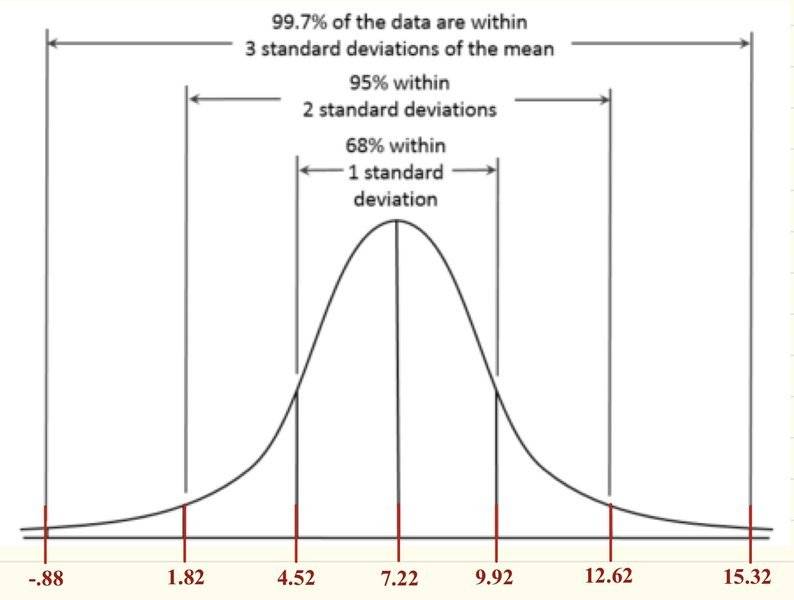
In a Physics lab experiment involving dart throws at a target with 13 bins, a Gaussian Distribution was created based on class data, revealing a third standard deviation below the mean of 7.22 as -0.88. This negative value indicates a possible outcome where a dart lands to the left of the first bin, suggesting that while the bins are limited, the distribution can still account for extreme values. The average, standard deviation, and standard error were calculated as 7.22, 2.7, and 0.085, respectively. The presence of negative values in a Gaussian Distribution does not imply an error; rather, it reflects the potential for outliers in the data. Thus, the distribution accurately represents the variability of dart throws, including poor aim.
aron silvester
So in my Physics lab, we divided into groups and our task was to throw darts on a target containing 13 bins. The bins look something like the image below. At the end, our class combined our average, standard deviation, and standard error. I made a Gaussian Distribution and I noticed that the third standard deviation below the mean of 7.22 is equal to -0.88. Is this possible to have a negative value even though there were only 13 bins?

Class Data:
Average: 7.22
Standard Deviation: 2.7
Standard Error: 0.085

Here is the target. It was just a paper that we pinned to the wall.

IMG_1594.JPG


Here is the Gaussian Distribution that I created with the negative value.
IMG_1595.JPG
 
Physics news on Phys.org
Since you have labelled the bins left to right in order, the number can be thought to measure distance from the origin where the origin is one box to the left of box 1. There is nothing wrong with the distribution. Its telling you that there is some finite probability that someone is really bad at aiming and throws a dart which lands to the left of box 1.
 
I do not have a good working knowledge of physics yet. I tried to piece this together but after researching this, I couldn’t figure out the correct laws of physics to combine to develop a formula to answer this question. Ex. 1 - A moving object impacts a static object at a constant velocity. Ex. 2 - A moving object impacts a static object at the same velocity but is accelerating at the moment of impact. Assuming the mass of the objects is the same and the velocity at the moment of impact...

Similar threads

  • · Replies 6 ·
Replies
6
Views
2K
Replies
4
Views
2K
Replies
28
Views
4K
  • · Replies 4 ·
Replies
4
Views
3K
  • · Replies 19 ·
Replies
19
Views
2K
  • · Replies 3 ·
Replies
3
Views
3K
Replies
2
Views
6K
  • · Replies 8 ·
Replies
8
Views
5K
  • · Replies 7 ·
Replies
7
Views
4K
  • · Replies 7 ·
Replies
7
Views
6K