Negative values for Gaussian Distribution

Click For Summary
SUMMARY

The discussion centers on the validity of negative values in a Gaussian Distribution derived from a Physics lab experiment involving dart throws. The class data includes an average of 7.22, a standard deviation of 2.7, and a standard error of 0.085. The participant observed that the third standard deviation below the mean results in a value of -0.88, which is mathematically valid, indicating a finite probability of scoring below the lowest bin. This highlights the nature of Gaussian distributions and their implications in statistical analysis.

PREREQUISITES
  • Understanding of Gaussian Distribution principles
  • Familiarity with standard deviation and standard error calculations
  • Basic knowledge of statistical probability
  • Experience with data visualization tools for plotting distributions
NEXT STEPS
  • Explore the implications of negative values in statistical distributions
  • Learn about the Central Limit Theorem and its relation to Gaussian Distribution
  • Investigate data visualization techniques using tools like Python's Matplotlib
  • Study the concept of finite probability in statistical analysis
USEFUL FOR

Students in statistics or physics, data analysts, and anyone interested in understanding the properties of Gaussian distributions and their applications in experimental data analysis.

aron silvester
So in my Physics lab, we divided into groups and our task was to throw darts on a target containing 13 bins. The bins look something like the image below. At the end, our class combined our average, standard deviation, and standard error. I made a Gaussian Distribution and I noticed that the third standard deviation below the mean of 7.22 is equal to -0.88. Is this possible to have a negative value even though there were only 13 bins?

Class Data:
Average: 7.22
Standard Deviation: 2.7
Standard Error: 0.085

Here is the target. It was just a paper that we pinned to the wall.

IMG_1594.JPG


Here is the Gaussian Distribution that I created with the negative value.
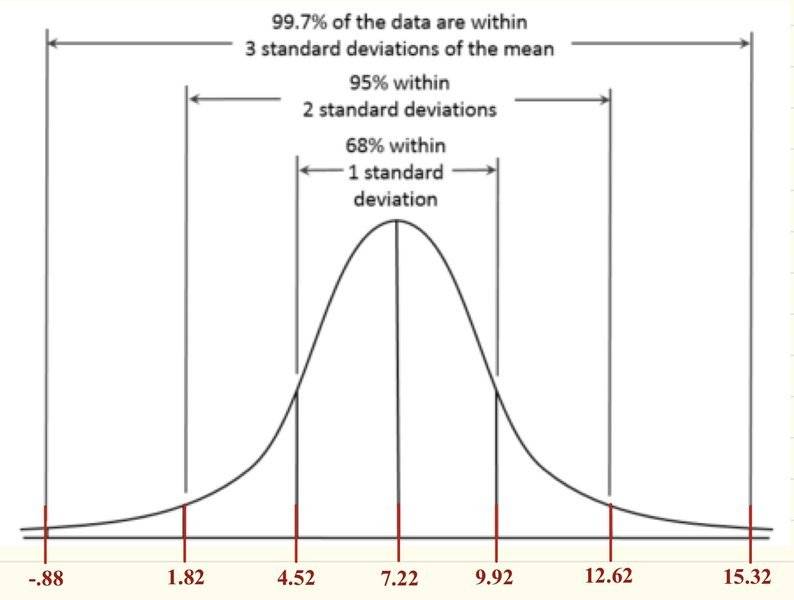
IMG_1595.JPG
 
Physics news on Phys.org
Since you have labelled the bins left to right in order, the number can be thought to measure distance from the origin where the origin is one box to the left of box 1. There is nothing wrong with the distribution. Its telling you that there is some finite probability that someone is really bad at aiming and throws a dart which lands to the left of box 1.
 

Similar threads

  • · Replies 6 ·
Replies
6
Views
2K
Replies
4
Views
2K
  • · Replies 4 ·
Replies
4
Views
3K
Replies
28
Views
4K
  • · Replies 2 ·
Replies
2
Views
2K
  • · Replies 13 ·
Replies
13
Views
2K
  • · Replies 19 ·
Replies
19
Views
3K
Replies
2
Views
6K
  • · Replies 8 ·
Replies
8
Views
5K
  • · Replies 3 ·
Replies
3
Views
3K