Neuronal Dynamics Passive membrane equation

  • Context: MHB 
  • Thread starter Thread starter winterdrops
  • Start date Start date
  • Tags Tags
    Dynamics Membrane
Click For Summary
SUMMARY

The discussion focuses on solving the differential equation of the passive membrane model, specifically the equation T_m dv/dt = -v. The integration process leads to the solution v = -RI_0 e^{-t/T_m}, which is derived from the initial condition v = -RI_0 when t = 0. The final expression for the membrane potential u is u = u_rest + RI_0(1 - e^{-t/T_m}). This solution is crucial for understanding neuronal dynamics in the context of passive membrane behavior.

PREREQUISITES
  • Understanding of differential equations and integration techniques
  • Familiarity with neuronal dynamics and passive membrane models
  • Knowledge of the constants T_m (membrane time constant) and R (resistance)
  • Basic concepts of electrical potentials in biological systems
NEXT STEPS
  • Study the derivation of the passive membrane equation in detail
  • Explore the implications of the time constant T_m in neuronal signaling
  • Learn about the role of resistance R in neuronal membrane models
  • Investigate numerical methods for simulating neuronal dynamics
USEFUL FOR

Neuroscientists, biophysicists, and students studying neuronal dynamics or mathematical modeling of biological systems will benefit from this discussion.

winterdrops
Messages
1
Reaction score
0
Hi guys,

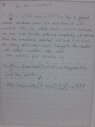
I am able to solve dif equation of passive membrane model. But later, author says following instructions to integrate first model. Even though I can solve the dif equation of model, I couldn't achieve the solution.

Could you help me pls. Best regards.
 

Attachments

  • Int1.jpg
    Int1.jpg
    882.9 KB · Views: 168
Physics news on Phys.org
Let $v = u - u_{\text{rest}}-RI_0$. Since $I(t) = I_0$, the equation becomes $T_m\, dv/dt = -v$, or $dv/v = -dt/T_m$. Integrating both sides, we obtain $\ln|v| = -t/T_m + C$ where $C$ is a constant. Thus $v = Ae^{-t/T_m}$ where $A$ is a constant. Since $v = -RI_0$ when $t = 0$, then $A = -RI_0$. Hence $v = -RI_0 e^{-t/T_m}$, or, $$u = u_{\text{rest}} + RI_0 - RI_0 e^{-t/T_m} = u_{\text{rest}} + RI_0(1 - e^{-t/T_m})$$
 

Similar threads

Replies
0
Views
2K
  • · Replies 4 ·
Replies
4
Views
2K
  • · Replies 1 ·
Replies
1
Views
4K
  • · Replies 2 ·
Replies
2
Views
1K
  • · Replies 8 ·
Replies
8
Views
2K
  • · Replies 1 ·
Replies
1
Views
3K
  • · Replies 2 ·
Replies
2
Views
2K
Replies
4
Views
1K
Replies
1
Views
1K
  • · Replies 1 ·
Replies
1
Views
2K