What New Discoveries Await in NASA's Detailed Geological Map of Mars?

  • Thread starter Thread starter BillTre
  • Start date Start date
  • Tags Tags
    Map Mars
Click For Summary
SUMMARY

The new geological map of Mars, developed by NASA and the US Geological Survey, offers unprecedented detail and accuracy in depicting the planet's surface geology. This map integrates a diverse array of remotely sensed data, including morphologic, topographic, spectral, and thermophysical observations, significantly enhancing the understanding of Martian landforms over time. The use of precise topographic mapping has improved the portrayal of surface morphology, surpassing previous methods that were hindered by atmospheric haze. Additionally, the map provides various download options for users interested in exploring Mars' geological features.

PREREQUISITES
  • Understanding of geological mapping techniques
  • Familiarity with remote sensing data types
  • Knowledge of topographic analysis methods
  • Experience with interactive web mapping tools
NEXT STEPS
  • Explore NASA's Mars Geological Map download options
  • Learn about remote sensing data acquisition methods
  • Investigate topographic mapping techniques for planetary surfaces
  • Develop skills in creating interactive web maps using JavaScript
USEFUL FOR

Astronomers, geologists, educators, and developers interested in planetary science and geological mapping of Mars will benefit from this discussion.

BillTre
Science Advisor
Gold Member
2024 Award
Messages
2,727
Reaction score
11,934
TL;DR
Putting it here, not in space, due to the geological nature of the subject.
NASA and the US Geological Survey have produced a new geological map of Mars.
Better than before.
Very detailed and interesting (to me anyway).
Lots of download options.
This new global geologic map of Mars, which records the distribution of geologic units and landforms on the planet's surface through time, is based on unprecedented variety, quality, and quantity of remotely sensed data acquired since the Viking Orbiters. These data have provided morphologic, topographic, spectral, thermophysical, radar sounding, and other observations for integration, analysis, and interpretation in support of geologic mapping. In particular, the precise topographic mapping now available has enabled consistent morphologic portrayal of the surface for global mapping (whereas previously used visual range image bases were less effective, because they combined morphologic and albedo information and, locally, atmospheric haze). Also, thermal infrared image bases used for the new map tended to be less affected by atmospheric haze and thus are reliable for analysis of surface morphology and texture at even higher resolution than the topographic products.

Here is one of my favorite Martian regions:
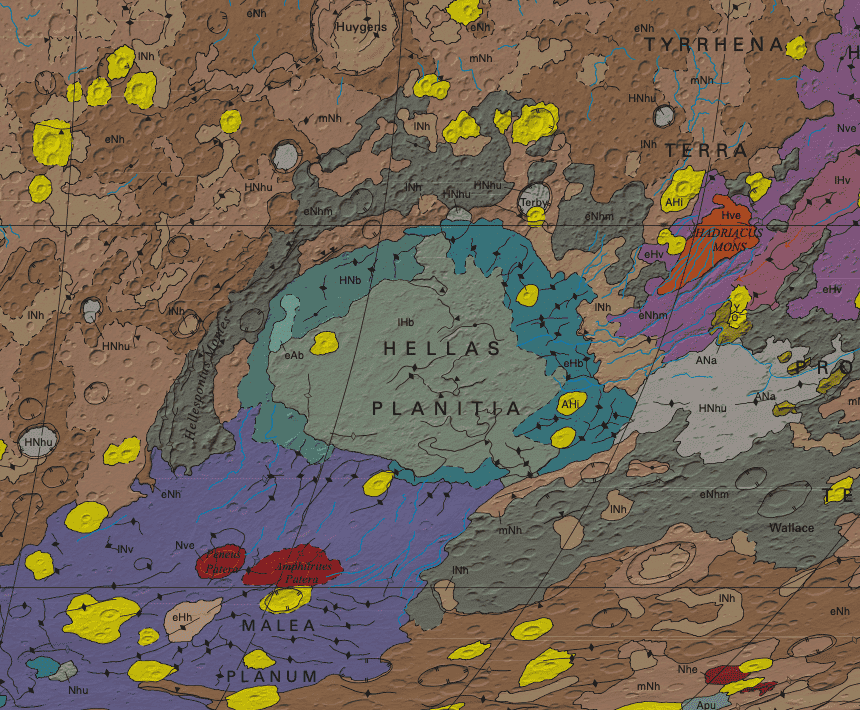
Screen Shot 2020-04-26 at 11.21.53 AM.png
 
  • Like
Likes   Reactions: pinball1970, jim mcnamara, anorlunda and 1 other person
Earth sciences news on Phys.org
So, of course I just had to look up Mark Watney's route which led me to the Wiki page that actually had a map of it... :oldtongue:

er_Arabia_Terra_in_the_Martian_highlands_to_Ares_4.jpg
 
  • Like
Likes   Reactions: pinball1970, davenn, jim mcnamara and 3 others
I literally just watched The Martian last night on the telly. (Backwards. Tuned in halfway, then it started again.)

I have that colourized altitude map as a 24x36 poster.

And I made an interactive webpage that allows you to switch layers on and off - feature labels for altitude, photo sat data and topology. http://www.davesbrain.ca/science/mars_atlas/
It's a pity I built it so long ago, the JavaScript to rollover labels for every crater larger than 20km is out-of-date. :(

Had to do this to make any sense of Robinson's "Mars" series.
 
  • Like
Likes   Reactions: chemisttree, pinball1970, Tom.G and 1 other person
Over the last several years (maybe over a decade or so) I have looked at Mars, the sky, and the moon on Google earth.

I have been looking at the Mars version, and wonder if, or, how much of, the additional geographical information will make it there. As most have, I've looked at the tracks of the old exploration vehicles (and Mark Watneys' trek) on Google Earth/Mars.
 

Similar threads

  • · Replies 64 ·
3
Replies
64
Views
12K
  • · Replies 20 ·
Replies
20
Views
7K
  • · Replies 6 ·
Replies
6
Views
3K
Replies
0
Views
2K
  • · Replies 11 ·
Replies
11
Views
4K
  • · Replies 2 ·
Replies
2
Views
3K
  • · Replies 2 ·
Replies
2
Views
4K
  • · Replies 6 ·
Replies
6
Views
5K
  • · Replies 1 ·
Replies
1
Views
4K