New Horizons Sees First Features on Pluto

Click For Summary
SUMMARY

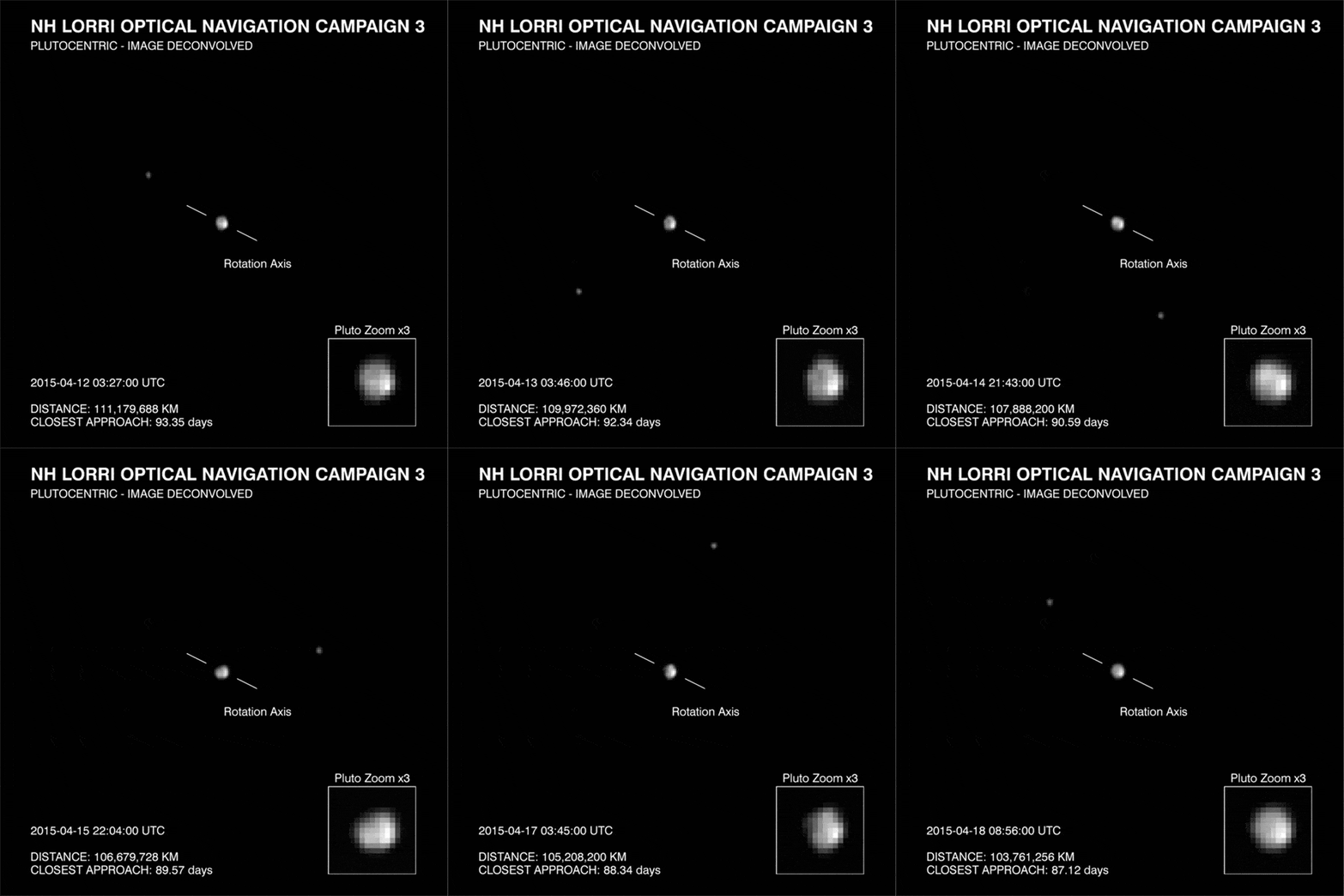
The New Horizons space probe has captured detailed images of Pluto's surface features for the first time, surpassing previous Hubble Space Telescope (HST) images in resolution. The discussion highlights the tidal locking of Pluto and the elliptical orbit observed in the images. While the resolution of New Horizons images is claimed to be higher, some participants argue that HST's capabilities have not been fully acknowledged. Further detailed images are expected in approximately two months, which will enhance the understanding of Pluto's surface.

PREREQUISITES
  • Understanding of planetary science and celestial mechanics
  • Familiarity with the capabilities of space probes like New Horizons
  • Knowledge of astronomical imaging techniques, particularly Hubble Space Telescope imaging
  • Basic comprehension of tidal locking and orbital mechanics
NEXT STEPS
  • Research the imaging capabilities of the New Horizons space probe
  • Explore the effects of tidal locking on celestial bodies
  • Learn about the Hubble Space Telescope's imaging techniques and limitations
  • Investigate the upcoming data release from New Horizons and its implications for planetary science
USEFUL FOR

Astronomers, planetary scientists, and space enthusiasts interested in the latest findings from the New Horizons mission and the study of Pluto's surface features.
Drakkith
Mentor
Messages
23,198
Reaction score
7,677
From here: http://www.slate.com/blogs/bad_astr...sees_surface_features_for_the_first_time.html

"At a press conference on Wednesday astronomers working on the New Horizons space probe revealed new images that show surface features on Pluto for the first time!"

newhorizons_plutospin_apr2015.gif
 
  • Like
Likes   Reactions: Greg Bernhardt, DennisN and wabbit
Astronomy news on Phys.org
Wow. Not much detail here yet but aren't we seeing the tidal lock of Pluto in action in this movie ? The more I look at it the more obvious it seems.
 
It does sort of look like it. I hadn't noticed before.
 
Actually, great as these images are, their title seems overstated, Hubble showed surface features before. I guess they mean "first time for New Horizon".
 
I believe that is the intended message. :wink:

Interestingly, New Horizons' images are now more detailed than the HST's.
 
Hmm not quite yet from what I see, I don't think they beat that yet though it's only a matter of time :

421589main_p1006aw-540.jpg
 
wabbit said:
Wow. Not much detail here yet but aren't we seeing the tidal lock of Pluto in action in this movie ? The more I look at it the more obvious it seems.
The rotation axis is a bit tilted against the view (see the changing apparent distance between Pluto and Charon), so we still see something new.
Not much to see. One area looks darker, in agreement with the reconstruction from Hubble images. Anyway, we'll see more in two months.
 
Oh two months ? I was kinda hoping for something earlier.. but I suppose you can't force celestial mechanics to play by the rules of live TV shows : )

Yes I noticed the elliptical apparent orbit, was trying to eyeball the focii but to no avail I'm afraid. I convinced myself it was centered but this may as well be self delusion. It does look so though with a major axis about 25 % longer than minor ?
 
Last edited:
wabbit said:
Hmm not quite yet from what I see, I don't think they beat that yet though it's only a matter of time :

The article is the one claiming that the resolution is higher. Plus I think your image is derived from a number of much lower quality images. I know for a fact that the HST can't see Pluto anywhere close to the resolution shown in the image.
 
  • #10
Right they must mean better optical resolution.
Found something that looks like a single image from HST, perhaps not the best one but it isn't close
PIA00827_modest.jpg
 
  • #11
The Hubble "image" is a computer-generated model to fit several images, right.

wabbit said:
Oh two months ? I was kinda hoping for something earlier.
Well, Pluto diameter in pixels is roughly inversely proportional to the time to fly-by, which is ~2.5 months away. In 1 month we get images with roughly twice the resolution. That will look something like the model from Hubble but for every image, which allows to make better composite images.
 
  • #13
In the meantime they might also work the same magic as HST to do a nice composite - not much point maybe but it would be fun : )
 
  • #14
Drakkith said:
See here, Wabbit: http://www.boulder.swri.edu/~buie/pluto/mapstory.html
It tells the story of how the surface maps of Pluto were made and has a series of images from the HST.
Great, thanks !

Edit. Impressive processing, the single images look more or less similar the the NH pictures.
 

Similar threads

  • · Replies 4 ·
Replies
4
Views
3K
  • · Replies 6 ·
Replies
6
Views
3K
  • · Replies 3 ·
Replies
3
Views
2K
  • · Replies 5 ·
Replies
5
Views
2K
  • · Replies 0 ·
Replies
0
Views
2K
Replies
5
Views
2K
  • · Replies 3 ·
Replies
3
Views
2K
  • · Replies 2 ·
Replies
2
Views
2K
  • · Replies 2 ·
Replies
2
Views
2K
  • · Replies 129 ·
5
Replies
129
Views
20K