Newton's identities and matrices

Click For Summary
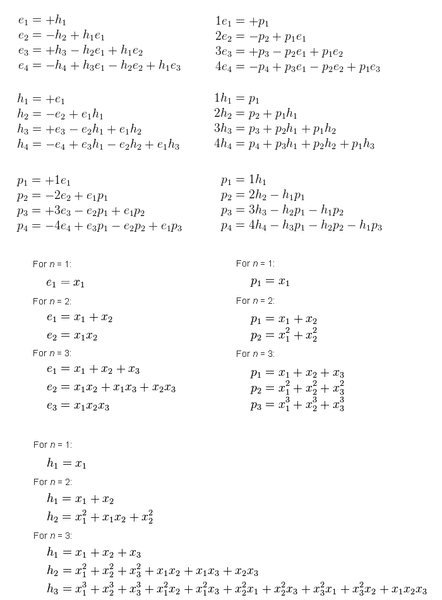
Newton's identities relate the power sums of the eigenvalues of a matrix to its invariants. The statements that ek equals the kth invariant Ik, pk equals the trace of Ak, and hk equals the determinant of Ak are affirmed as correct. The matrix A is defined as a diagonal matrix with eigenvalues x1, x2, ..., xn. These identities are essential in understanding the relationships between the eigenvalues and the matrix's characteristics. The discussion emphasizes the importance of these identities in matrix theory.
Jhenrique
Messages
676
Reaction score
4
About the Newton's identities:
Newton_s_identities.png


I'm right if I state that ek = Ik, pk = tr(Ak) and hk = det(Ak) (being Ik the kth-invariant of the matrix A)?
 
Physics news on Phys.org
PS: being ##A = \begin{bmatrix}
x_1 & 0 & \cdots & 0 \\
0 & x_2 & \cdots & 0 \\
\vdots & \vdots & \ddots & \vdots \\
0 & 0 & \cdots & x_n \\
\end{bmatrix}##
 
I am studying the mathematical formalism behind non-commutative geometry approach to quantum gravity. I was reading about Hopf algebras and their Drinfeld twist with a specific example of the Moyal-Weyl twist defined as F=exp(-iλ/2θ^(μν)∂_μ⊗∂_ν) where λ is a constant parametar and θ antisymmetric constant tensor. {∂_μ} is the basis of the tangent vector space over the underlying spacetime Now, from my understanding the enveloping algebra which appears in the definition of the Hopf algebra...

Similar threads

  • · Replies 6 ·
Replies
6
Views
3K
  • · Replies 8 ·
Replies
8
Views
2K
  • · Replies 2 ·
Replies
2
Views
1K
  • · Replies 4 ·
Replies
4
Views
3K
  • · Replies 3 ·
Replies
3
Views
2K
  • · Replies 11 ·
Replies
11
Views
6K
  • · Replies 15 ·
Replies
15
Views
5K
  • · Replies 9 ·
Replies
9
Views
25K
  • · Replies 1 ·
Replies
1
Views
3K
  • · Replies 8 ·
Replies
8
Views
3K