Noetherian Modules .... Cohn Theorem 2.2 .... ....

  • Context: Undergrad 
  • Thread starter Thread starter Math Amateur
  • Start date Start date
  • Tags Tags
    Modules Theorem
Click For Summary

Discussion Overview

The discussion revolves around understanding a specific aspect of the proof of Theorem 2.2 from P.M. Cohn's "Introduction to Ring Theory," particularly focusing on the implications of certain conditions related to Noetherian modules and chain conditions. Participants seek clarification on the reasoning behind the assertion that equality holds in a chain of submodules under specific conditions.

Discussion Character

  • Technical explanation, Conceptual clarification, Debate/contested

Main Points Raised

  • Peter seeks clarification on how the condition ##a_j \in N_{i_j}## and ##k = \text{ max} \{ i_1, \ ... \ ... \ , i_r \}## leads to equality in the chain from ##N_k## onwards.
  • Some participants propose that to show ##N_{k+1} \subseteq N_k##, it suffices to demonstrate that elements of the form ##n = \sum \lambda_i a_i## belong to ##N_k##, given that ##a_1, \dots, a_r## are contained in ##N_k##.
  • Peter expresses confusion about whether all elements ##a_1, \dots, a_r## are contained in ##N_{k+1}## and questions the argument that leads to ##(a_1, \dots, a_r) \subseteq N_k##.
  • A later reply clarifies that since ##k \geq i_1##, it follows that ##N_{i_1} \subseteq N_k##, thus implying ##a_1 \in N_k## and similarly for other indices.
  • There is a discussion about the meaning of the notation ##(a_1, \dots, a_r)##, which refers to the module generated by these elements.

Areas of Agreement / Disagreement

Participants do not reach a consensus on the clarity of the argument regarding the containment of elements in the submodules, indicating that some aspects of the proof remain contested or unclear.

Contextual Notes

Participants highlight potential ambiguities in the proof, particularly regarding the assumptions about the containment of elements in the submodules and the implications of the chain conditions.

Math Amateur
Gold Member
MHB
Messages
3,920
Reaction score
48
I am reading P.M. Cohn's book: Introduction to Ring Theory (Springer Undergraduate Mathematics Series) ... ...

I am currently focused on Section 2.2: Chain Conditions ... which deals with Artinian and Noetherian rings and modules ... ...

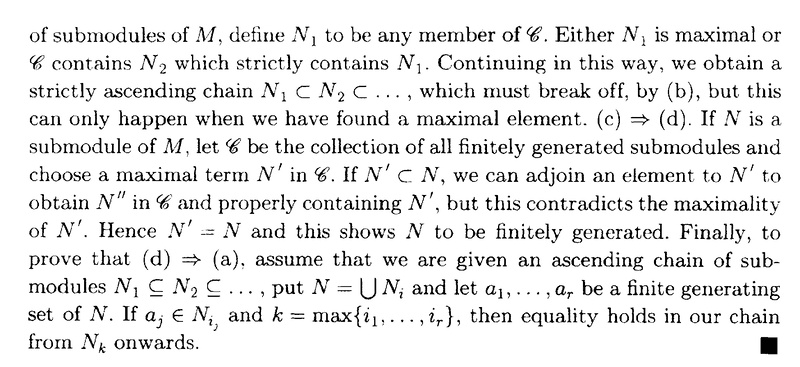
I need help with understanding an aspect of the proof of Theorem 2.2 ... ...Theorem 2.2 and its proof (including some preliminary relevant definitions) read as follows:
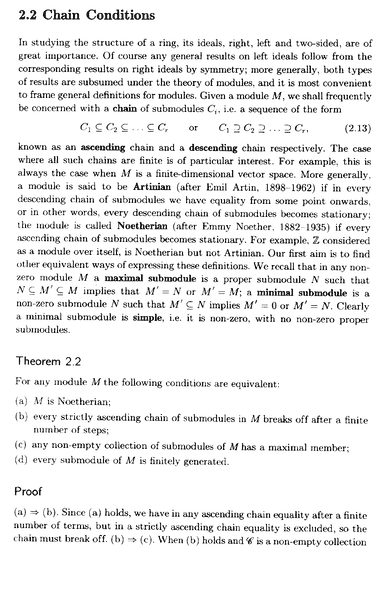
Cohn - 1 - Theorem 2.2 ... PART 1 ... .png

Cohn - 2 - Theorem 2.2 ... PART 2 ... .png

At the end of the above proof by Cohn we read the following:

" ... ... If ##a_j \in N_{i_j} ## and ##k = \text{ max} \{ i_1, \ ... \ ... \ , i_r \}##, then equality holds in our chain from ##N_k## onwards. ... ... "
Can someone please explain how/why ##a_j \in N_{i_j} ## and ##k = \text{ max} \{ i_1, \ ... \ ... \ , i_r \}## implies that equality holds in our chain from ##N_k## onwards. ... ... ?Help will be appreciated ...

Peter
 

Attachments

  • Cohn - 1 - Theorem 2.2 ... PART 1 ... .png
    Cohn - 1 - Theorem 2.2 ... PART 1 ... .png
    41.9 KB · Views: 994
  • Cohn - 2 - Theorem 2.2 ... PART 2 ... .png
    Cohn - 2 - Theorem 2.2 ... PART 2 ... .png
    44.1 KB · Views: 990
Last edited:
Physics news on Phys.org
Math Amateur said:
I am reading P.M. Cohn's book: Introduction to Ring Theory (Springer Undergraduate Mathematics Series) ... ...

I am currently focused on Section 2.2: Chain Conditions ... which deals with Artinian and Noetherian rings and modules ... ...

I need help with understanding an aspect of the proof of Theorem 2.2 ... ...Theorem 2.2 and its proof (including some preliminary relevant definitions) read as follows:View attachment 222878
View attachment 222879
At the end of the above proof by Cohn we read the following:

" ... ... If ##a_j \in N_{i_j} ## and ##k = \text{ max} \{ i_1, \ ... \ ... \ , i_r \}##, then equality holds in our chain from ##N_k## onwards. ... ... "
Can someone please explain how/why ##a_j \in N_{i_j} ## and ##k = \text{ max} \{ i_1, \ ... \ ... \ , i_r \}## implies that equality holds in our chain from ##N_k## onwards. ... ... ?Help will be appreciated ...

Peter

It suffices to show that ##N_{k+1} \subseteq N_k##.

Take ##n \in N_{k+1} \subseteq N = (a_1, \dots, a_r)##. Then ##n = \sum \lambda_i a_i## for elements ##\lambda_i##. Now, ##a_1, \dots, a_r## are contained in ##N_k##, because we have an increasing chain, and hence ##n\in N_k## as well, since modules are closed under linear combinations.
 
Last edited by a moderator:
  • Like
Likes   Reactions: Math Amateur
Math_QED said:
It suffices to show that ##N_{k+1} \subseteq N_k##.

Take ##n \in N_{k+1} \subseteq N = (a_1, \dots, a_r)##. Then ##n = \sum \lambda_i a_i## for elements ##\lambda_i##. Now, ##a_1, \dots, a_r## are contained in ##N_k##, because we have an increasing chain, and hence ##n\in N_k## as well, since modules are closed under linear combinations.
Thanks for the help Math_QED ...

BUT ... just some clarifications ...

You write:

" ... ... Take ##n \in N_{k+1} \subseteq N = (a_1, \dots, a_r)##. ... ... "

This means ##N_{k+1} \subseteq N## and also ##N = (a_1, \dots, a_r)## ... is that correct ...

But then surely ##n## may equal ##\sum_{ i = 1}^t \lambda_i a_i## where ##t \lt r## ... and so ##a_1, \dots, a_r## may not all be contained in ##N_{k + 1} ## let alone ##N_k## ...

I am really puzzled as to exactly why ##(a_1, \dots, a_r)## are contained in ##N_k## ... ... what is the exact argument?

Can you clarify?

Peter
 
Math Amateur said:
Thanks for the help Math_QED ...

BUT ... just some clarifications ...

You write:

" ... ... Take ##n \in N_{k+1} \subseteq N = (a_1, \dots, a_r)##. ... ... "

This means ##N_{k+1} \subseteq N## and also ##N = (a_1, \dots, a_r)## ... is that correct ...

But then surely ##n## may equal ##\sum_{ i = 1}^t \lambda_i a_i## where ##t \lt r## ... and so ##a_1, \dots, a_r## may not all be contained in ##N_{k + 1} ## let alone ##N_k## ...

I am really puzzled as to exactly why ##(a_1, \dots, a_r)## are contained in ##N_k## ... ... what is the exact argument?

Can you clarify?

Peter

For your first question, yes that's exactly what it means, for your second question:

We can find coefficients such that ##n = \sum_{i=1}^r \lambda_i a_i##, because ##n \in (a_1 \dots, a_r)##. But ##a_1 \in N_{i_1}##

and ##k = \max\{i_1, \dots, i_r\}##, so ##k \geq i_1##. This implies that ##N_{i_1} \subseteq N_k##, because the chain is increasing, so ##a_1 \in N_k## and you can do the same thing for the other indices, obtaining that ##a_1, \dots, a_r \in N_k##

EDIT: Maybe you don't know what I mean with ##(a_1, \dots, a_r)##. This is the module generated by the elements ##a_1, \dots a_r##. I.e., the smallest submodule that contains these elements.
 
Last edited by a moderator:
  • Like
Likes   Reactions: Math Amateur

Similar threads

  • · Replies 2 ·
Replies
2
Views
1K
  • · Replies 2 ·
Replies
2
Views
2K
Replies
3
Views
2K
  • · Replies 10 ·
Replies
10
Views
4K
  • · Replies 1 ·
Replies
1
Views
2K
  • · Replies 4 ·
Replies
4
Views
2K
  • · Replies 1 ·
Replies
1
Views
1K
  • · Replies 3 ·
Replies
3
Views
2K
  • · Replies 5 ·
Replies
5
Views
2K
  • · Replies 13 ·
Replies
13
Views
3K