Non-Linear Infinite Resistor Ladder

  • Context: Undergrad 
  • Thread starter Thread starter bob012345
  • Start date Start date
Join the discussion
Registration is free. Ask a follow-up in this thread, or start your own.
9 replies · 465 views
bob012345
Gold Member
Messages
2,406
Reaction score
1,106
TL;DR
An infinite resistor ladder is given in one of Paul Nahin’s books* and he asks the reader to find the exact solution. I believe there is no closed form exact solution as a single rational number.
The circuit looks like this;
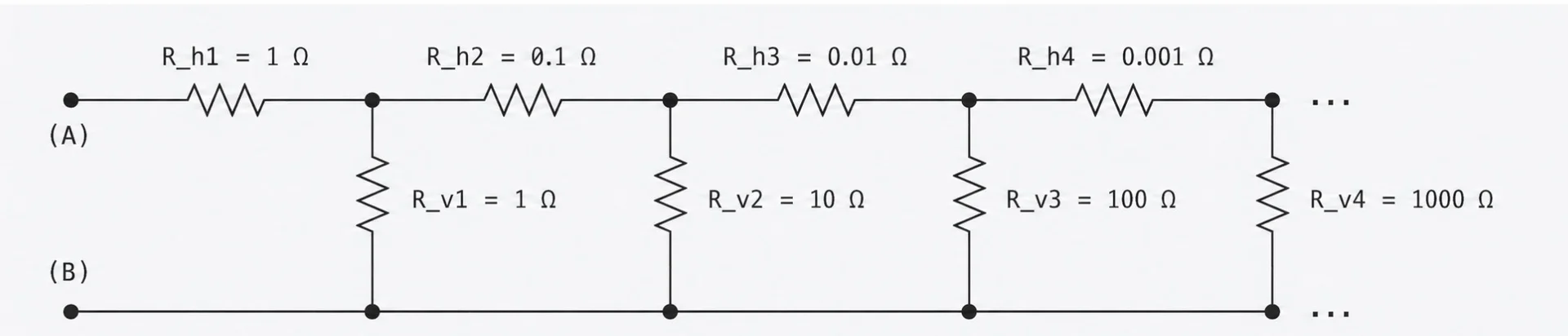
IMG_6260.webp


I used LTSpice simulations, hand calculations and other tools to compute the equivalent resistance of this ladder and to see it converge toward a solution but found no exact closed form solution. I believe the exact solution is an irrational number but I can’t prove it. Note that if one only computes to a few decimal places one might think it’s a repeating number as professor Nahin suggested in his book in which he freely admits he did not know the answer but instead challenged the readers to find one. Of course this is to be taken not as a practical exercise but more a math exercise.


* Mrs. Perkins’s Electric Quilt (challenge problem 3.4)


I get ##R_∞ =1.900991080179287315…##
 
Physics news on Phys.org
Your spoiler is numerically correct.
For each stage, you add conductivity in parallel, then resistance in series.
Note that conductivity g, is the reciprocal of resistance r, so; g = r-1.
 
Reply
  • Like
Likes   Reactions: bob012345
Baluncore said:
Your spoiler is numerically correct.
For each stage, you add conductivity in parallel, then resistance in series.
Note that conductivity g, is the reciprocal of resistance r, so; g = r-1.
Thanks but do you agree it’s converging to an irrational number?
 
bob012345 said:
Thanks but do you agree it’s converging to an irrational number?
Simply fixed value ladders always do converge to a recurring continued fraction, and since an RCF can be evaluated with a quadratic equation, they will contain the square root of a non-square number, which is irrational.
In this case the ladder is exponentially converging, and so I expect it cannot be written as an RCF, but will almost certainly evaluate to an irrational number.

This code evaluates from right to left. A solution accurate to n digits requires n terms.
Code:
Dim As Integer i, n = 20
Dim As Double term, r = 10^(n+1)
For i = n To 0 Step -1
    term = 10^(-i)      ' this term
    r = term + 1 / r    ' add the term as conductance in parallel
    r = term + 1 / r    ' add the term as resistance in series
Next i
 
Reply
  • Like
Likes   Reactions: bob012345
Baluncore said:
Simply fixed value ladders always do converge to a recurring continued fraction, and since an RCF can be evaluated with a quadratic equation, they will contain the square root of a non-square number, which is irrational.
In this case the ladder is exponentially converging, and so I expect it cannot be written as an RCF, but will almost certainly evaluate to an irrational number.
Thanks. In looking at the exact solutions for the first few terms it seems the fractions quickly get gigantic.

IMG_6304.webp

These seem also to have no common factors so each fraction cannot be reduced. I suspect this pattern continues as ##n→∞## we get an infinitely large fraction which cannot be reduced.

Also, I believe not all infinite ladders have to have irrational equivalent resistances. If in the ladder above, the horizontal resistors are all 4 Ohms and the vertical resistors are 3 Ohms, the equivalent resistance is 6 Ohms.
 
If you can evaluate the exponential ladder as a fraction, p/q, which you can, then the result must always be a fraction, and so the result should always be rational.

Then comes a problem, that you must evaluate an infinite number of terms, so p and q will each have an infinite number of digits, and the evaluation process will take longer than forever.

It seems there are few or no common divisors between p and q, so the numbers do not collapse.

bob012345 said:
Also, I believe not all infinite ladders have to have irrational equivalent resistances.
You are correct, that is a good counter example.
 
bob012345 said:
TL;DR: An infinite resistor ladder is given in one of Paul Nahin’s books* and he asks the reader to find the exact solution. I believe there is no closed form exact solution as a single rational number.

The circuit looks like this;

View attachment 373716
The resistance between points A and B can be expressed in the form of the infinite continued fraction. $$ 1+\frac{1}{1+\frac{1}{0.1+\frac{1}{0.1+\frac{1}{0.01+\frac{1}{0.01+\ddots }}}}} $$
or $$ a_{0}+\frac{1}{a_{1}+\frac{1}{a_{2}+\frac{1}{a_{3}+\ddots}}} $$
where
  • ## a_0 = 1 ##
  • ## a_1 = 1 ##
  • ## a_2 = 0.1 ##
  • ## a_3 = 0.1 ##
  • ## a_4 = 0.01 ##
  • ## a_5 = 0.01 ##
  • ## a_6 = 0.001 ##
  • ## a_7 = 0.001 ##
In general, for any step ## n\ge0 ##, the paired coefficients are ## a_{2n} = a_{2n+1} = 10^{-n} ##.

By using Excel I get the next results:
  • Depth 1 (up to the second ## 1 ##): ## 2.0000000000000 ##
  • Depth 3 (up to the second ## 0.1 ##): ## 1.9099099099099 ##
  • Depth 5 (up to the second ## 0.01 ##): ## 1.9018741230797 ##
  • Depth 7 (up to the second ## 0.001 ##): ## 1.9010792969512 ##
  • Depth 9 (up to the second ## 0.0001 ##): ## 1.9009999009822 ##
  • Depth 11 (up to the second ## 0.00001 ##): ## 1.9009919622508 ##
  • Depth 13 (up to the second ## 0.000001 ##): ## 1.9009911683864 ##
  • Depth 15 (up to the second ## 0.0000001 ##): ## 1.9009910890000 ##
  • Depth 17 (up to the second ## 0.00000001 ##): ## 1.9009910810614 ##
  • Depth 19 (up to the second ## 0.000000001 ##): ## 1.9009910802675 ##
  • Depth 21 (up to the second ## 0.0000000001 ##): ## 1.9009910801881 ##
  • Depth 23 (up to the second ## 0.00000000001 ##): ## 1.9009910801802 ##
  • Depth 25 (up to the second ## 0.000000000001 ##): ## 1.9009910801794 ##
Obviously, the resistance between points A and B is approximately 1.9009910801794 ohms.
 
Reply
  • Like
Likes   Reactions: bob012345 and WWGD
I have found that this continued fraction converges rather slowly. As ##n→∞##, the horizontal resistors become vanishingly small and the rest of the ladder collapses to ##0.9 ⋅10^n##. Substituting that for the last term in the series for each ##n## yields much faster convergence.

IMG_6312.webp
 
The thing I find about continued fractions, and ladder attenuators, is that evaluation from right to left attenuates the numerical errors made earlier on the right as the computation moves to the left. That means it is quite insensitive to the choice made as an approximate guess for the infinite right-hand side.
 
Reply
  • Like
Likes   Reactions: bob012345
Baluncore said:
The thing I find about continued fractions, and ladder attenuators, is that evaluation from right to left attenuates the numerical errors made earlier on the right as the computation moves to the left. That means it is quite insensitive to the choice made as an approximate guess for the infinite right-hand side.
I’m not sure what you mean. It makes a big difference what value I pick for the infinite termination. The value of ##0.9⋅10^n## is not arbitrary.